
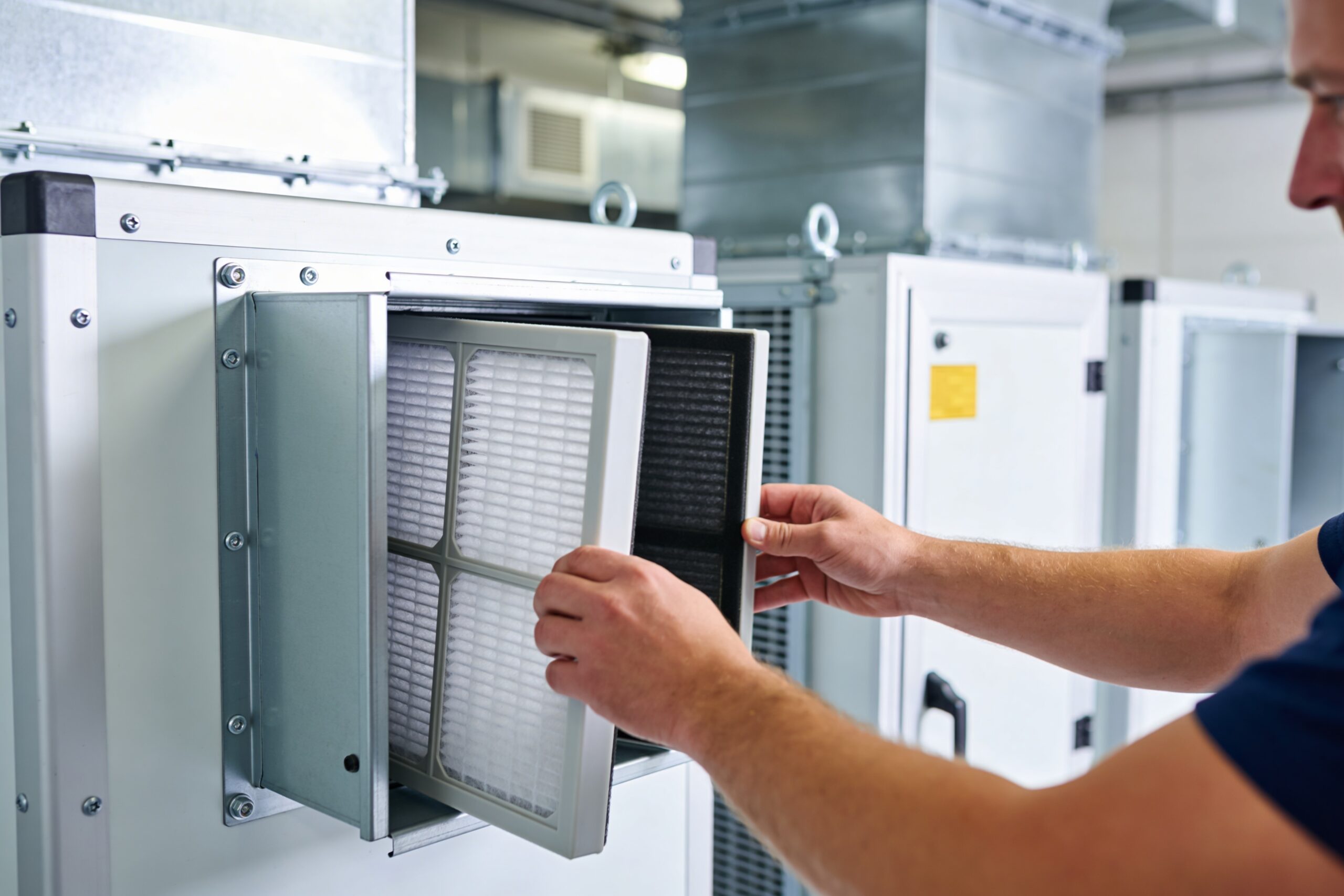

Change the air filter. It is the most repeated piece of HVAC advice in existence. People hear it so often they stop actually processing it. A clogged air filter is responsible for more AC service calls, more frozen coils, more compressor failures, and more uncomfortable summers than almost any other single cause. It is not a reminder for tidiness. It is a real mechanical problem with a specific failure cascade.
Where the Filter Sits in the System
The air filter is positioned in the return air path between the return grille and the air handler. Every cubic foot of air the blower moves through the system passes through the filter first. When the filter loads up with dust, pet dander, pollen, and debris, it becomes a progressively larger restriction. The blower has to work harder to pull air through. Less air gets through. Everything downstream suffers.
The Cascade of Failures From a Clogged Filter
Stage 1: Reduced Airflow Over the Evaporator Coil
The evaporator coil absorbs heat from the air blown across it. When airflow drops, less heat reaches the coil per minute of operation. The refrigerant continues evaporating at its design pressure but without sufficient heat load, the coil surface temperature drops below 32 degrees F. Moisture in the airflow freezes on contact.
Once ice starts forming, it insulates the coil from further airflow, compounding the restriction. Eventually the coil becomes a block of ice, airflow drops to near zero, and the system blows warm air even while running at full power. A clogged filter is the most common cause of a frozen evaporator coil.
Stage 2: Increased System Static Pressure
Static pressure is the resistance the blower works against. A clean residential filter typically adds 0.1 to 0.2 inches of water column (IWC) to system static pressure. A severely clogged filter can add 0.5 to 1.0+ IWC, a 5x to 10x increase.
What increased static pressure does:
- Forces the blower motor to draw more electrical current
- On PSC motors: the motor slows down under high static, reducing airflow further
- On ECM variable-speed motors: the motor compensates by speeding up, increasing energy consumption
- In both cases, motor temperatures rise and lifespan shortens
Stage 3: Dirty Coil Accumulation
A filter that is completely overloaded starts letting particles pass through rather than capturing them. Those particles land directly on the evaporator coil. A fine layer of dust on the coil fins acts as an insulator, reducing the coil’s ability to transfer heat. Research on coil fouling in HVAC systems shows measurable reductions in heat transfer efficiency once significant accumulation occurs.
Stage 4: Compressor Stress
A frozen coil forces the refrigerant circuit into an abnormal operating state. Low-temperature, low-pressure vapor returning to the compressor in an abnormal state creates conditions that damage valve assemblies and reduce oil film protection. Sustained operation leads to compressor failure. Compressor replacement on a residential system costs $1,200 to $2,500 in parts alone. A $15 air filter prevents it.
Stage 5: Higher Electric Bills
A restricted system runs longer to achieve the same cooling result. Longer run time equals higher energy consumption. Peer-reviewed research on HVAC filter pressure drop (published in Building Simulation, 2012) confirms that cooling energy use increases as the filter gets dirty over time, with the magnitude depending on fan type, system capacity, and MERV rating.
The Cumulative Failure Picture
| Filter Condition | System Effect | Risk Level |
| Clean (0 to 30 days) | Normal airflow, normal efficiency | None |
| Lightly loaded (30 to 60 days) | Slight efficiency reduction | Low |
| Moderately clogged (60 to 90 days, high-dust home) | Measurable airflow reduction, efficiency loss | Moderate |
| Severely clogged (90+ days, never changed) | Coil freezing risk, motor strain, coil fouling begins | High |
| Completely blocked (collapsing filter) | Frozen coil, blower motor overload, compressor risk | Critical |
How Often to Replace the Filter
| Home Type | Recommended Interval |
| Low occupancy, no pets, minimal dust | 60 to 90 days |
| Average occupancy, no pets | 30 to 60 days |
| Pets (1 to 2) | 30 to 45 days |
| Multiple pets or allergy sufferers | 20 to 30 days |
| Renovation or construction nearby | Check weekly, replace as needed |
The actual check overrides the calendar: pull the filter and hold it up to a light. Clean filters let light through. A filter that blocks nearly all light needs to be replaced regardless of how long it has been in service.
Browse air filters at SupplyHouse in all standard sizes and MERV ratings, including Honeywell Home, Filtrete, and Lennox options.
MERV Ratings: Which One Is Right
| MERV Rating | Particle Size Captured | Airflow Restriction | Best For |
| MERV 1 to 4 | Large particles only | Very low | Older, lower-capacity systems |
| MERV 8 | Dust, pollen, mold spores | Low to moderate | Most residential systems |
| MERV 11 | Fine particles, pet dander | Moderate | Homes with allergies, newer systems |
| MERV 13 | Very fine particles, bacteria | Higher | High-efficiency systems, medical needs |
| MERV 16+ | Near-HEPA performance | High | Commercial, specialized residential |
MERV 8 is the standard recommendation for most residential HVAC systems. Using a MERV 13 filter in a system designed for MERV 8 creates exactly the kind of airflow restriction that triggers coil freezing and compressor stress. Consult the equipment manufacturer’s maximum recommended MERV rating before upgrading.
Related reading: How to Select the Best Air Furnace Filter covers filter selection in full detail on the SupplyHouse blog.
Pre-Summer Filter Maintenance Checklist
- Replace the air filter (do not carry over a winter-loaded filter into cooling season)
- Check that the filter sits flush in the rack with no gaps around the edges (bypass is as bad as blockage)
- Verify filter direction: arrows on the filter frame indicate airflow direction toward the air handler
- For media cabinet systems (4 to 5 inch thick filters), check every 90 days instead of monthly
- Keep one spare filter on hand for the season
- Note the size and MERV rating: most residential filters are 1 inch thick, 16×25 or 20×25 being the most common sizes
For the full spring startup walkthrough, see How to Prepare an Air Conditioner for Spring Startup on the SupplyHouse blog.
Frequently Asked Questions
How often should an AC air filter be changed in summer?
Check monthly during the cooling season. Replace every 30 days in homes with pets or high dust levels, every 60 to 90 days in low-occupancy homes. The actual filter condition overrides any schedule.
Can a dirty filter cause the AC to stop cooling entirely?
Yes. A severely clogged filter freezes the evaporator coil, which blocks airflow completely and stops the cooling cycle even while the system continues running.
What MERV rating should a residential AC filter be?
MERV 8 is the standard recommendation for most residential systems. Higher ratings (11 to 13) improve filtration but require a system with sufficient blower capacity to handle the added restriction. Check the equipment manufacturer’s specification before upgrading.
Is a thicker filter always better?
No. A thick, high-MERV filter in a system not designed for that resistance creates the same problems as a clogged standard filter. Match the filter to the equipment specification.
Does a dirty air filter affect heating as well as cooling?
Yes. A clogged filter restricts airflow in both heating and cooling modes. For heat pump systems especially, restricted airflow can impair both cycles.
Can a filter cause the AC to run all night without cooling the house?
Yes. A moderately clogged filter reduces system capacity enough that on very hot days, the system cannot overcome the heat load. Replacing the filter restores capacity in many cases. If the problem persists after a fresh filter, low refrigerant or dirty coils are next.
What happens if a filter collapses?
A severely clogged filter can be pulled inward by the pressure differential, partially collapsing and allowing debris to pass directly onto the evaporator coil. A collapsed filter is a system emergency. Replace it immediately and schedule a coil inspection.
Is it OK to run the AC with no filter at all?
Only for a few hours in an emergency while waiting for a replacement. Running without a filter pulls every airborne particle directly onto the evaporator coil. Even a few weeks without a filter can foul the coil enough to require professional cleaning.
Does filter brand matter?
Mostly no. MERV rating and correct sizing matter far more than brand. Any filter meeting the specified MERV rating from a reputable manufacturer performs comparably.
How much can a dirty filter increase the electric bill?
Research on HVAC filter pressure drop confirms that cooling energy use increases as the filter gets dirtier, with the magnitude depending on fan type and system capacity. On a typical residential system running through a full cooling season, the difference is meaningful. The cost of a replacement filter is a fraction of that increase.
Less Dirt, More Chill
The air filter is the simplest, cheapest, and most overlooked component in the entire AC system. Neglect it long enough and it sets off a chain reaction: restricted airflow, frozen coil, motor strain, dirty evaporator coil, and eventually compressor damage. The fix costs less than $20 and takes two minutes. Check it monthly during summer, match the MERV rating to what the system is designed for, and keep a spare on the shelf. SupplyHouse stocks filters in all standard sizes and MERV ratings with fast shipping so the right filter is always one order away.