
Sponsored Post
A homeowner calls about swapping an aging oil boiler for something electric. No gas line reaches the property, the addition only needs a modest amount of radiant heat, and skipping a flue sounds appealing on paper. Electric boilers solve real problems on the right jobs, but forcing one into the wrong house turns into a callback nobody wants. Knowing exactly when a unit like the NextGen Boiler earns its spot in the mechanical room, and when a heat pump or fuel-fired system serves the client better, keeps installs profitable and clients warm for winters to come.
What Actually Sets an Electric Boiler Apart
An electric boiler heats water with resistance elements instead of burning natural gas, propane, or oil. Current runs through the elements, the elements heat the water, and a circulator pushes that hot water out to baseboard, radiators, or PEX radiant loops. Nothing gets burned, so nothing needs a flue, chimney, or combustion air supply.
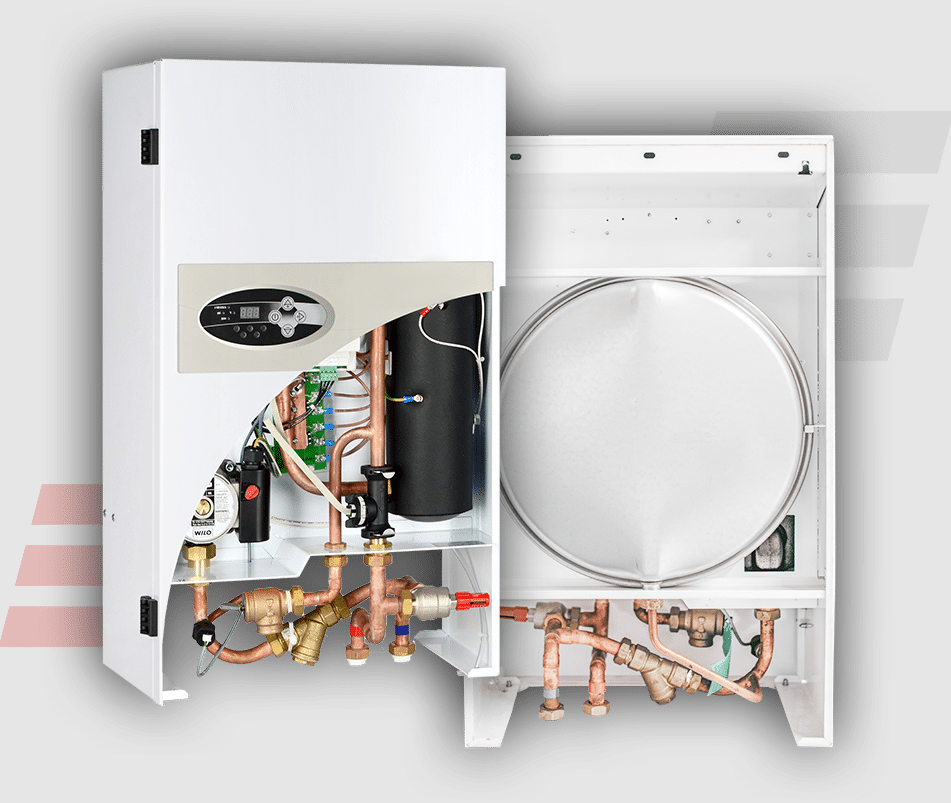
Pre-assembled units like the NextGen Boiler carry the entire hydronic package inside one cabinet: heat exchanger, circulating pump, expansion tank, air vent, and safety relief valve. Installers connect supply and return lines, wire the unit to a dedicated circuit, and the boiler handles staging and outdoor reset internally. Compare that to a standard gas boiler install, where the expansion tank, circulator, and venting all get sourced and piped as separate components.
Five Situations Where an Electric Boiler Earns Its Spot
No Natural Gas on the Property
Rural properties and off-grid buildings often choose between propane, oil, or paying for a gas line extension that runs up a big bill before the first BTU gets delivered. An electric boiler skips that decision entirely. Installation stays simpler because there is no flue, chimney, or fuel tank to plan around, and maintenance drops since there is no burner, ignition system, or combustion chamber to service.
Insulation Already Doing the Heavy Lifting
Electric resistance heat tends to cost more per BTU than natural gas in most utility territories, so the math favors electric boilers most in spaces that do not need many BTUs to begin with. Apartments, condos, small modern builds, and passive or near-passive construction all fit that profile. When the building envelope is doing its job, the added electricity cost stays smaller and easier for a client to accept.
Solar or Off-Peak Rates Already in Place
A property with a sizable solar array, battery storage, or time-of-use electricity rates can offset a real share of an electric boiler’s operating cost. Winter heating demand still lands hardest exactly when solar production drops, so the pairing works best as a complement to good insulation and a modest heating load, not as a fix for a drafty, oversized system.
Combustion-Free Is a Non-Negotiable
Electric boilers do not burn fuel, do not produce carbon monoxide, and do not need gas piping or venting. That combination matters to safety-focused households, tightly sealed modern builds where combustion air becomes a real design constraint, and clients working through a broader electrification plan.
Tight Mechanical Rooms and Complicated Venting
Retrofitting a flue into a building that never had one, or finding chimney access in a house that lost its old boiler decades ago, adds cost and complexity fast. Compact, pre-assembled units are frequently easier and cheaper to install in tight closets, crawlspace mechanical rooms, or additions where running new venting would mean opening up finished walls.
For the piping and sizing side of a radiant retrofit, SupplyHouse Real Talk’s How to Design a Hydronic Heating System walks through heat loss and manifold planning in more depth, and the DIY Radiant Heat Panel article covers a pre-assembled electric boiler panel built for smaller radiant zones.
Where an Electric Boiler Makes the Most Sense
Scaling Up with the Cascading System
Larger homes and higher domestic hot water demand do not rule out an electric boiler.
NextGen’s cascading system links multiple units together for a combined output as high as 100,000 BTU, per the manufacturer, without giving up the plug-and-play simplicity of a single cabinet. Sizing the cascade to an actual heat loss calculation, rather than dropping in one undersized unit, is what gets a bigger property the best numbers out of the system.
Cold Climates Favor Resistance Heat
Air-source heat pumps lose heating capacity as outdoor temperatures drop, a well-documented limitation covered directly in the Department of Energy’s own cold-climate heat pump research. A NextGen Boiler does not have that problem. Rated output stays the same whether it is 40°F or well below freezing outside, which makes it a dependable pick for the coldest stretches of a heating season, in any climate zone.
NextGen Boiler vs. a Heat Pump
A heat pump does not create heat directly, it moves it, which lets a well-matched unit post a coefficient of performance well above 1.0 in mild weather. According to ENERGY STAR, that can mean up to three times more heat energy delivered than the electricity consumed. The NextGen Boiler takes a different, simpler path to a comfortable home: no refrigerant to charge, no outdoor condenser exposed to weather, no line set to braze and evacuate, and no efficiency curve that shifts with the forecast. For a contractor who wants one clean cabinet to install and a homeowner who wants steady output all winter, that trade-off is an easy one.
Electric Boiler vs. Heat Pump at a Glance
A side-by-side look at how the two technologies actually stack up, before pricing out either one for a specific job.
| Category | Electric Resistance Boiler | Air-Source Heat Pump |
| How it heats | Converts electricity directly to heat | Moves existing heat from outdoor air |
| Typical efficiency | Close to 100% (COP of about 1.0) | Up to 300% (COP roughly 2.0 to 4.0) |
| Combustion byproducts | None | None |
| Cooling capability | No | Yes, most units reverse to cool |
| Best load profile | Modest to large with the cascading system | Wide range with proper sizing for climate |
| Typical install complexity | Low, one plug-and-play cabinet | Moderate, needs refrigerant lines and an outdoor unit |
| Cold-weather output | Stays constant regardless of outdoor temperature | Decreases as outdoor temperature drops |
NextGen Boiler Lineup by Load
Every model in the NextGen Electric Boilers lineup runs on 240V and houses the same core components. Rated current and breaker size are the numbers that decide whether the electrical panel has room for the job.
| Model | Rated Power | BTU/Hour Output | Rated Current | Breaker Requirement |
| NG004 | 4 kW | 13,652 | 16.66A | 1 @ 30A |
| NG006 | 6 kW | 20,478 | 25.0A | 1 @ 40A |
| NG008 | 8 kW | 27,304 | 33.3A | 1 @ 50A |
| NG012 | 12 kW | 40,956 | 50.0A | 1 @ 60/70A |
| NG014 | 14.4 kW | 49,147 | 60.0A | 1 @ 80A |
Jobs that outgrow a single unit are not necessarily stuck. NextGen’s cascading system combines multiple boilers to reach output as high as 100,000 BTU, per the manufacturer, which keeps the same plug-and-play cabinets in play on larger loads instead of jumping straight to a commercial electric boiler.
Individual model pages: NG004 · NG006 · NG008 · NG012 · NG014
Where the NextGen Boiler Delivers Its Best Results
| Situation | NextGen Advantage | Best Practice for Top Results |
| No gas access | Skips the flue, chimney, and gas piping entirely | A straightforward swap, no extra planning needed |
| Larger or higherdemand homes | Cascading system reaches up to 100,000 BTU | Size the cascade to an actual heat loss calculation |
| Cold climates | Output holds steady regardless of outdoor temperature | Works reliably solo, no- cold-weather derating to plan around |
| Solar or off-peak rates | Off-peak capability built into every model | Sync boiler staging with the utility’s off-peak window |
| Whole-home electrification | Combustion-free with a 2-year limited warranty | Pair multiple units through the cascading system for full coverage |
Sizing and Installing an Electric Boiler
- Run a heat loss calculation for the space, not the square footage. Match total BTU/hour output to that number with a reasonable safety margin instead of guessing off room size.
- Check the panel for available capacity. Each NextGen model needs a single dedicated breaker sized to its rated current, from 30A on the 4kW unit up to 80A on the 14.4kW unit.
- Confirm system pressure and flow requirements. Verify make-up water pressure falls within the manufacturer’s specified operating range and that flow meets the unit’s minimum GPM at the system’s expected head loss.
- Mount the boiler and connect supply and return lines per manufacturer instructions. Since the expansion tank, circulator, air vent, and safety relief valve already live inside the cabinet, most of the piping work is tying into the existing distribution system.
- Bring in a licensed electrician for the circuit. NextGen’s own product documentation is explicit that installation, commissioning, and service belong to a licensed, qualified professional working to manufacturer instructions and local code, not to a homeowner or unlicensed installer.
- Commission and test staging. Confirm outdoor reset and off-peak features are configured correctly before calling the job finished.
Watch: How to Install a NextGen Boiler
For a visual walkthrough of the process above, NextGen’s own quick-install video, How to install your NextGen Boiler [quick install], covers the main points to follow when setting up the plugand-play electric boiler for a hydronic radiant heat system.
Frequently Asked Questions
Does an electric boiler need a flue or chimney?
No. Resistance heating does not burn fuel, so there is no combustion byproduct and no venting requirement.
How many amps does a NextGen Boiler need?
It depends on the model. Rated current runs from 16.66A on the 4kW NG004 up to 60.0A on the 14.4kW NG014, each on its own dedicated breaker sized to match, per the manufacturer’s product specifications.
Can an electric boiler run on solar power?
Yes, if the solar array and battery storage are sized for it. The pairing works well for offsetting daytime load, though winter heating demand still peaks when solar production is at its lowest.
Is an electric boiler cheaper to install than a gas boiler?
Installation is often simpler since there is no flue or gas piping to run, which tends to reduce labor and material costs on the install itself. Operating cost is a separate question that depends heavily on local electricity rates.
Will a NextGen Boiler heat a large, older home well?
Yes. Pairing the cascading system with an accurate heat loss calculation lets a NextGen setup cover larger, higher-demand homes for a combined output as high as 100,000 BTU, per the manufacturer, without losing the plug-and-play simplicity of a single unit.
Does a NextGen Boiler lose output in cold weather like a heat pump can?
No. Rated output stays the same regardless of outdoor temperature. Air-source heat pumps, by contrast, lose heating capacity as temperatures drop, a limitation documented in the Department of Energy’s own cold-climate heat pump research.
What is the real difference between a NextGen Boiler and a heat pump?
A heat pump can post a coefficient of performance up to about 4.0 in mild weather, per ENERGY STAR, because it moves heat instead of creating it. That advantage narrows in cold weather and never applies to installation complexity: a NextGen Boiler needs no refrigerant, no outdoor unit, and no line set, just a supply and return connection plus a dedicated circuit.
Does a NextGen Boiler include the expansion tank and circulator?
Yes. The heat exchanger, circulating pump, expansion tank, air vent, and safety relief valve are all housed inside the unit, per the manufacturer’s product specifications.
Who can install or service a NextGen Boiler?
Per the manufacturer, heating equipment must be installed, commissioned, and serviced by a licensed, qualified professional following manufacturer instructions and applicable codes. Manufacturers do not accept warranty or technical support requests directly from homeowners or unlicensed individuals.
What warranty comes with a NextGen Boiler?
Every model in the lineup carries a 2-year limited warranty and is UL Listed, per the manufacturer’s product specifications.
Can multiple NextGen Boilers be combined for a larger load?
Yes. NextGen’s cascading system links multiple units to reach a combined output as high as 100,000 BTU, according to the manufacturer, which extends the same pre-assembled approach to bigger jobs without switching to a commercial platform.
When Electric Makes Sense
That homeowner with the aging oil boiler and no gas line gets a good outcome either way. A wellinsulated space with modest heating demand, no combustion appetite, and either cheap power or a tight mechanical room is exactly where a unit like the NextGen Boiler earns its place. A larger or drafty home just calls for pairing the boiler with the cascading system and a real heat loss calculation, not walking away from electric altogether.
Run the heat loss, check the panel capacity against the specs in the lineup table above, and shop the full Electric Boilers category or the NextGen Electric Boilers lineup directly for the next job that fits the profile.