
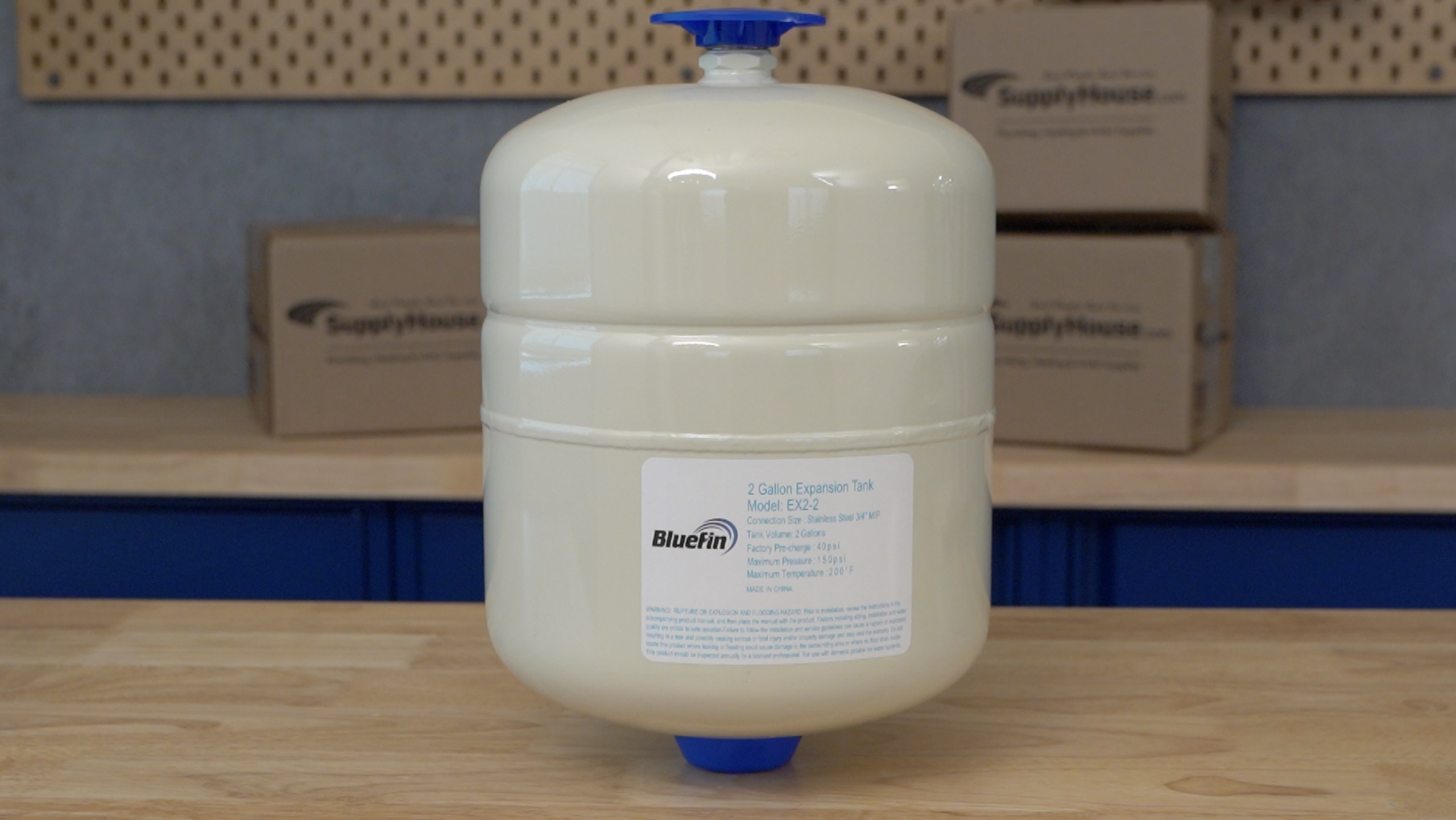

A water heater fails a service call three separate times in eighteen months, and the diagnosis keeps missing the real target. The pressure relief valve gets replaced. The anode rod gets swapped. The heater itself finally gets condemned and hauled out. Nobody checks the small tank sitting on the cold water line, quietly holding water instead of air. That tank is the domestic expansion tank, and Bluefin builds a full lineup of them specifically for potable water systems. Getting the pre-charge right is the difference between a tank that lasts a decade and one that waterlogs in year one.
What a Domestic Expansion Tank Is
A domestic expansion tank is a small steel vessel installed on the cold water supply line, usually within a few feet of the water heater. Inside, a rubber diaphragm splits the tank in two. One side connects to the plumbing system and holds water. The other side is sealed and holds compressed air, set at the factory to a specific pre-charge pressure.
Bluefin’s version of this tank, the one featured in the Bluefin Basics walkthrough, is built for exactly this application: potable water on a residential cold water line, not hydronic heating loops. As heated water expands, it pushes into the water side of the tank and compresses the air pocket instead of forcing pressure through the rest of the system.
Why Domestic Expansion Tanks Are Needed
Water expands when it’s heated. In an older, open plumbing system, that expanding water had somewhere to go: back toward the street main. Modern code changed that. Check valves, backflow preventers, and pressure reducing valves now sit on most incoming service lines to keep water from ever flowing backward into the public supply. Those same devices turn a home’s plumbing into a closed loop.
Once the loop closes, heated water has no path back to the main, and pressure inside the pipes climbs with nowhere to release it. If no faucet or fixture happens to be open when that expansion occurs, the pressure has to go somewhere. A domestic expansion tank gives it somewhere to go that isn’t the rest of the plumbing system.
Why It Matters for System Performance
An expansion tank only protects the system if the air side holds a pressure that roughly matches the static water pressure in the system. Get that wrong and the tank stops functioning as intended, in one of two directions.
Charged too low, the diaphragm sits against the water inlet before the system even reaches normal operating pressure. Water pushes past sooner than it should, the air pocket accepts less volume than the tank was sized for, and the tank waterlogs early in its service life.
Charged too high, the diaphragm never moves during normal cycling. The tank looks installed and connected, but it contributes nothing, and the temperature and pressure relief valve absorbs pressure spikes it should never see.
Either failure mode shows up the same way on a service call: banging pipes, a T&P valve that weeps or discharges, or a water heater that seems to fail faster than it should. A tank charged to the right pressure protects the water heater, the fixtures, and every pipe joint between them. That’s the whole performance case for getting this step right.
How to Charge a Bluefin Expansion Tank Properly
Charging a Bluefin expansion tank for maximum performance comes down to matching the air-side pre-charge to the system’s static water pressure, using the Schrader valve built into every tank in the lineup. The tools below make the job a five-minute task instead of a guessing game.
-
- A standard tire pressure gauge (automotive or bicycle style)
-
- A bicycle pump, portable air compressor, or shop compressor with a blow gun attachment
-
- An adjustable wrench, for tanks with a threaded protective valve cap
-
- A way to isolate the tank from the system, ideally a ball valve on the tank tee
-
- Shut off the cold water supply feeding the tank, using an isolation valve if one is installed, or the building’s main shutoff if not.
-
- Open a nearby faucet or the tank’s drain port to relieve system pressure down to zero.
-
- Locate the air valve at the base or side of the tank. It looks identical to the valve stem on a bicycle or car tire and uses the same design, called a Schrader valve.
-
- Remove the protective cap covering the valve.
-
- Press a tire gauge onto the valve and read the current pre-charge. A reading of zero, or water spraying instead of air hissing out, means the internal diaphragm has failed and the tank needs replacement rather than recharging.
-
- Compare the reading against the incoming static water pressure, measured at a hose bib or gauge port with no water running anywhere in the building.
-
- Add air with the pump or compressor until the gauge matches the static pressure reading, checking often to avoid overcharging.
-
- Replace the protective cap.
-
- Restore the water supply slowly and check the tank connection for leaks.
Matching Pre-Charge to Incoming Water Pressure
The target number always comes back to one rule: match the tank’s air-side pressure to the static water pressure the tank will actually see once it’s back in service.
| Static Water Pressure | Recommended Pre-Charge | Notes |
| 40 psi | 40 psi | Typical low end for municipal supply |
| 50 psi | 50 psi | Common residential average |
| 60 psi | 60 psi | Common upper end before a PRV becomes standard practice |
| Above 80 psi at the meter | Match the PRV setpoint, not the raw incoming pressure | Most plumbing codes call for a pressure reducing valve once meter pressure exceeds 80 psi |
SupplyHouse’s guide to installing and setting a pressure reducing valve covers PRV setpoint selection in more detail for systems above 80 psi.
Bluefin Potable Water Expansion Tanks at a Glance
The tank featured in Bluefin’s charging walkthrough belongs to a small lineup of potable water expansion tanks built for exactly this application. Specs below come straight from the Bluefin Potable Water Expansion Tanks category on SupplyHouse.com.
| Model | Volume | Connection | Factory Pre-Charge | Best Fit |
| EX2-2 | 2 Gallon | 3/4″ NPT | 25 psi | Compact installs, modest hot water demand |
| EX3 | 3.2 Gallon | 3/4″ NPT | 50 psi | Mid-size homes or higher static pressure systems |
| EX4 | 4.5 Gallon | 3/4″ NPT | 25 psi | Larger tank-type water heaters or multiple bathrooms |
Tanks up to 8″ in diameter pair with the 8″ HydroClaw Expansion Tank Support Bracket, while larger tanks like the EX4 fit the 11″ HydroClaw Expansion Tank Support Bracket. Either bracket keeps a waterlogged tank’s added weight off the copper fittings instead of relying on the pipe alone.
Reading the Warning Signs of a Failed Tank
-
- Tank feels warm or hot from top to bottom, instead of warm on top and room temperature at the bottom
-
- Noticeable weight increase when lifting or shifting the tank
-
- Water discharging from the T&P valve with no obvious cause
-
- Banging or hammering noise in the pipes right after a faucet shuts off
-
- System pressure gauge creeping upward after the water heater runs, even with a PRV in place
For a broader look at how expansion tanks work across both potable and hydronic systems, see Expansion Tanks: What Are They and Why Are They Important? For orientation questions once a replacement tank is on hand, Expansion Tank Mounting Positions covers vertical, horizontal, and upside-down installs.
Frequently Asked Questions
What does a domestic expansion tank actually do?
It gives heated water a place to expand into that isn’t the rest of the plumbing system. An internal diaphragm separates a compressible air pocket from the water side, and that air pocket absorbs the added volume created when water heats up in a closed loop.
Why do check valves make an expansion tank necessary?
A check valve, backflow preventer, or pressure reducing valve blocks water from moving back toward the street main. That turns what used to be an open system into a closed one. Heated water that used to expand backward now has nowhere to go unless a tank is installed to absorb it.
What PSI should a domestic expansion tank be charged to?
The pre-charge should match the static water pressure of the system, measured with no water flowing anywhere in the building. A system running at 50 psi calls for a tank charged to 50 psi. Where a pressure reducing valve is installed, the tank should match the PRV’s setpoint rather than the raw incoming pressure.
How is the pre-charge checked on an installed tank?
The system gets depressurized first, then a standard tire gauge reads the pressure at the Schrader valve on the tank’s air side. Checking with the system still under pressure gives an inaccurate reading, since residual water pressure skews the gauge.
What happens if the tank is never charged, or loses its charge over time?
The tank fills with water instead of holding an air cushion, a condition commonly called waterlogging. A waterlogged tank can’t absorb thermal expansion, so pressure has to vent somewhere else, usually through the water heater’s temperature and pressure relief valve.
How often should the pre-charge be checked?
Checking once a year, during routine water heater service, catches most slow leaks before they cause a failure. Any time a T&P valve weeps or pipes start hammering, checking the tank should be one of the first steps, not the last.
What is a Schrader valve, and why does an expansion tank have one?
It’s the same valve design used on bicycle and automotive tires: a spring-loaded core that holds air under pressure and opens briefly when a gauge or pump presses against it. Expansion tanks use one to make checking and adjusting the air-side pre-charge possible without opening the tank.
How is a waterlogged tank diagnosed in the field?
Two quick checks usually confirm it. First, feel the tank from top to bottom; a healthy tank reads warm near the top connection and room temperature lower down, while uniform warmth suggests water has displaced the air pocket. Second, check the Schrader valve directly. Water spraying out instead of air confirms the diaphragm has failed.
Can the tank be charged without draining the whole system?
Isolating the tank at its own shutoff valve, where one is installed, allows the tank to be drained and recharged without shutting down water to the rest of the building. Systems without a dedicated isolation valve need the main supply closed temporarily instead.
What size expansion tank does a typical residential water heater need?
Sizing depends on the water heater’s tank volume, the system’s static pressure, and the incoming water temperature. SupplyHouse’s Expansion Tank Sizing Calculator walks through those inputs and recommends a size based on the specific system rather than a generic rule of thumb.
Five Minutes Now, No Callback Later
Nobody calls a plumber because they’re curious about their expansion tank. They call because a T&P valve is weeping, a water heater failed early, or pipes are banging every time a faucet shuts off. In most of those cases, the fix already exists on the cold water line, sitting quietly at the wrong pressure.
A gauge, a pump, and five minutes settle the question for good. Bluefin’s potable water expansion tanks ship factory pre-charged and ready to install, and the full lineup, along with matching HydroClaw mounting brackets, is in stock and ready to ship from SupplyHouse
Want to see these techniques performed in real time? Watch the video below for a visual walkthrough that reinforces the steps covered in this guide.
Featured video: Bluefin Basics, “Domestic Expansion Tanks: What They Are & How to Charge Them”