
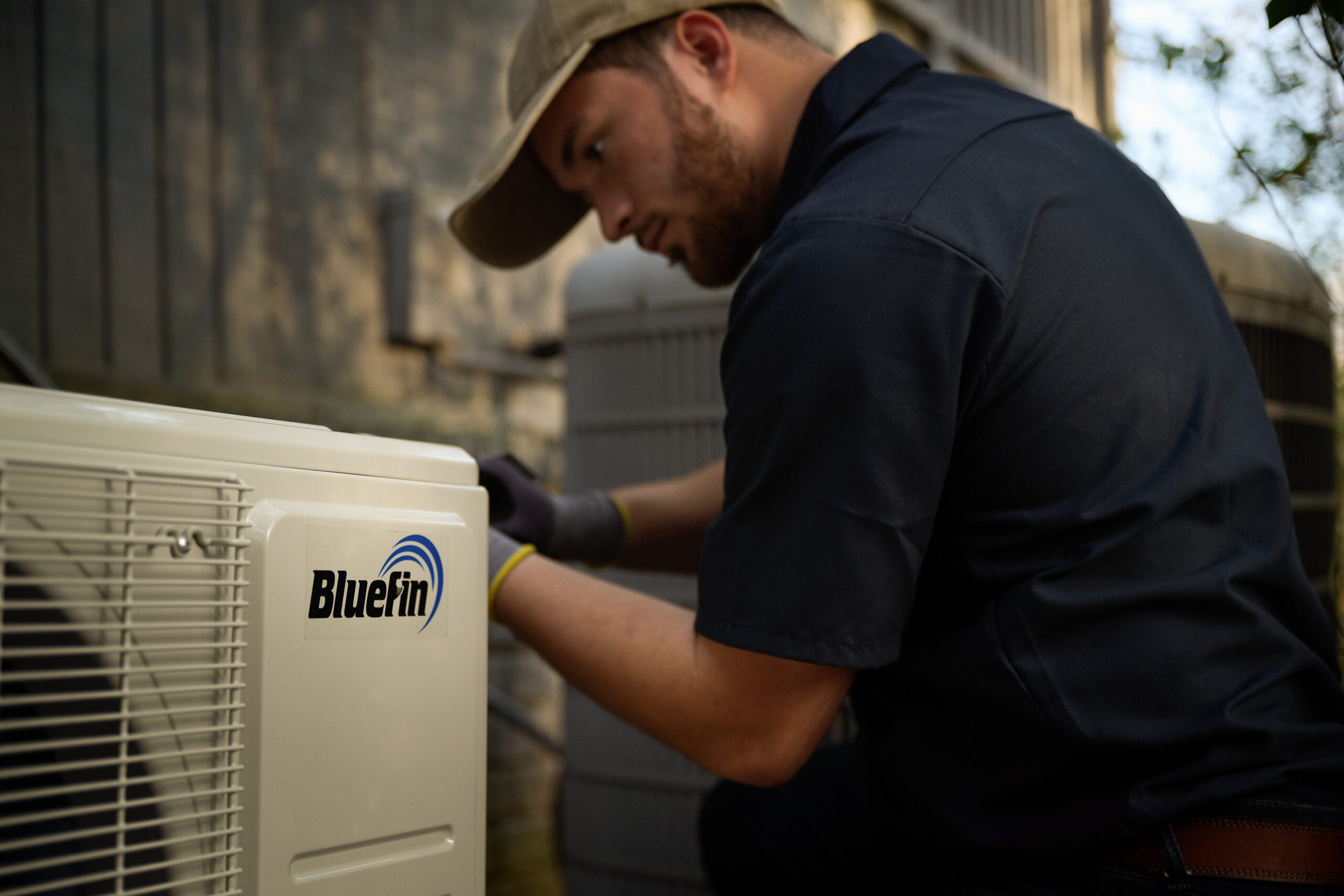
 A mini split job has a reputation for being clean and quick. Two units, a line set, a couple of holes in the wall, done. That reputation is mostly earned, but only when the steps happen in the right order. A bad flare or a sloppy vacuum pull can turn a straightforward install into a callback within the first cooling season. Browse the full mini split lineup at SupplyHouse here: Mini Split Air Conditioners. This guide walks through every phase from pre-install planning through commissioning startup, the way an experienced HVAC technician would do it.
Before the First Hole: Pre-Install Planning
The most expensive part of any mini split install happens before the drill comes out. Get these decisions right on the front end.
Sizing and equipment: BTU capacity must match the space. An undersized unit short-cycles; an oversized one never reaches proper dehumidification. Run a Manual J calculation for new construction or major remodels. For typical single-room installs, the rule of thumb is 500 to 600 BTU per square foot for standard ceiling heights, adjusted up for high ceilings, sun exposure, or high occupancy. Not sure which system to spec? The Mini Split Buying Guide on the blog covers sizing, zoning, and feature comparisons in detail.
Single-zone vs. multi-zone: Single-zone systems connect one indoor head to one outdoor condenser. Multi-zone systems run up to eight indoor heads off a single outdoor unit. For most residential installs, single-zone mini splits are the starting point. Confirm the manufacturer’s minimum and maximum line set lengths, the required electrical circuit, and approved refrigerant type before ordering anything.
Line set selection: Line set diameter is dictated by the indoor unit specs, not personal preference. Most 9,000 to 18,000 BTU wall-mount heads use a 1/4″ liquid line and a 3/8″ or 1/2″ suction line. Length must account for the actual routing path, not straight-line distance. Factor in vertical rise, turns, and any slack needed for the connection at each unit. SupplyHouse stocks both flared line sets and standard line sets. Flared line sets are the better choice for most ductless installs. For a deeper look at sizing and selection, see Selecting a Line Set for Your Mini-Split AC System.
Mounting the Indoor Unit
The indoor air handler goes on the wall first. Location matters more than most installers acknowledge. Follow these guidelines:
- Mount high on the wall, typically 6 to 8 inches from the ceiling. Cold air drops naturally and distributes evenly from that height.
- Keep the unit away from direct sunlight, heat sources, and return air pathways that could skew the thermostat sensor reading.
- Maintain a minimum of 6 inches of clearance on both sides and above the unit for adequate airflow and service access.
- Locate the unit so the line set routing to the outside wall is as short and direct as possible.
Mounting plate and levelness: Fasten the mounting plate to wall studs or appropriate anchors. Use a level. A unit that’s even slightly off level will drain condensate incorrectly and pool water inside the head. Mark the center of the wall penetration before drilling, accounting for the line set routing path. The standard wall penetration is a 3-inch core through the exterior wall, drilled at a slight downward pitch to the outside to allow condensate drainage.
Once the plate is secured, a mini split installation support tool like the Rectorseal Mighty Bracket hooks onto the mounting plate and holds the indoor unit in position while both hands are free for connecting refrigerant lines, the condensate drain, and electrical.
Routing and Connecting the Line Set
The line set connects the indoor and outdoor units. Routing it correctly protects the copper from damage and the refrigerant from heat gain.
Routing best practices:
- Keep bends gradual. Tight kinks in the copper restrict refrigerant flow and can permanently deform the line.
- Maintain the insulation fully intact along the entire run. Any gap in suction line insulation causes condensation and heat gain.
- Protect exterior runs with a line set cover. It keeps the install clean and protects the insulation from UV degradation.
- Bundle the line set with the condensate drain line and control wire before feeding through the wall penetration. Tape or zip-tie the bundle every 3 to 4 feet to prevent sagging.
Making the flare connections: If using a pre-flared line set, inspect each flare before connecting. A cracked, uneven, or double-flared connection will leak. For field-cut line sets, use a quality deburring tool and a calibrated flaring block. Torque flare nuts to spec, typically 18 ft-lbs for 1/4″ and 26 ft-lbs for 3/8″ connections, though always confirm with the equipment manufacturer’s installation manual. Finger-tight plus a calibrated wrench, never a crescent and a guess.
Mounting the Outdoor Condenser
The outdoor unit needs a stable, level platform with adequate clearance on all sides for airflow and service access. Ground pads, rooftop frames, or wall brackets are all acceptable mounting methods, but each must be sized to the unit’s weight and designed to minimize vibration transfer.
SupplyHouse stocks mini split mounting brackets for wall-mounted condenser applications. Keep a minimum of 12 inches of clearance on the service side and 24 inches from walls on the discharge side. Avoid locations where snow accumulation, debris, or exhaust from other equipment could restrict airflow.
Once the condenser is in position, connect the line set at the service valves. Caps stay on until the vacuum pull is complete. Do not open the service valves yet.
Vacuum Pull and Pressure Test
This is where most callback-generating mistakes happen. A short or sloppy vacuum pull leaves moisture and non-condensables in the refrigerant circuit. They cause acid formation, slugging, and compressor failure. Do it right the first time.
Step-by-step vacuum procedure:
- Connect the manifold gauge set to the service port on the outdoor unit.
- Connect the vacuum pump to the center manifold hose.
- Open both manifold valves and run the vacuum pump until the system reaches 500 microns or lower. Use a micron gauge, not manifold gauge pressure readings. On most residential mini split installs, this takes 30 to 45 minutes with a quality two-stage pump.
- Close the manifold valves and shut off the pump. Watch the micron gauge for 5 to 10 minutes. If the reading rises above 1,000 microns, there’s a leak or moisture still in the system. Find and fix it before proceeding.
- Once the system holds below 500 microns for 10 minutes, the evacuation is complete.
Nitrogen pressure test (for longer line sets or questionable flares): Before pulling vacuum, some technicians charge the line set with dry nitrogen to 150 to 200 PSI and check for pressure drop over 10 to 15 minutes. Any drop indicates a leak. Repair it before proceeding to evacuation.
Electrical Connections
A mini split requires a dedicated circuit. Most single-zone residential systems run on 208/230V with a 15A or 20A breaker, though multi-zone systems and larger tonnage units may require 30A or higher. Always confirm the unit’s nameplate data and the manufacturer’s wiring diagram before touching the panel.
Control wire runs inside the line set bundle from the indoor unit to the outdoor terminal block. Most systems use a 4-conductor or 5-conductor cable. Terminal designations vary by manufacturer. Follow the wiring diagram in the installation manual exactly.
Verify polarity, ground continuity, and all terminal connections before applying power. A loose terminal can arc and fail quietly for weeks before causing a diagnostic code or visible damage.
Opening the Service Valves and Commissioning
With the vacuum complete and electrical connected, the system is ready to charge and start up.
- Open both service valves (liquid and suction) fully with a hex key. The factory refrigerant charge in the outdoor unit flows into the line set and indoor unit.
- Reinstall the valve stem caps and service port caps. Torque to spec.
- Apply power to the system. Allow 3 to 5 minutes for the system to stabilize before switching to cooling mode.
- Set the thermostat to cooling with a setpoint 5 to 8°F below ambient. Verify the indoor fan runs, airflow is strong and even, and the outdoor compressor starts within a few minutes.
- Check suction and discharge pressures if the system is equipped with service ports. For most R-410A systems, suction pressure in cooling mode should be in the 110 to 130 PSI range at typical ambient temperatures. R-32 and R-454B systems operate at similar pressures.
- Verify the condensate drain is flowing freely at the indoor unit termination.
- Record the installation data: model numbers, line set length, refrigerant type, operating pressures, and any additional refrigerant added. Leave the customer a copy.
Common Mini Split Installation Mistakes
| Mistake | What Goes Wrong | How to Avoid It |
| Skipping the micron gauge | Moisture left in system causes acid formation and compressor failure | Always use a dedicated micron gauge. Manifold readings aren’t accurate enough. |
| Over-tightening flare nuts | Cracked flare seats cause refrigerant leaks | Use a torque wrench. Confirm spec in the installation manual. |
| Improper unit levelness | Condensate pools inside the head; drains back into the room | Check level in both directions before securing the mounting plate. |
| Opening service valves before vacuum pull | Air and moisture contaminate the refrigerant circuit | Service valves stay closed until evacuation is complete and confirmed. |
| Undersized electrical circuit | Nuisance tripping under load; potential overheating | Confirm nameplate MCA and MOCP values. Size accordingly. |
| Kinked line set | Restricted refrigerant flow, high head pressure, compressor overwork | Use a line set bender for direction changes. Keep bend radius generous. |
| Missing condensate trap or improper slope | Water leaks at indoor unit; mold growth in drain pan | Slope the drain line a minimum of 1/4″ per foot toward the termination. |
Frequently Asked Questions
Does a mini split install require EPA 608 certification?
Yes. Handling refrigerant in any HVAC system requires an EPA Section 608 certification. While some DIY-focused mini split brands sell pre-charged systems that don’t require cutting and recharging lines, any work that involves opening a refrigerant circuit requires certification.
How long does a typical single-zone mini split install take?
A straightforward single-zone residential install typically runs 4 to 6 hours for an experienced HVAC technician working alone. More complex routing, difficult mounting locations, or multi-zone systems take longer.
What’s the maximum line set length for a typical mini split?
Most residential mini splits are rated for a maximum line set length of 50 to 65 feet, with a factory refrigerant pre-charge sized for a 25-foot run. Runs beyond 25 feet typically require adding refrigerant. Confirm the specific value in the equipment installation manual. Never exceed the manufacturer’s maximum.
Can the indoor unit be mounted on an interior wall?
Yes, but the line set routing becomes more involved. The line set still needs to reach the outdoor condenser, which means running it through interior walls, ceilings, or exposed conduit. Plan the routing path before drilling anything.
How much refrigerant needs to be added for longer line set runs?
The standard figure is approximately 0.2 oz of R-410A per foot of line set beyond the factory-rated distance, though this varies by manufacturer and refrigerant type. Always check the equipment documentation for the specific adder rate.
What micron level is considered a passing vacuum pull?
Industry standard is 500 microns or lower, with the system holding below 1,000 microns for a minimum of 5 to 10 minutes after the pump is isolated. Some manufacturers specify 300 microns. Follow the equipment manufacturer’s recommendation if it’s more stringent.
Can the outdoor condenser be mounted on a wall bracket instead of a ground pad?
Yes. Wall mounting is common in tight spaces or on second-story installations. Use a bracket rated for the unit’s weight, secured to structural framing. SupplyHouse carries mini split mounting brackets designed for this application. Always confirm the bracket’s load rating against the condenser weight listed on the unit’s nameplate.
What’s the difference between R-410A and R-32/R-454B systems from an installation standpoint?
The installation procedure is largely the same, but technician awareness matters. R-32 and R-454B are mildly flammable (A2L classification). Avoid ignition sources during installation, particularly during vacuum pull and pressure testing. The operating pressures are similar to R-410A. Many newer mini split systems are transitioning to these lower-GWP refrigerants.
Why is the system blowing warm air immediately after startup?
Several causes: the service valves weren’t fully opened, the vacuum pull was incomplete and moisture is restricting the TXV or EEV, the system is in a defrost or protection mode delay after startup, or the thermostat setpoint is above the current room temperature. Work through each systematically before assuming a refrigerant issue.
Should condensate drain line covers be used on interior runs?
For exposed interior runs, yes. Insulating the drain line prevents condensation on the exterior of the drain pipe, particularly in humid climates where the pipe temperature can drop below the dew point. On exterior runs, UV-resistant insulation or a line set cover protects both the drain and the refrigerant lines.
Do It Once, Do It Right
A mini split install done right is one of the cleanest jobs in HVAC. Two units, a line set, a proper vacuum pull, and the system is running. Every shortcut taken in the middle, a flare that’s “close enough,” a vacuum pulled to 1,500 microns instead of 500, an outdoor unit mounted without checking level, turns a clean job into a callback.
Get the equipment spec right up front. Pull a proper vacuum. Torque the flare connections. The system will run for years without complaint.
SupplyHouse stocks everything needed for a complete mini split installation: the systems themselves, pre-flared insulated line sets, mounting brackets, line set covers, and accessories.