
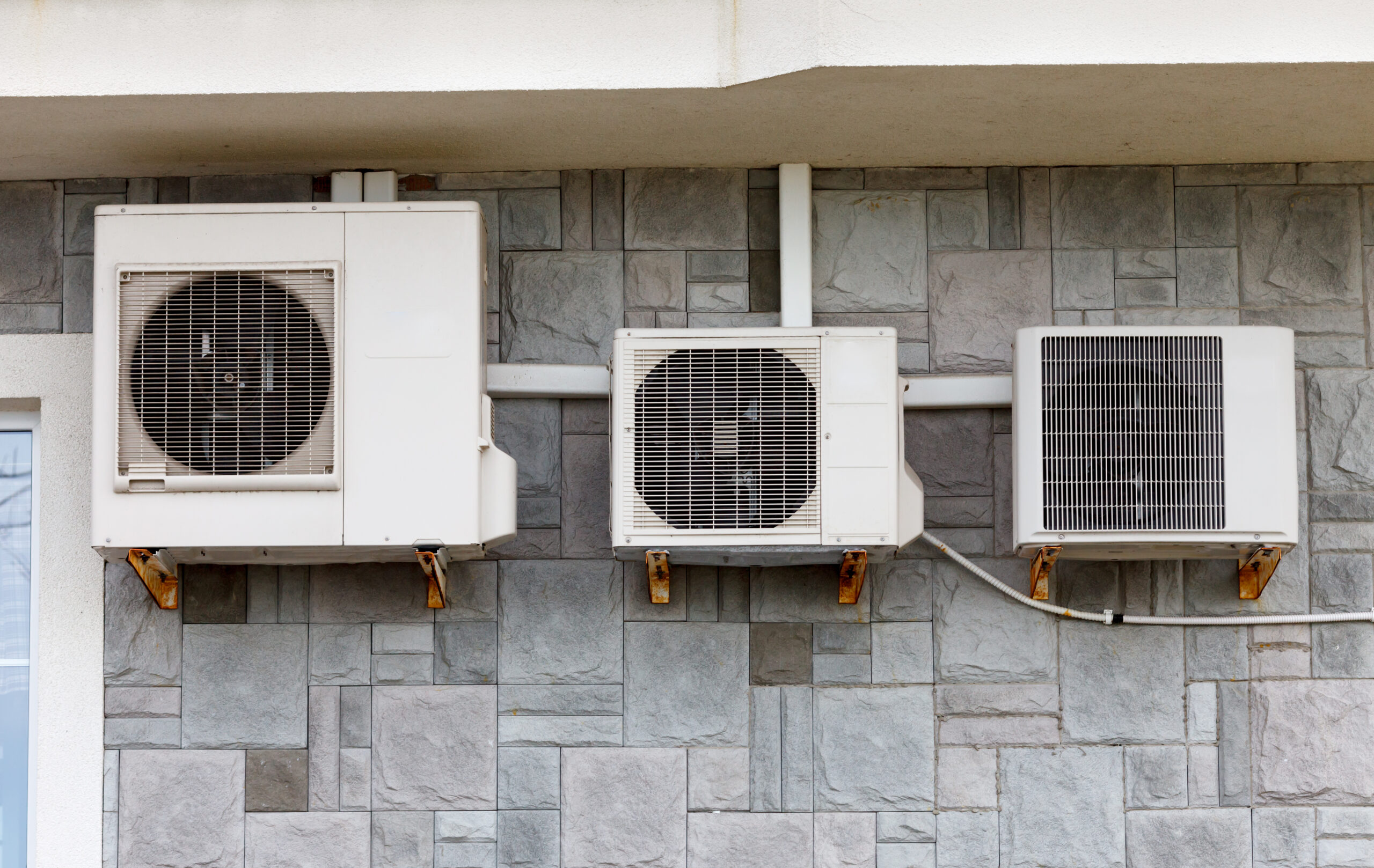
 Bigger is not better. An oversized unit short-cycles, turning on and off too frequently to properly dehumidify the air. The house ends up cold and clammy, the compressor wears out from constant hard starts, and nobody is comfortable. An undersized unit runs continuously and still cannot hit the setpoint on the hottest day of the year.
Tons and BTU: The Language of Cooling Capacity
Cooling capacity is expressed in tons or BTU per hour (BTUh). One ton equals 12,000 BTU per hour of cooling capacity. Residential systems range from 1.5 to 5 tons in half-ton increments: 1.5, 2, 2.5, 3, 3.5, 4, 4.5, and 5 tons.
To find the tonnage of an existing system, check the model number on the outdoor condenser unit. Most manufacturers encode capacity as a two-digit number in the model string: 18, 24, 30, 36, 42, 48, or 60. Divide by 12 for tonnage. A model number containing “36” means 3 tons. Always verify with the manufacturer’s literature for that model.
AC Sizing Chart by Square Footage
| Square Footage | Estimated Tonnage | BTUh |
| 600 to 900 sq ft | 1.5 tons | 18,000 |
| 900 to 1,200 sq ft | 2 tons | 24,000 |
| 1,200 to 1,500 sq ft | 2.5 tons | 30,000 |
| 1,500 to 1,800 sq ft | 3 tons | 36,000 |
| 1,800 to 2,100 sq ft | 3.5 tons | 42,000 |
| 2,100 to 2,400 sq ft | 4 tons | 48,000 |
| 2,400 to 3,000 sq ft | 5 tons | 60,000 |
These figures assume a moderate climate zone (Zones 3 to 4), 8-foot ceilings, average insulation, and standard window area. Use this chart only as a rough starting point. Every variable below adjusts the number.
Variables That Adjust the Number Up or Down
| Factor | Adjust Down | Adjust Up |
| Insulation quality | Well-insulated, new construction | Poor insulation, pre-1980 |
| Windows | Double-pane, minimal area | Single-pane, large or many |
| Climate zone | Cool northern climate | Hot, humid South or Southwest |
| Ceiling height | Standard 8 ft | 10 to 12+ ft ceilings |
| Sun exposure | Well-shaded, north-facing | Full afternoon sun, south or west facing |
| Stories | Two-story (upper insulates lower) | Single-story with large roof area |
| Occupancy | Low occupancy | High occupancy, active kitchen |
The Oversizing Trap
An oversized AC cools the space so quickly it shuts off before completing a full humidity removal cycle. The result:
- Cold but clammy air at 72 degrees F feels less comfortable than properly dehumidified 74 degree air
- Mold and mildew risk increases as indoor humidity stays elevated
- The compressor experiences more wear per cooling cycle due to repeated hard starts
- Energy costs per hour of cooling are higher than a correctly-sized system
What a Manual J Load Calculation Actually Is
The square footage chart is a planning tool. A Manual J residential load calculation is the engineering-standard method used by licensed HVAC contractors. It accounts for square footage by room, insulation R-values, window area and type, air infiltration rate, local design temperatures, occupancy and internal heat loads, and ductwork efficiency.
Any HVAC contractor who quotes a system size based only on square footage without running a load calculation is guessing. Residential comfort pays for estimation errors for the life of the equipment.
Mini Split Sizing
For ductless mini split applications, the same BTU-to-square footage principles apply. A 12,000 BTU (1-ton) single-zone unit handles roughly 500 to 600 square feet in moderate climates.
Browse single-zone mini split systems at SupplyHouse.
Browse multi-zone mini split systems at SupplyHouse.
Use the SupplyHouse mini split sizing calculator for quick BTU estimates.
What Happens With Wrong Sizing (Both Directions)
| Issue | Too Small | Too Large |
| Run time | Runs continuously | Short cycles (1 to 3 min on/off) |
| Temperature | Never reaches setpoint | Reaches setpoint fast |
| Humidity control | Poor | Poor (not enough run time to dehumidify) |
| Comfort | Too warm | Cold and clammy |
| Energy use | High (runs constantly) | High (inefficient cycling) |
| Equipment wear | High (motor fatigue) | High (compressor hard starts) |
Frequently Asked Questions
Is a bigger AC unit always better?
No. An oversized unit short-cycles, turning on and off too rapidly without running long enough to remove humidity from the air. The house feels cold but clammy, and the compressor wears out faster from constant starting.
How do I find the tonnage of an existing AC system?
Look at the model number on the outdoor condenser unit. Find the two-digit number in the model string (18, 24, 30, 36, 42, 48, or 60) and divide by 12. A model number containing “36” means a 3-ton system.
What is a Manual J load calculation?
Manual J is the ACCA-standard method for calculating a home’s heating and cooling load. It accounts for square footage, insulation, windows, orientation, climate, and occupancy. It is the most accurate method for sizing any residential HVAC system.
How does ceiling height affect AC sizing?
Standard sizing assumes 8-foot ceilings. For each foot above 8 feet, add roughly 10% to the BTU requirement. A 12-foot-ceiling great room has 50% more air volume than a standard room of the same square footage.
What size AC unit is needed for a 1,500 sq ft home?
In a moderate climate with average insulation, approximately 2.5 tons (30,000 BTUh). In a hot, humid climate or a poorly insulated older home, closer to 3 tons. In a well-insulated newer home in a cooler climate, 2 tons may suffice. A Manual J confirms the right number.
What size mini split is needed for a single room?
A 12,000 BTU (1-ton) unit covers roughly 500 to 600 square feet in moderate conditions. Use the SupplyHouse mini split sizing calculator for a quick estimate, and factor in sun exposure, insulation, and ceiling height.
Measure Twice, Chill Once
AC sizing comes down to one principle: right-size the system for the actual heat load, not the biggest number that fits the budget. Square footage gives a starting estimate. Climate zone, insulation, ceiling height, and sun exposure move the final number meaningfully. A Manual J load calculation from a licensed HVAC contractor is the only way to be certain. For ductless applications, SupplyHouse carries single-zone and multi-zone mini split systems with a sizing calculator to help narrow the right unit before the install begins.