


Running a one-person trade shop used to mean long hours, thin margins, and a constant battle with paperwork that had nothing to do with the actual work. That’s starting to change. SupplyHouse surveyed 751 skilled tradespeople across the country (including plumbers, electricians, HVAC techs, general contractors, and more) to understand how solo work and AI adoption are reshaping the trades. What we found points to a genuine shift in how tradespeople are choosing to build their careers and what’s making it possible.
Key Takeaways
- Nearly half of all tradespeople (49%) now work solo.
- AI-using contractors earn 16% more than those who don’t use AI.
- 65% of solo tradespeople use AI at work and earn 34% more than solo contractors who don’t.
- AI saves the average solo contractor nearly 7 hours every week. That’s more than 350 hours a year.
- Nearly 1 in 3 business-owning tradespeople (31%) say AI played a role in their decision to stay small or go solo.
- 50% of tradespeople believe AI will shrink the number of employees small shops need in the future.
- 15% of employed tradespeople are planning to go solo within the next 12 months.
The Solo Contractor Boom
Solo work isn’t a fallback for tradespeople. It’s increasingly a deliberate choice. The data shows a workforce actively opting out of traditional employment in favor of independence, and they’re largely happy about it.
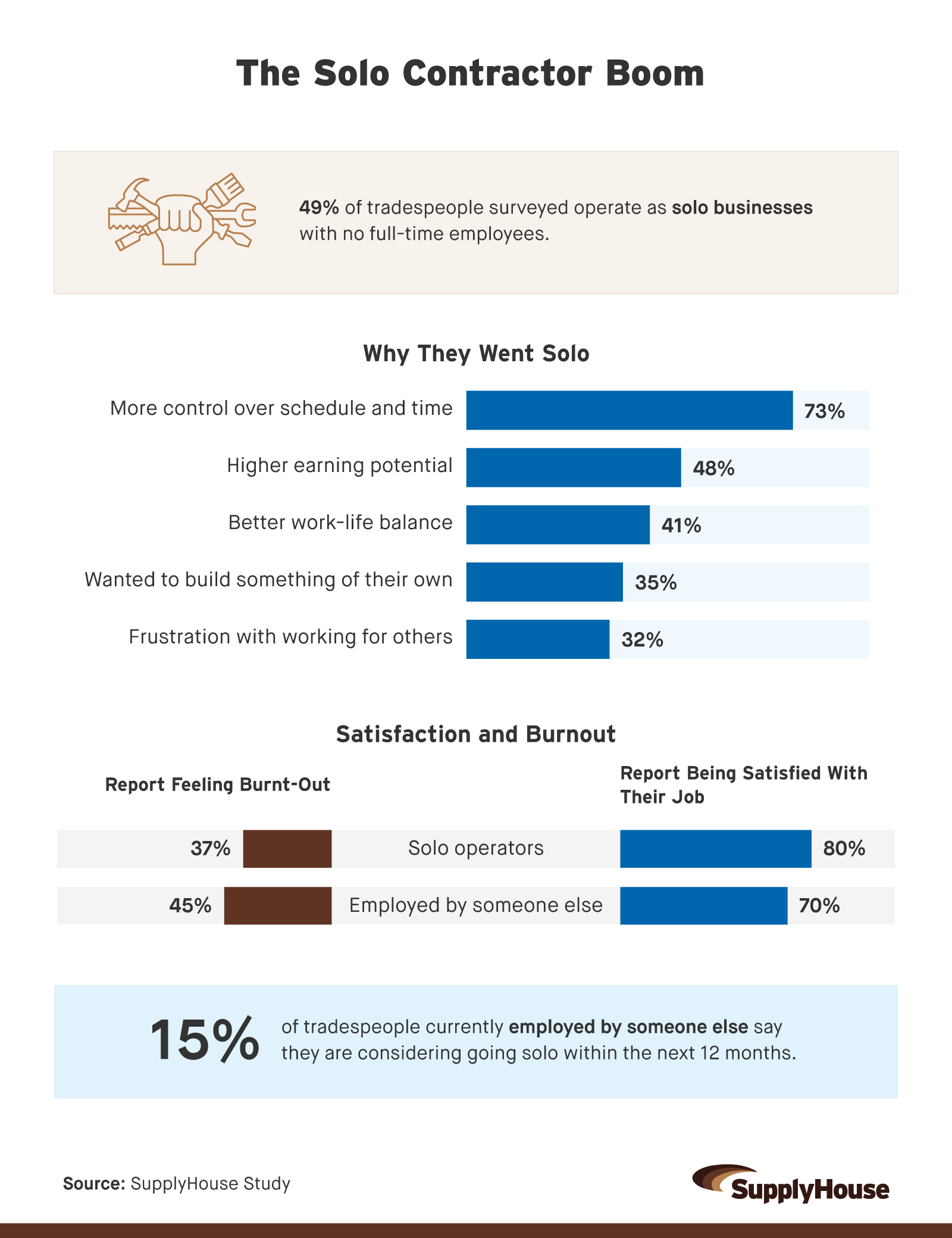
Close to half of all tradespeople surveyed (49%) operate as solo businesses with no full-time employees, and Gen Z leads the way with a solo rate of 54%. This isn’t just a trend among veterans looking to go independent late in their careers; younger tradespeople are starting out that way.
The motivations are clear. Nearly three-quarters of independent tradespeople (73%) cited more control over their schedule and time as a top reason for going solo. Higher earning potential came in at 48%, followed by:
- Better work-life balance (41%)
- Desire to build something of their own (35%)
- Frustration with working for others (32%)
And the data backs up those instincts. Solo operators reported higher job satisfaction than employed tradespeople (80% vs. 70%) and lower burnout rates (37% vs. 45%). Yet, going solo isn’t without friction. Taking time off without losing income was the most commonly cited challenge (45%), followed by marketing and finding new customers (32%) and managing workload volume (24%). But on balance, most solo operators appear to have few regrets.
The pipeline isn’t slowing down either. Among tradespeople currently employed by someone else, 15% said they’re considering going solo within the next 12 months.
The AI Toolbox for Tradesworkers
AI isn’t just for tech companies and marketing departments anymore. Across the trades, solo contractors are finding practical, time-saving uses for it, and the ones who’ve adopted it are seeing a measurable difference in their bottom line.
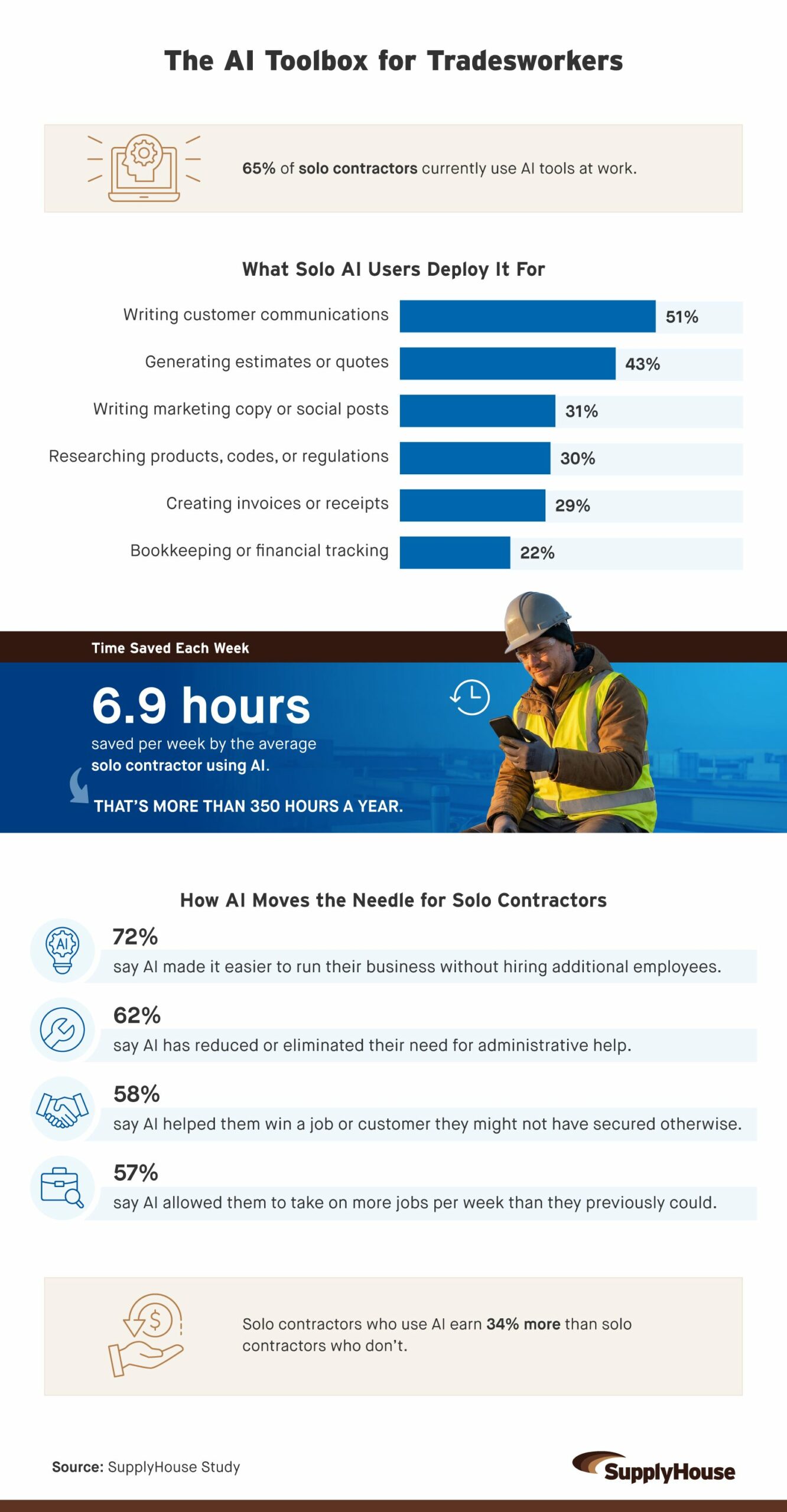
Nearly two-thirds of solo contractors (65%) currently use AI tools at work. The most common applications are:
- Writing customer communications (51%)
- Generating estimates or quotes (43%)
- Writing marketing copy or social posts (31%)
- Researching products, codes, or regulations (30%)
- Creating invoices or receipts (29%)
- Bookkeeping or financial tracking (22%)
These are the unglamorous back-office tasks that drain hours from every workday. Luckily, AI saves the average solo contractor 6.9 hours per week, which works out to more than 350 hours a year. For someone running a one-person operation, that’s essentially weeks of billable time reclaimed.
The business impact goes beyond time savings. Among solo contractors who use AI, 72% said it made it easier to run their business without hiring additional employees. More than half (58%) said AI helped them win a job or customer they might not have otherwise secured, and 57% said it allowed them to take on more jobs per week than they previously could. Solo contractors who use AI also earned 34% more than those who don’t, a gap that’s hard to ignore.
The Future of AI in Contracting
Tradespeople aren’t just using AI today. Many believe it will fundamentally change how small trade businesses are structured in the years ahead.
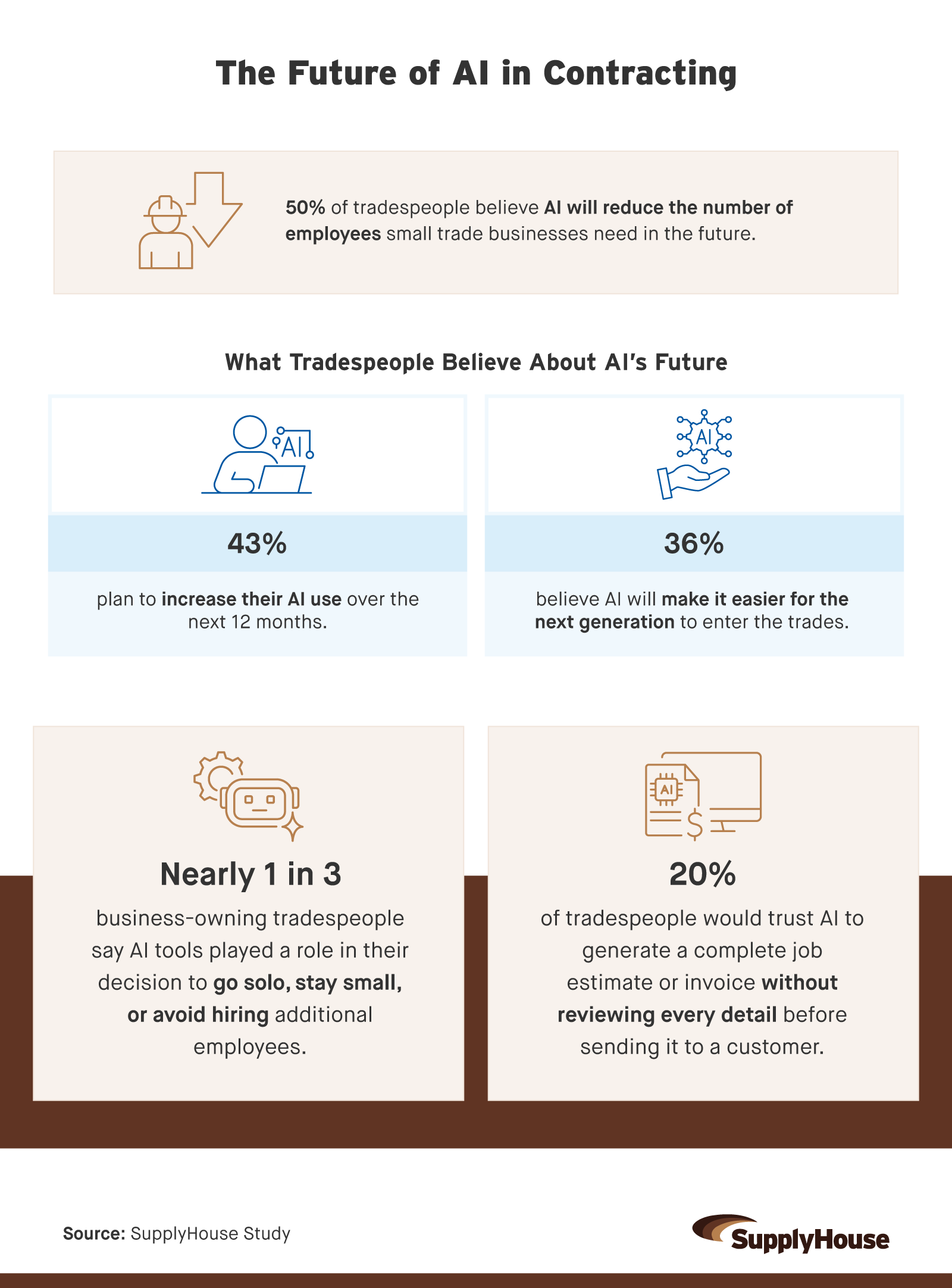
Half of all tradespeople surveyed believe AI will reduce the number of employees small trade businesses need going forward. That’s a notable finding. The people doing this work every day see AI not as a temporary productivity hack, but as something that could change the size and shape of small trade shops entirely.
That belief is already shaping business decisions. Nearly 1 in 3 business-owning tradespeople (31%) said AI played a role in their decision to go solo, stay small, or avoid hiring additional employees. For a meaningful share of the workforce, AI isn’t just a tool. It’s part of the reason they felt confident going it alone.
Looking ahead, 43% of tradespeople said they plan to increase their use of AI over the next 12 months, and 36% believe AI will make it easier for the next generation to enter the trades. Comfort with AI-assisted customer communication is also growing: 43% said they feel comfortable using AI to handle direct customer communication, with 15% saying they already do it regularly.
Trust in AI to handle estimates or invoices without review, however, is still limited. Only 20% said they’d send an AI-generated estimate or invoice to a customer without reviewing every detail first.
One Person, Bigger Possibilities
The portrait that emerges from this research is of a trades workforce increasingly comfortable running lean and finding real advantages in it. Solo contractors who’ve embraced AI are working smarter, earning more, and reclaiming time they used to lose to administrative work. Whether you’re already running your own shop or thinking about making the move, the tools available today make the one-person operation more viable than ever. The work itself hasn’t changed, but the business side of it is getting a whole lot easier.
Methodology
We surveyed 751 tradespeople across the United States, including plumbers, electricians, HVAC technicians, general contractors, carpenters, painters, roofers, and other skilled trade professionals. The objective of this study was to understand how solo work and AI adoption are affecting career decisions, daily workflows, and earning potential among skilled tradespeople in the United States.
Respondents were 53% men and 46% women. By generation, 54% were millennials, 23% were Gen Z, and 19% were Gen X. Baby boomers accounted for 4% of the sample and were excluded from the generational breakdowns. By work arrangement, 36% were solo operators with no employees, 13% were solo operators who occasionally used subcontractors, 11% owned or operated a business with 1 to 5 employees, and 35% were employed by someone else.
About SupplyHouse
SupplyHouse is a trusted, trades-first online supplier that combines expert-level product knowledge and fast nationwide fulfillment to make finding and buying plumbing, heating, cooling, and electrical essentials simple and reliable.
Fair Use Statement
The information in this article may be used for noncommercial purposes only. If shared, proper attribution with a link back to SupplyHouse must be included.