
Black iron pipe threading is one of those skills that separates a tech who can complete a gas or heating job from the jobsite out versus one who has to wait on a supply house run. A power threader on the floor, a set of die heads, and a consistent technique produce clean NPT threads in under a minute per fitting. Knowing how to cut clean pipe, select the right die, keep the work lubricated, and recognize a good thread takes the guesswork out and produces joints that seal the first time.
What Black Iron Pipe Threading Requires
- Pipe cutter or hacksaw for cutting pipe to length
- Pipe reamer for removing inside burr after cutting
- Power threader (Ridgid 300 series or similar) or hand ratchet threader for smaller runs
- Die heads in the correct pipe sizes (1/2″, 3/4″, 1″, 1-1/4″, 1-1/2″, 2″ NPT are the most common for gas and heating)
- Thread cutting oil, applied continuously during threading
- Pipe vise or threader stand to hold the pipe
- Go/no-go thread gauge or ring gauge for quality verification
Browse pipe threading tools at SupplyHouse
How to Cut Pipe to Length
Measurement: NPT threads are tapered. Assembled joint length depends on how far the fitting travels onto the pipe before hand-tight, plus thread engagement. Standard practice is to cut the pipe 1/2 to 3/4 inch shorter than the center-to-center dimension to account for thread engagement inside fittings. Measure carefully and cut consistent.
- Mark the cut line on the pipe with a soapstone pencil or marker.
- Place the pipe in the vise or pipe stand. The cut point should be accessible and the pipe supported on both sides of the cut.
- If using a pipe cutter: place the wheel on the mark, tighten until the wheel contacts the pipe, and rotate the cutter around the pipe. Tighten the knob slightly after each revolution until the pipe separates. A sharp wheel produces a clean, square cut.
- If using a hacksaw: cut perpendicular to the pipe axis. An angled cut produces a tapered pipe end that creates thread problems.
- Ream the cut end with a pipe reamer. The inside burr from a cutter wheel is significant and restricts flow if not removed. Spin the reamer inside the pipe end until the burr is gone.
How to Select the Die Head
NPT (National Pipe Taper) die heads are sized by nominal pipe size, which does not equal the pipe’s actual outside diameter. A 3/4″ NPT die head is for pipe with a nominal size of 3/4″, regardless of what the outside diameter actually measures.
| Nominal Pipe Size | Common Applications | Die Head Required |
| 1/2″ NPT | Gas drops, small branch lines, boiler near-piping | 1/2″ NPT 11-R die |
| 3/4″ NPT | Gas mains in residential, boiler supply/return branches | 3/4″ NPT 11-R die |
| 1″ NPT | Larger gas mains, boiler supply/return mains, hot water headers | 1″ NPT 11-R die |
| 1-1/4″ NPT | Gas service entrance lines, main hot water headers | 1-1/4″ NPT 11-R die |
| 1-1/2″ NPT | Commercial gas, large boiler headers | 1-1/2″ NPT 11-R die |
| 2″ NPT | Commercial gas mains, large heating headers | 2″ NPT 11-R die |
Die heads consist of four cutting dies held in a head body. The dies are marked with the pipe size they cut. Install the die head into the threader by engaging the head’s tabs with the threader drive slots. The head should click securely into position and not wobble.
How to Thread Pipe
Threading produces a tapered NPT thread that tightens as a fitting is engaged. The standard for residential and commercial gas and heating pipe is 11.5 TPI (threads per inch) for sizes 1/2″ to 2″.
- Secure the pipe in the vise with the end to be threaded extending 3 to 4 inches beyond the chuck.
- Apply cutting oil to the pipe end and inside the die head before starting. Thread cutting oil lubricates the dies, cools the work, and flushes metal chips away from the cutting edges. Without oil, die life drops dramatically and thread quality suffers.
- On a power threader: engage the die head with the pipe end. Switch the machine on and apply forward pressure on the carriage handwheel to guide the dies onto the pipe. Once the dies catch and begin cutting, the carriage advances automatically. Maintain a steady flow of cutting oil from the oil can.
- On a hand ratchet threader: engage the die head with the pipe end and rotate clockwise (facing the pipe end) while applying forward pressure. After the dies catch, continue rotating while applying oil every few turns.
- Thread until the pipe end is flush with or slightly beyond the face of the die head. Complete the thread cut per the die-head/threader design and then back the head off as required by the tool.
- Clear chips from the thread with a brush and wipe the thread clean with a rag.
- Inspect the thread.
How to Inspect a Finished Thread
A good NPT thread:
- Is uniform around the full circumference, no gaps or torn sections
- Has 7 to 8 visible thread crests from the pipe end to where the thread disappears into the pipe OD
- Passes a ring gauge or fitting hand-tight: a new fitting should thread by hand 3 to 4 turns before needing a wrench
- Is free of chips and metal particles
A bad thread:
- Shows torn or ragged thread crests (dull dies, no oil, or pipe end not square)
- Has fewer than 6 visible crests (die head ejected too early or dies not advancing)
- Tapers too sharply or shows a step (pipe not concentric in the chuck)
- A fitting that threads by hand more than 5 turns indicates oversized or worn dies
- A fitting that won’t thread by hand at all indicates undersized thread or misaligned pipe
Assembly and Sealing
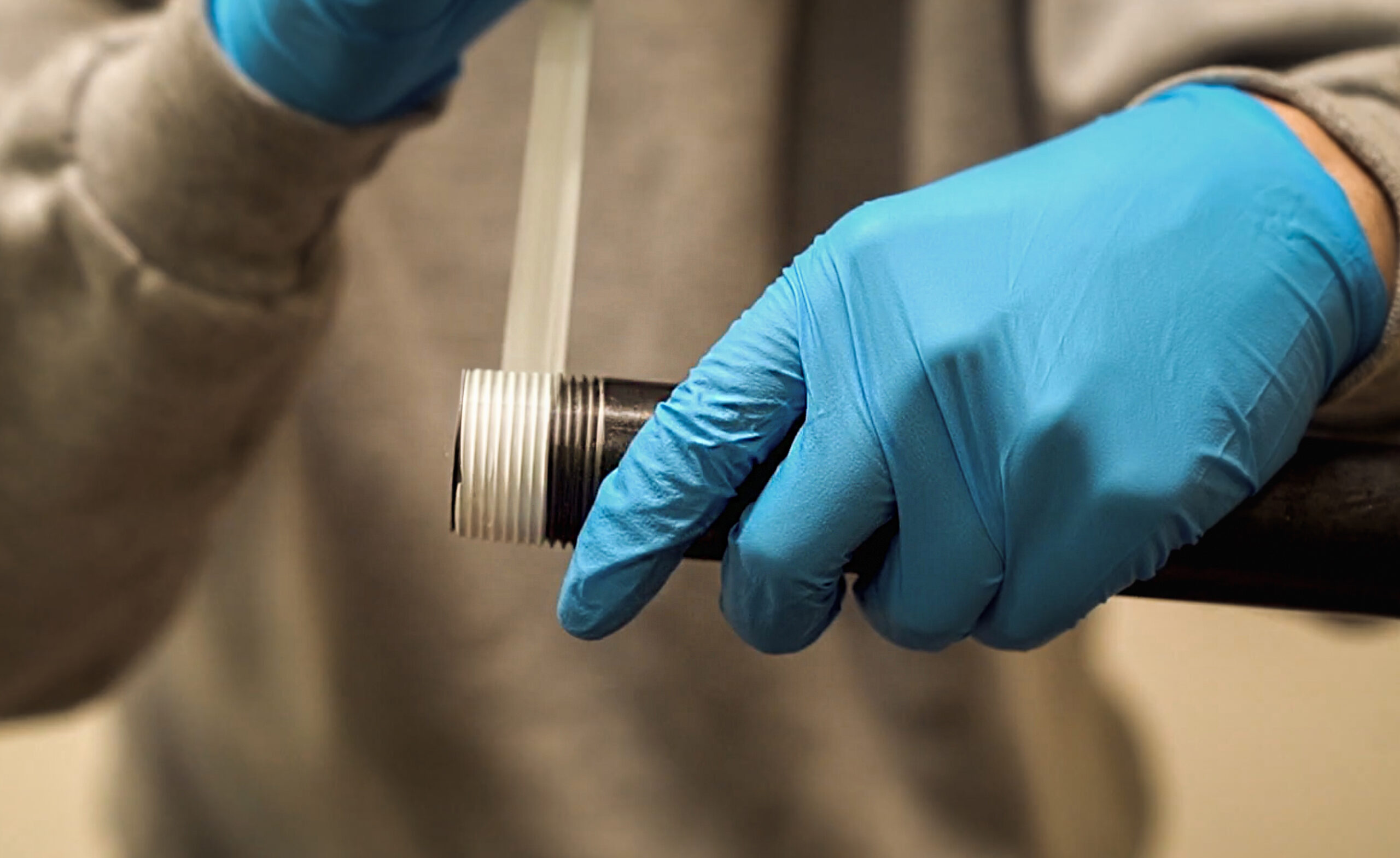
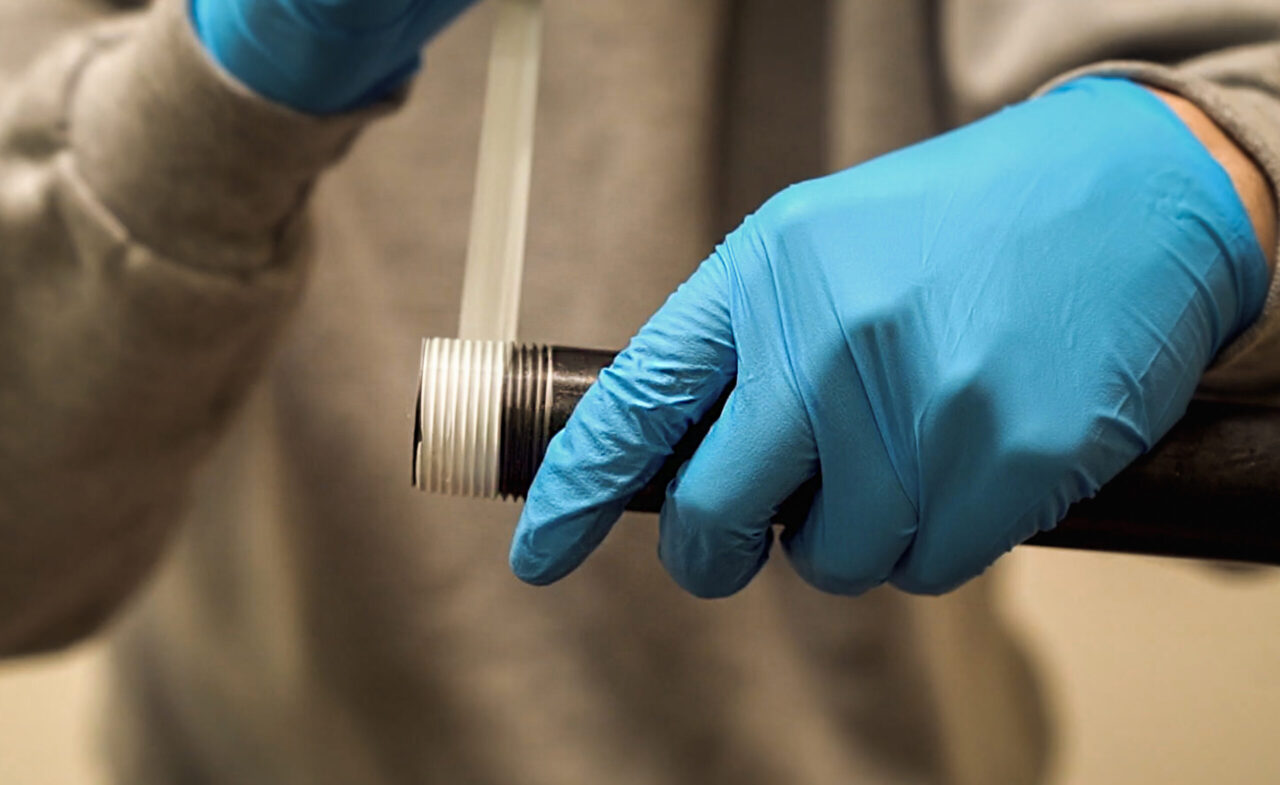
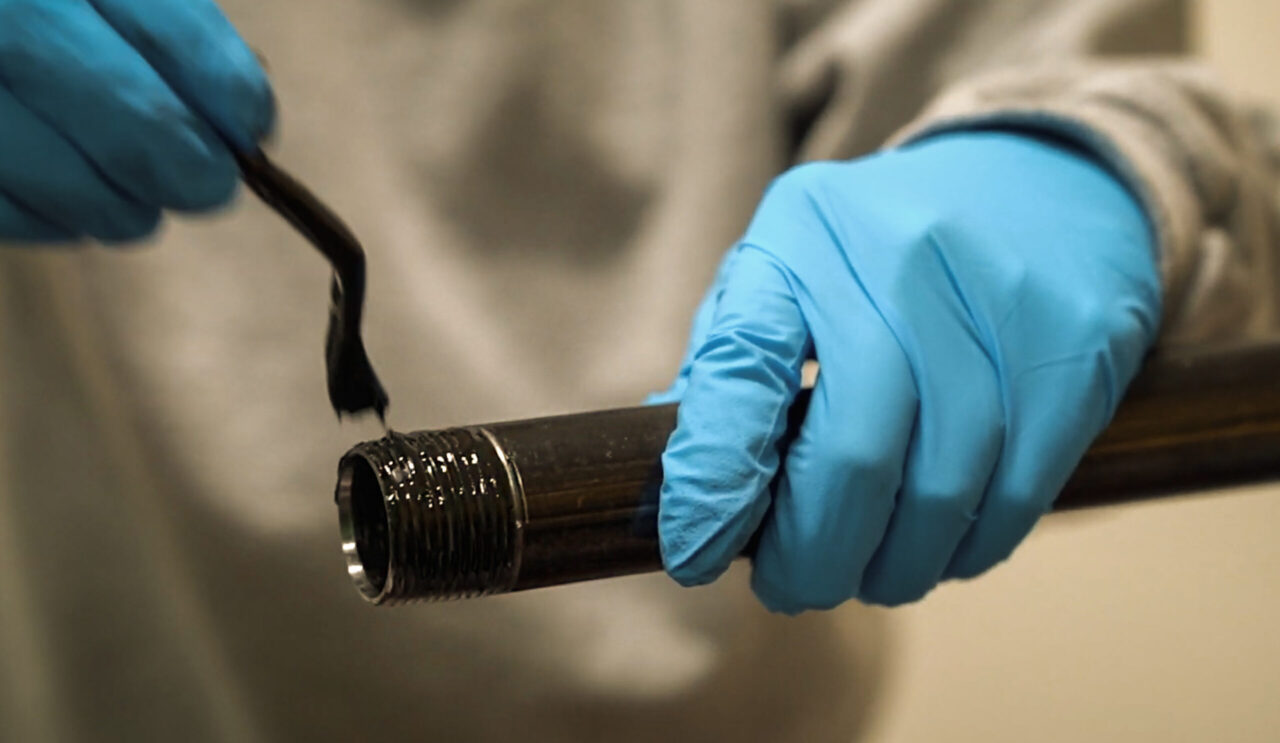
Black iron pipe for gas systems uses yellow PTFE tape rated for gas service, or a pipe dope specifically formulated and approved for gas. Standard white PTFE tape is not rated for gas service and should not be used on gas piping. Read the label.
Apply tape or dope to the male threads only: never to the female threads inside a fitting. Apply tape by wrapping in the direction of the thread (clockwise when looking at the pipe end) for two to three complete wraps. Pull the tape tight against the threads as it wraps.
Assemble hand-tight, then wrench-tighten 2 to 3 additional turns for 1/2″ to 1″ pipe. Larger pipe requires slightly less additional engagement. Overtightening splits cast iron fittings.
Frequently Asked Questions
Can I use cutting oil from any brand, or does it need to match the die brand?
Thread cutting oil is not brand-specific. Any sulfurized or chlorinated cutting oil suitable for ferrous pipe threading works with any brand of die head. The key is using it consistently and in sufficient quantity. Running dry even briefly dulls dies and produces poor threads.
My threads look fine but the fitting leaks after pressure testing. What happened?
Several possibilities: wrong pipe dope or tape (white PTFE is not gas-rated), insufficient tape wraps, tape applied to female threads instead of male, or threads not fully cleaned of chips before assembly. Re-thread the joint, clean thoroughly, and apply fresh gas-rated sealant.
The die head keeps jamming and won’t advance. What’s wrong?
Most jamming comes from insufficient oil, dull dies, or a pipe end that wasn’t square. Reverse the threader briefly to back the dies off the pipe, apply fresh oil, and re-engage. If the problem persists, the dies are dull and need replacement or sharpening.
How many threads should I cut on 3/4″ black iron pipe for a standard fitting?
For 3/4″ NPT, standard thread engagement is approximately 11 threads. A complete thread cycle with a standard 11-R die head produces this automatically when the die is allowed to run to its self-ejection point.
Can I rethread a pipe that was cut too short?
No. NPT threads require a minimum pipe length to produce sufficient thread engagement for a seal. A pipe cut too short results in insufficient thread depth regardless of how many times it’s threaded. Cut a new piece.
When do I replace die heads?
Die heads need replacement or sharpening when: threads show consistently torn crests despite adequate oil, the dies require excessive force to advance, or the finished threads fail ring gauge inspection. Cutting more pipe doesn’t fix dull dies. Continuing with dull dies produces undersized threads and wastes time.
Ready to Thread
Black iron pipe threading is one of the skills that doesn’t get faster or more reliable without reps. Cut the pipe square, ream the end, feed the die with oil, and let the machine do the work. The thread quality shows up in inspection and in whether the joint seals or weeps on the first pressure test. Clean threads, correct sealant, and proper engagement get the job done right the first time.
Shop pipe threading tools and all plumbing tools at SupplyHouse.