
A boiler running at 180 degrees F on a 45-degree day is like running a car engine at full throttle in a parking lot. The load doesn’t need that much heat. Outdoor reset fixes that mismatch by adjusting the boiler’s supply water temperature based on how cold it is outside: more heat when it’s colder, less when it’s milder. On a properly configured system, outdoor reset cuts fuel use, reduces boiler short cycling, and extends equipment life. It’s one of the highest-return retrofits on any existing hydronic system.
What Outdoor Reset Actually Does
A standard aquastat maintains a fixed boiler temperature, typically 160 to 180 degrees F, regardless of outdoor temperature. The boiler fires until the water reaches setpoint, the zones extract heat, and the boiler fires again. On mild days, the boiler reaches setpoint quickly and short cycles: many short firing intervals that stress the heat exchanger and waste fuel on standby losses.
An outdoor reset controller replaces the fixed setpoint with a sliding one. As outdoor temperature rises, the controller lowers the target supply water temperature. The result is a boiler that runs longer at lower temperatures on mild days instead of short cycling at high temperatures. The heat output better matches the actual load.
The relationship between outdoor temperature and supply water temperature is called the reset curve (or heating curve). A typical curve might be: at 0 degrees F outdoor temperature, supply water at 180 degrees F; at 60 degrees F outdoor temperature, supply water at 100 degrees F. The slope and shape of that curve are adjustable to match the building and heating system.
When Outdoor Reset Delivers the Most Benefit
- Non-condensing cast iron or steel boilers: reduces short cycling, extends equipment life, improves comfort.
- Condensing boilers: the real payoff. Condensing boilers achieve 90+ percent efficiency when return water is cool enough to condense flue gases (below approximately 130 degrees F). Outdoor reset keeps supply temperatures low enough on mild days for condensing to occur, extracting maximum efficiency from the boiler.
- Baseboard and fin-tube systems: more emitter surface area per BTU at lower temperatures, so lower supply temperatures still deliver adequate heat.
- Radiant floor systems: already designed for low supply temperatures (100-130 degrees F). Outdoor reset keeps supply temperatures matched to the floor’s design range.
Wiring a Tekmar Outdoor Reset Controller
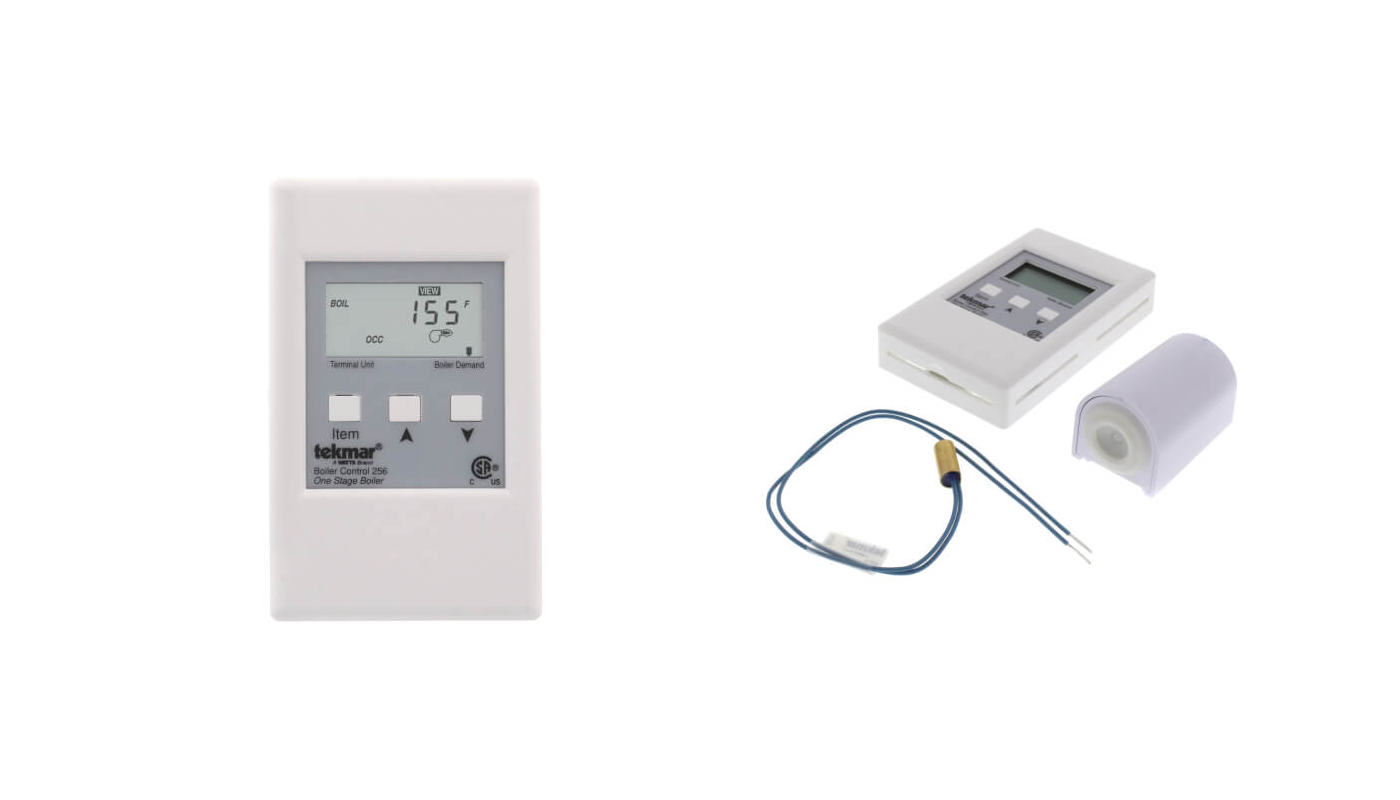
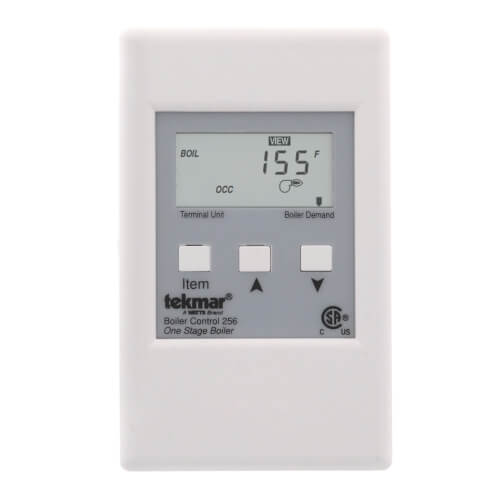
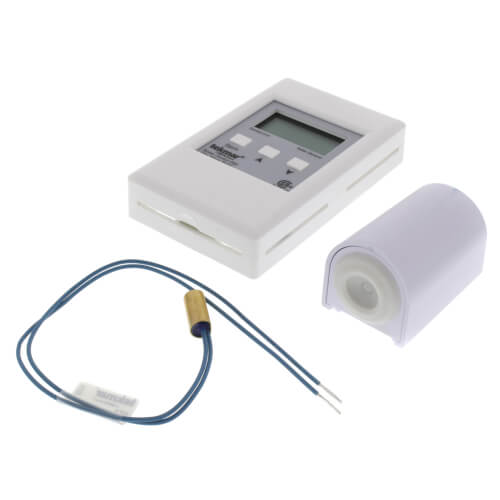
The Tekmar 256 and 260 series are common standalone outdoor reset controllers used on residential hydronic systems. The 256 controls one boiler stage. The 260 adds DHW priority. Both are similar in concept.
Tools needed: multimeter, screwdrivers, thermostat wire (18 AWG, 4-conductor minimum), outdoor sensor mounting hardware.
- Shut off power to the boiler at the service switch or breaker before opening any electrical enclosures.
- Mount the Tekmar controller on the boiler or on a nearby wall. It must be powered according to the model requirements and wiring diagram. The 256 uses 24 Vac power, while the 260 uses 120 Vac power.
- Install the outdoor sensor on the north wall of the building, away from direct sunlight, exhaust vents, and other heat sources. The sensor reads ambient outdoor air temperature. A false reading from direct sun or exhaust exposure produces inaccurate reset calculations.
- Run 18 AWG thermostat wire from the outdoor sensor to the controller. Polarity matters on some Tekmar sensors but not all. Check the installation guide for the specific model.
- Install the supply temperature sensor in a well on the boiler outlet pipe or strap it to the supply pipe with insulation over it. The supply sensor placement is critical: it must read actual supply water temperature, not ambient temperature in the boiler room.
- Connect the controller’s boiler relay to the boiler’s TT (thermostat) terminals. On most residential boilers, the TT terminals are the low-voltage call-for-heat input. When the Tekmar controller determines the boiler should fire, it closes this relay.
- Connect 120V power to the controller. Restore power to the boiler.
Shop the Tekmar 256 Outdoor Reset Boiler Control and Tekmar 260 One Stage Boiler and DHW Control at SupplyHouse. Browse all Tekmar controls.
Setting the Reset Curve
The reset curve has two primary settings: the design supply temperature at design outdoor temperature (the coldest expected day), and the reset ratio (how steeply supply temperature drops as outdoor temperature rises).
Starting point settings for a baseboard system:
| Outdoor Temp | Supply Water Temp | Notes |
| Design day (typically 0 to 10F) | 170 to 180F | Full boiler output, coldest conditions |
| 40F outdoor | 140 to 150F | Shoulder season, moderate load |
| 60F outdoor | 100 to 120F | Minimal load; boiler may not need to fire |
For radiant floor systems, lower these values by 40 to 60 degrees F across the curve. Radiant floors don’t need water above 120 to 130 degrees F even at design conditions for most residential loads.
After initial setup, observe the system over a few days at different outdoor temperatures. If rooms overshoot setpoint, flatten the curve (reduce the design supply temperature). If rooms undershoot on cold days, raise the design temperature. Most systems require one or two curve adjustments during commissioning.
Critical Setting: Minimum Supply Temperature
Non-condensing boilers, especially cast iron sectional boilers, must not have flue gases condense inside the boiler sections. Acidic condensate corrodes cast iron and unlined chimney masonry rapidly. The minimum supply temperature setting on the outdoor reset controller prevents this: even on mild days, the boiler does not produce supply water below the minimum.
For most non-condensing cast iron boilers: set the minimum supply temperature to 140 degrees F. This keeps return water temperatures above 120 degrees F on most operating conditions, preventing condensation.
For condensing boilers with stainless or aluminum heat exchangers: no minimum supply temperature limit is required for condensation protection. Lower supply temperatures mean more condensing, which is the desired outcome.
Outdoor Reset with DHW Priority
Systems with an indirect water heater on the boiler need a priority relay: when the domestic hot water zone calls, the boiler ignores the outdoor reset curve and fires at full temperature until the tank is satisfied. An indirect water heater needs boiler-temperature water (160 to 180 degrees F) to heat the tank efficiently. Outdoor reset temperatures of 110 to 130 degrees F can’t heat a DHW tank adequately.
The Tekmar 260 handles this with a built-in DHW priority input. Wire the indirect water heater’s aquastat to the DHW priority terminals. When the DHW zone calls, the 260 overrides the reset curve and fires the boiler at full temperature until the DHW aquastat is satisfied.
Frequently Asked Questions
Will outdoor reset work with any hydronic boiler?
Outdoor reset works with virtually any hydronic boiler. The key consideration is minimum supply temperature for non-condensing cast iron boilers. As long as the controller is set to maintain a minimum supply temperature above 140 degrees F, outdoor reset is safe on cast iron sectional boilers. Condensing boilers benefit most from outdoor reset and have no condensation protection concerns.
What is the difference between the Tekmar 256 and 260?
The 256 controls one stage of boiler operation with outdoor reset. The 260 adds a DHW priority input and output, allowing the boiler to override the reset curve when the domestic hot water zone calls.
How do I know if my outdoor reset is working?
On a mild day (40 to 50 degrees F outdoor), the boiler supply temperature should be noticeably lower than its full design temperature. If the boiler is running at 180 degrees F on a 50-degree day, the reset curve is not working or not configured correctly. Also watch for longer run times and less cycling compared to a fixed aquastat system.
Can outdoor reset be added to a boiler that already has a standard aquastat?
Yes. The Tekmar controller wires into the boiler’s TT (thermostat) terminals and overrides the aquastat’s role in calling for heat. The aquastat remains in the circuit as a high-limit safety, which is correct. The Tekmar controls when the boiler fires; the aquastat prevents it from exceeding its high-limit setting.
What if the outdoor sensor fails?
Most Tekmar controllers default to a fixed supply temperature setpoint if the outdoor sensor is disconnected or fails. The boiler continues to operate, just without outdoor reset. An error indicator on the controller signals the sensor fault.
Is outdoor reset worth adding to an older cast iron boiler?
Yes, with the minimum supply temperature set correctly. Reducing short cycling on a cast iron boiler extends its lifespan, reduces fuel use, and improves comfort. The payback on the controller cost is typically measured in months, not years, in a climate with a long heating season.
Smarter Heat Starts Here
Outdoor reset is one of the few controls upgrades that pays back quickly on almost every hydronic system it’s added to. The wiring is straightforward, the setup takes an afternoon, and the result is a system that runs longer at lower temperatures instead of blasting and cycling. The setup takes longest on the first system. After that, it’s a two-hour add-on that customers notice in comfort and fuel bills.
Shop Tekmar outdoor reset controllers including the Tekmar 256 One-Stage Boiler Control and Tekmar 260 Boiler and DHW Control at SupplyHouse.