
Ground fault circuit interrupters have been required by the NEC for decades, but the wiring still trips up more contractors than most care to admit. The LINE/LOAD terminal confusion alone is responsible for callbacks on a huge number of jobs. Get it backwards and the outlet might appear to work fine, right up until an inspector presses the Test button and nothing trips. Get it right and one GFCI receptacle can protect an entire downstream run, eliminating the need for multiple devices on the same circuit. Here is how to install a GFCI outlet correctly, from box prep through final test.
Why GFCI Protection Matters (and Where the NEC Requires It)
A GFCI monitors the current flowing between the hot and neutral conductors. The moment an imbalance of as little as 4 to 6 milliamps appears, typically caused by current leaking through a person to ground, the device interrupts the circuit in as little as 1/40th of a second. A standard breaker would not trip on a fault that small. That speed is why GFCI protection is required near water.
Under NEC 2023 Section 210.8, the list of required locations for dwelling units has expanded to 12. Here is the full picture:
| Location | NEC 2023 Section | Notes |
| Bathrooms | 210.8(A)(1) | All receptacles within bathroom |
| Garages / accessory buildings | 210.8(A)(2) | Including attached/detached garages |
| Outdoors | 210.8(A)(3) & (F) | All exterior receptacles |
| Crawl spaces (at or below grade) | 210.8(A)(4) | Including unfinished areas |
| Basements (all) | 210.8(A)(5) | Finished and unfinished |
| Kitchens (all receptacles) | 210.8(A)(6) | 2023 expanded beyond countertop |
| Food/beverage prep areas | 210.8(A)(7) | Wet bars, butler’s pantries, etc. |
| Within 6 ft of sinks (laundry, utility) | 210.8(A)(8) | Any sink, not just kitchen |
| Boathouses | 210.8(A)(9) | All receptacles |
| Bathtub/shower areas | 210.8(A)(10) | Within 6 ft of outside edge |
| Pool/spa/hot tub areas | 210.8(A)(11) | See also NEC 680 |
| Dishwashers | 210.8(D) | Branch circuit or outlet |
The 2023 update broadened kitchen GFCI requirements from countertop receptacles only to all receptacles in the kitchen, and added new locations such as food/beverage prep areas and dishwashers. Always verify which NEC edition the local Authority Having Jurisdiction (AHJ) has adopted before starting any new installation, as adoption dates vary by jurisdiction.
Choosing the Right GFCI Device
Not all GFCI devices install or perform the same way. Picking the right one before pulling wire saves time on the job.
| Type | How It Works | Best For | Downstream Protection? |
| GFCI Receptacle | Built-in Test/Reset buttons; trips at 4-6 mA | Single or multi-outlet runs | Yes (via LOAD terminals) |
| GFCI Breaker | Protects at panel level; requires breaker replacement | Full circuit coverage | Yes (entire circuit) |
| AFCI/GFCI Combo Receptacle | Arc fault + ground fault protection in one device | Kitchens, laundry (NEC 2023) | Yes (via LOAD terminals) |
For most residential receptacle replacements and new installations in bathrooms, kitchens, garages, and outdoor locations, a tamper-resistant self-testing GFCI receptacle is the right call. Self-testing models run an automatic internal check every few seconds and flash a status indicator if the device fails. For locations requiring both arc fault and ground fault protection under the 2023 NEC, such as kitchens and laundry rooms, a dual-function AFCI/GFCI receptacle handles both requirements in a single device.
Tools and Materials
Pull these before touching the box:
- Non-contact voltage tester (verify dead before touching anything)
- Flat-head and Phillips screwdrivers
- Needle-nose pliers
- Wire strippers (matched to the wire gauge on the circuit)
- Electrical tape
- Wire nuts (if splicing in a new box)
- 12 AWG or 14 AWG NM-B cable as required for the circuit (see table above) from SupplyHouse Romex NM-B cable
- GFCI receptacle, either 15A or 20A, from SupplyHouse GFCI Receptacles
- New work or old work electrical box as needed from SupplyHouse Electrical Boxes and Enclosures
- Weatherproof cover plate for outdoor or wet-location installs
One note on amperage matching: a GFCI’s amp rating can never be higher than the breaker’s. A 15A circuit takes only a 15A GFCI, since a 20A device on a 15A circuit could draw more current than the breaker protects against. A 20A circuit can take a 20A GFCI, or a 15A GFCI as long as it’s a duplex receptacle or part of a multi-outlet circuit, per NEC Table 210.21(B)(3). When in doubt, check the breaker rating first.
Step-by-Step GFCI Installation
For a visual walkthrough, the SupplyHouse video below covers the full install in under four minutes, from matching the GFCI to the breaker through the final Test/Reset check.
Step 1 through Step 8 covers the full installation from panel shutoff through final test.
- Kill the power at the panel. Flip the breaker for the circuit being worked. Do not rely on just shutting off the wall switch.
- Confirm dead with a non-contact voltage tester at the existing outlet or at the open box. Test all conductors. Line voltage can backfeed from downstream devices in some wiring configurations. If the tester shows voltage after flipping the breaker, find the correct breaker and try again.
- Remove the existing outlet or prepare the new box. For a replacement, unscrew the cover plate and pull the old device forward. Before disconnecting anything, take a photo of the existing connections. For a new rough-in, install the box into the framing or drywall. Old-work boxes use built-in wings to clamp against the drywall from inside.
- Identify the wires. In standard NM-B cable: black = hot (line), white = neutral (line), bare copper = ground. For a GFCI that will protect downstream outlets, there will be two cable bundles in the box, one from the panel and one continuing forward. The bundle from the panel connects to the LINE terminals. The bundle continuing to downstream outlets connects to the LOAD terminals. With two bundles, keep them apart and label each one LINE or LOAD.
- Strip the wires. Remove roughly 3/4 inch of insulation from each conductor, just enough to make a solid terminal connection without exposed bare wire showing outside the terminal.
Step 6 is where most mistakes happen:
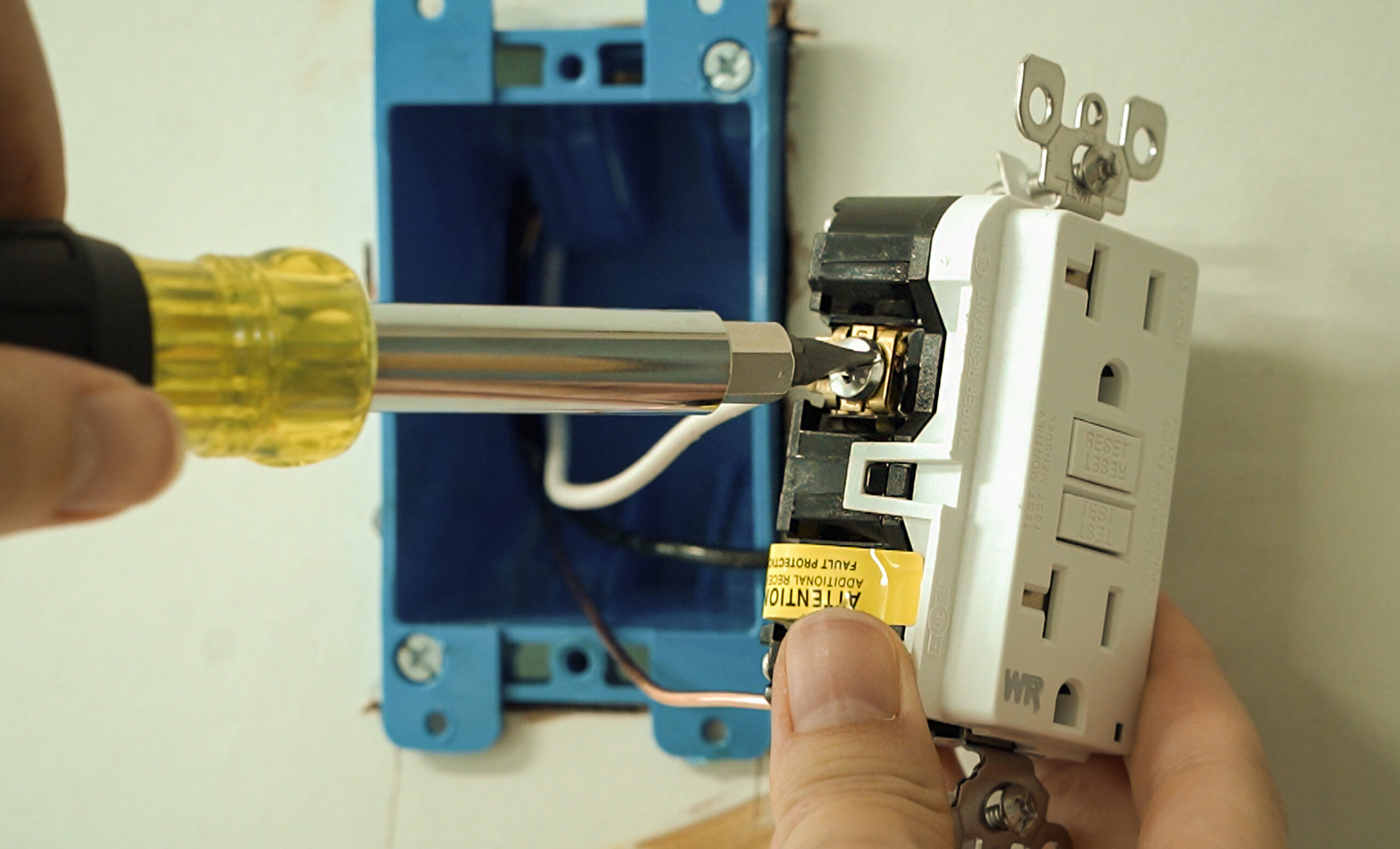
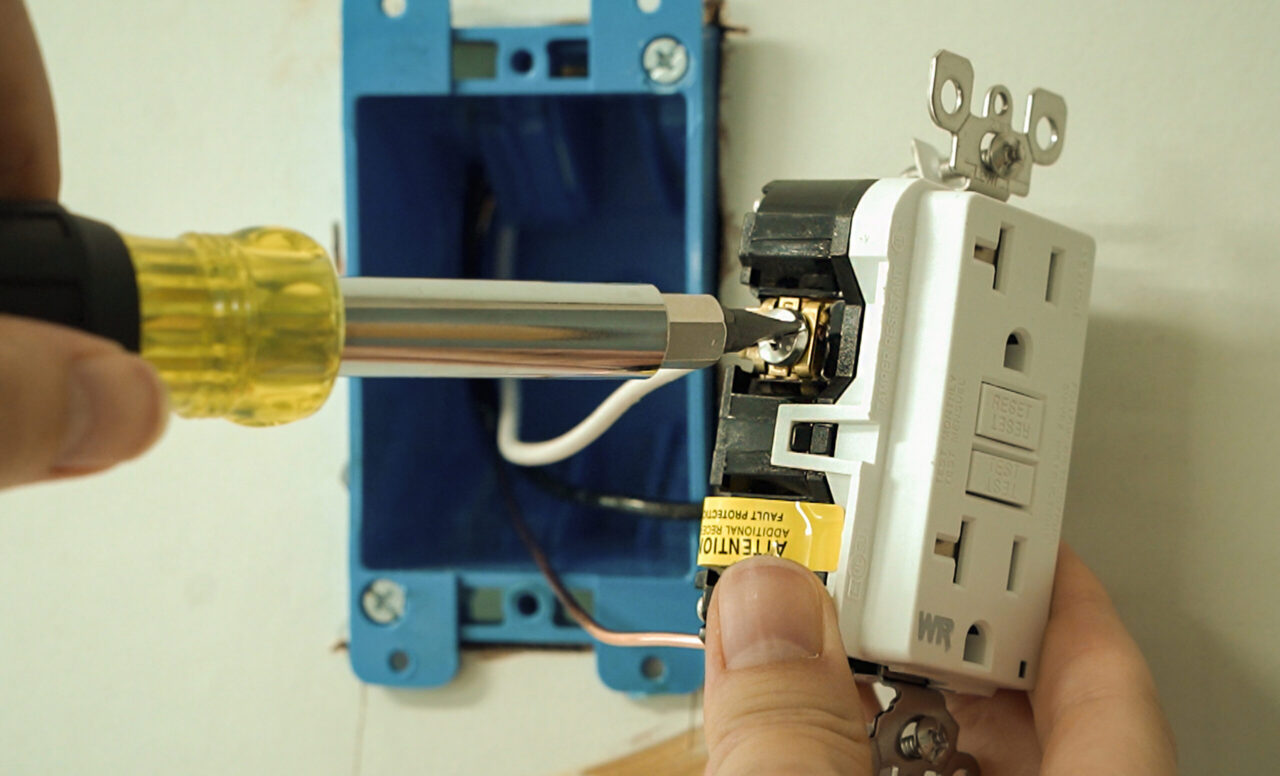
- Connect to the LINE terminals first. On a GFCI receptacle, LINE and LOAD terminals are labeled on the back of the device. A strip of tape covers the LOAD terminals from the factory as a reminder that they are optional. The black (hot) wire from the panel goes to the brass-colored LINE terminal. The white (neutral) wire from the panel goes to the silver-colored LINE terminal. The bare ground wire connects to the green grounding screw (use a wire nut to pigtail multiple ground wires together if your box contains more than one ground).
- Connect to the LOAD terminals only if protecting downstream outlets. If additional receptacles on the same circuit need GFCI protection without individual GFCI devices, connect the downstream cable’s black to the brass LOAD terminal and white to the silver LOAD terminal. Every standard receptacle downstream of the LOAD connection is now GFCI protected. If no downstream protection is needed, leave the factory warning tape over the LOAD terminals if you are not using them, ensuring nobody mistakenly wires to them.
- Fold the wires and mount the device. Press the wires back into the box neatly without sharp bends. Screw the GFCI receptacle to the box ears and attach the cover plate. For outdoor and wet locations, use a weatherproof in-use cover rated for that application.
- Restore power and test. Turn the breaker back on. Press the TEST button. The internal mechanism should trip and the RESET button should pop. No power should pass through the device in the tripped state. Press RESET firmly until it clicks. Power should restore. Use a plug-in outlet tester or non-contact tester to confirm the outlet is live after reset. If the GFCI feeds downstream outlets through the LOAD terminals, check that each one also loses power on TEST and comes back on RESET. After the install, test the GFCI the same way once a month.
Wiring Configurations at a Glance
GFCI receptacles can be wired three ways depending on the job:
- Single-location protection: Only one outlet needs GFCI protection. Use LINE terminals only. Downstream outlets (if any) remain unprotected.
- Multi-location protection: One GFCI protects multiple downstream standard receptacles. Connect the panel cable to LINE terminals and the outgoing cable to LOAD terminals. Label downstream outlets ‘GFCI Protected’ per NEC 406.4(D)(2) for replacement scenarios.
- No equipment ground available: In older wiring without a ground conductor, a GFCI receptacle is an NEC-accepted method to protect an ungrounded outlet. The outlet must be labeled ‘No Equipment Ground’ when installed this way.
Wire Gauge and Circuit Sizing Reference
Matching wire gauge to circuit amperage is non-negotiable. Here is the breakdown for the most common GFCI locations:
| Circuit Amperage | Wire Gauge (AWG) | Cable Type | Typical GFCI Location |
| 15A | 14 AWG | NM-B 14-2 | Bathroom, bedroom |
| 20A | 12 AWG | NM-B 12-2 | Kitchen, garage, outdoor |
| 20A (outdoor) | 12 AWG | NM-B 12-2 (WR rated) | Exterior, pool area, patio |
For kitchen and garage circuits requiring a 20A rating, 12 AWG NM-B cable is the standard. For bathroom circuits, 14 AWG is acceptable on a 15A circuit but always confirm the breaker rating first.
Outdoor and Wet-Location Installs
Outdoor GFCI installations need a few additional considerations beyond the standard indoor wiring steps.
- Use a weather-resistant (WR) rated GFCI receptacle. Under NEC 406.9(B)(1), receptacles in wet locations must be listed as weather resistant.
- Install in a weatherproof electrical box with an in-use (bubble) cover plate rated for wet-in-use applications. Flat covers are not acceptable for locations where cords remain plugged in during rain.
- Seal the cable entry point with conduit or use a weathertight fitting. Water intrusion at the cable entry is the most common cause of nuisance tripping on exterior circuits.
- For areas with extreme weather exposure, consider a GFCI receptacle rated for tamper and weather resistance combined, available in both 15A and 20A configurations.
Common Wiring Mistakes and How to Avoid Them
These account for the majority of GFCI callbacks:
- LINE and LOAD reversed: The outlet will appear to function but downstream protection won’t work, and the GFCI may not trip on a true ground fault. Always connect the panel cable to LINE and outgoing cable to LOAD.
- LINE only when downstream protection was the goal: With only the LINE terminals wired, the GFCI protects itself and nothing else. Outlets further down the circuit stay unprotected. To protect them, connect the outgoing cable to the LOAD terminals.
- Mixing neutrals from different circuits in a shared box: Each GFCI must have its neutral tied to the same circuit as its hot. Mixing neutrals from two different circuits creates a bootleg return path that can cause nuisance trips or masked faults.
- Relying on the GFCI without verifying the equipment ground: GFCI protection does not replace the equipment grounding conductor. Both are required in new work. GFCI-only (no ground) is only permitted as a replacement method in existing ungrounded systems.
- Over-torqued terminal screws: Cracked terminal posts are a common failure mode in high-cycle locations. Follow the manufacturer’s torque spec, typically 14 in-lbs for a 15A device.
- Skipping the final test: Every GFCI installation requires a Test/Reset cycle after power-up, full stop. A device that won’t trip on Test is defective, not installed correctly, or wired backward.
FAQs
Q: What’s the difference between LINE and LOAD terminals on a GFCI outlet?
A: LINE terminals connect to the incoming power from the panel. LOAD terminals are optional and connect to downstream outlets that need GFCI protection. Wiring the panel cable to LOAD instead of LINE is the single most common installation error on these devices.
Q: Can one GFCI outlet protect multiple standard outlets?
A: Yes. Connect the panel cable to the LINE terminals and the cable feeding downstream outlets to the LOAD terminals. Every standard receptacle downstream of the LOAD connection on that circuit is then GFCI protected. NEC 406.4(D)(2) requires labeling those outlets ‘GFCI Protected’ if there’s no individual GFCI device present.
Q: Does a GFCI outlet need a ground wire to work?
A: No. A GFCI receptacle functions on the current-sensing principle between hot and neutral conductors. The equipment grounding conductor is not part of the fault-detection circuit. The NEC permits GFCI receptacles as a replacement method in older ungrounded boxes, with required labeling per 406.4(D)(2)(b).
Q: What does the 2023 NEC say about kitchens and GFCI protection?
A: NEC 2023 Section 210.8(A)(6) expanded kitchen GFCI requirements to cover all 125V through 250V receptacles in the kitchen, not just those serving countertop surfaces. This means receptacles behind the refrigerator, under the cabinet, and any other kitchen outlet now require protection. Always verify which NEC edition the local AHJ has adopted before quoting compliance.
Q: What’s the difference between a self-testing GFCI and a standard GFCI?
A: A self-testing GFCI runs automatic internal checks (every few seconds on most Leviton and Pass & Seymour devices) to confirm the protective circuit is functioning. If the device fails a self-test, the status indicator flashes. Standard GFCIs require manual testing with the Test button to verify function. Self-testing models are now the preferred choice for most commercial and residential work because they keep checking themselves between manual tests. Even so, a self-testing GFCI should still get a manual Test/Reset once a month.
Q: When does a GFCI outlet need to be replaced rather than reset?
A: Replace the device when it won’t reset after a trip, when the indicator light flashes on a self-testing model, when physical damage is visible on the body or terminals, or when it has taken a significant electrical surge. Average service life for a GFCI receptacle is 10 to 15 years in dry locations, shorter in outdoor and high-humidity environments.
Q: Do 20A GFCI outlets look different from 15A versions?
A: Yes. A 20A GFCI receptacle (NEMA 5-20R) has one T-shaped slot on one side to accept both 15A and 20A plugs. A 15A GFCI has two parallel slots.
Q: Can a GFCI outlet be installed on an AFCI-protected circuit?
A: Yes. In fact, the 2023 NEC requires dual AFCI and GFCI protection in kitchens, laundry areas, and other specific locations. A dual-function AFCI/GFCI receptacle handles both requirements in a single device, which is often simpler than pairing separate devices.
Q: What type of electrical box does a GFCI outlet require?
A: A GFCI receptacle mounts in any standard single-gang device box. Because GFCI devices are deeper than standard outlets, box depth matters. Most modern boxes accommodate standard GFCI depth, but verify cubic inch capacity per NEC Article 314.16 before filling a box with multiple conductors. Browse electrical boxes at SupplyHouse to find new work and old work options.
Q: Is a permit required to install a GFCI outlet?
A: Permit requirements vary by jurisdiction. In most regions, replacing a like-for-like outlet in the same location does not require a permit, but adding a new circuit or relocating an outlet typically does. When in doubt, contact the local AHJ before starting the job.
Q: Are tamper-resistant (TR) receptacles required in residential dwellings, and where do they apply?
A: Yes. Under the National Electrical Code (NEC 406.12), virtually all 15-amp and 20-amp, 125-volt and 250-volt receptacles installed in dwelling units must be tamper-resistant. This includes:
- All living areas: Bedrooms, living rooms, hallways, dens, and sunrooms.
- Kitchens and dining areas.
- Garages, basements, and laundry rooms.
- Outdoors (when combined with weather-resistant ratings).
Stay Grounded
A GFCI outlet that trips on demand is doing its job. One that doesn’t is a liability waiting to surface at the worst possible moment.
The installation itself isn’t complicated. Kill the power, confirm dead, identify LINE from LOAD, wire it correctly, test it. That’s the job. Where contractors get into trouble is skipping the verification steps or assuming the device works because the outlet is live. A GFCI wired backward to the LOAD terminals can deliver power at the face and still fail to trip on a true ground fault.
Get it right the first time: use a self-testing tamper-resistant GFCI rated for the location, match the wire gauge to the circuit amperage, and always run a Test/Reset cycle before calling the job done. If anything seems off during or after the install, homeowners should stop and call a licensed electrician.
Browse GFCI receptacles, NM-B cable, electrical boxes, and weatherproof enclosures at SupplyHouse, all with fast nationwide shipping.
Shop the components for this install:
- GFCI Receptacles (15A and 20A, tamper-resistant and weather-resistant): supplyhouse.com/GFCI-Receptacles-21610000
- Electrical Receptacles (full category): supplyhouse.com/Electrical-Receptacles-21582000
- NM-B Romex Cable: supplyhouse.com/Romex-Cable-NM-B-26361000
- Electrical Boxes and Enclosures: supplyhouse.com/Electrical-Enclosures-Boxes-28081000
- Weatherproof Boxes and Covers: supplyhouse.com/Weatherproof-Boxes-and-Covers-20572000