
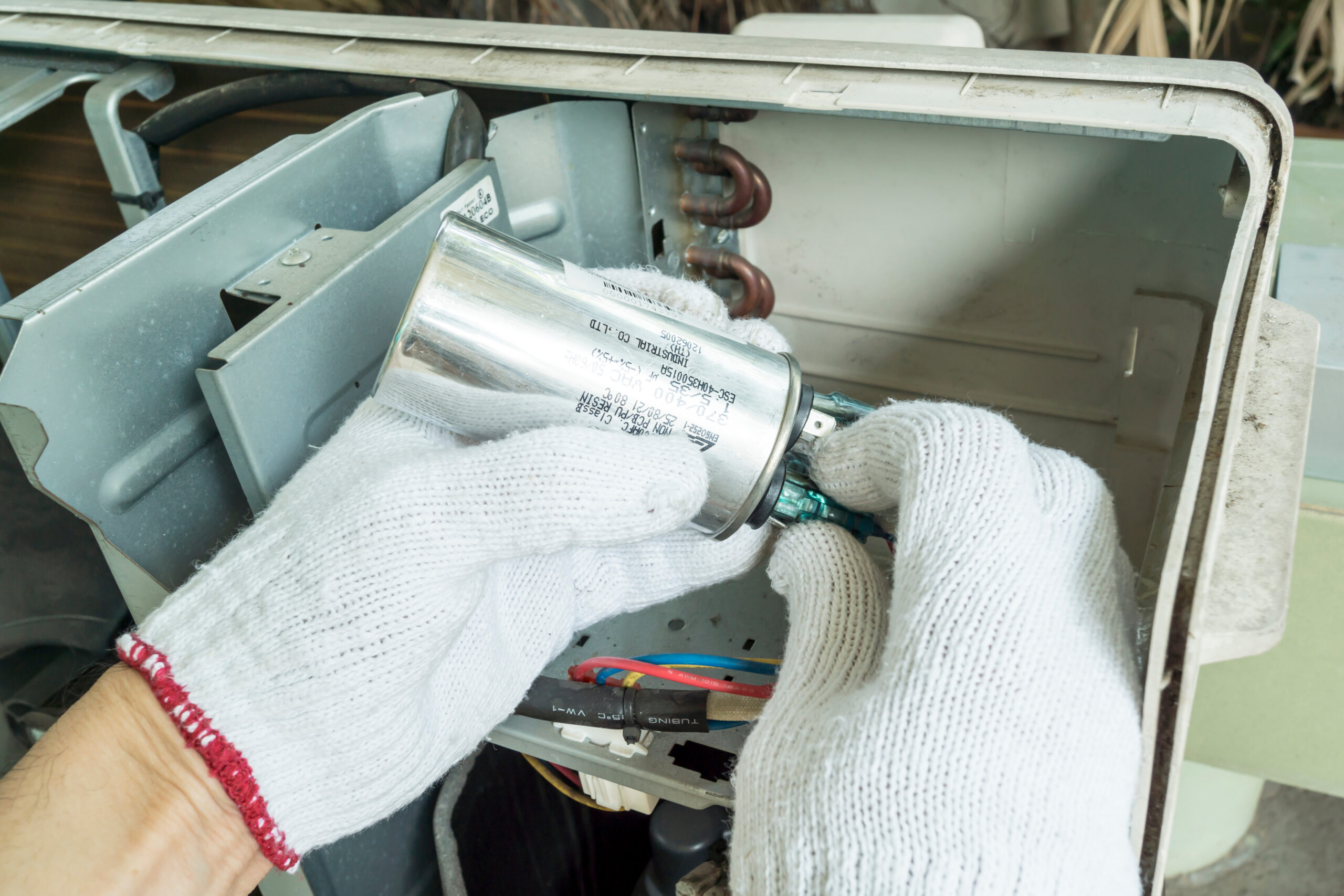
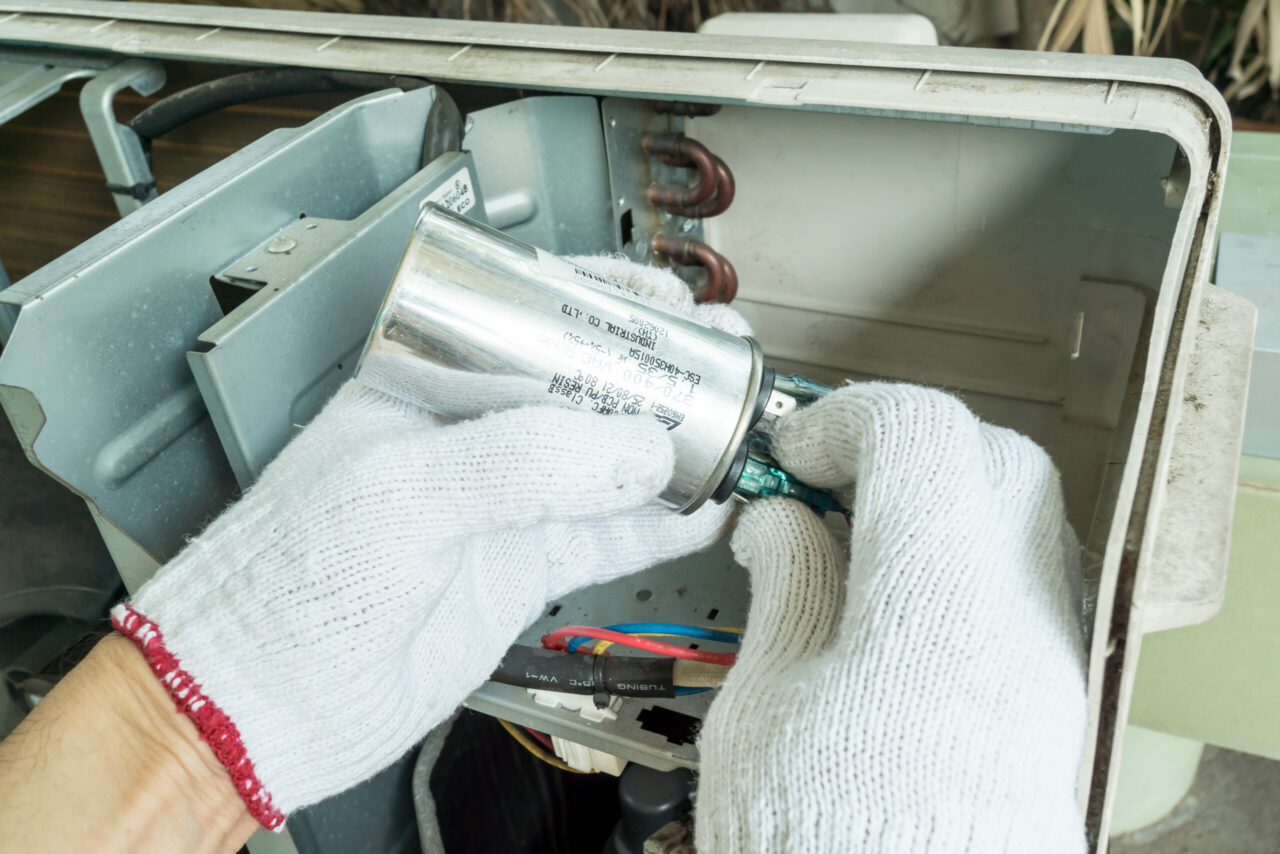
July is not the month to figure out capacitor diagnosis on the fly. When a homeowner calls because the outdoor unit is humming but not starting, or the fan is spinning slowly, the capacitor is the first suspect on more service calls than any other single part. Learning to test, spec, and swap one cleanly is the difference between a 30-minute call and a three-hour rabbit hole.
What a Capacitor Actually Does
A capacitor stores an electrical charge and delivers it in a controlled burst. AC systems use two types, and some condensing units have both.
| Type | Function | Common Failure Effect |
| Run capacitor | Keeps the compressor and fan motor running efficiently throughout the cycle | Motor runs slowly, draws high amps, overheats |
| Start capacitor | Provides extra torque during startup, then disconnects | System hums but won’t start; compressor clicks off on thermal protector |
| Dual run capacitor | Handles both the compressor and condenser fan motor in one can | Fan spins slowly or stops; compressor won’t start; or both |
Most residential units use a dual run capacitor, a single cylindrical can with three terminals labeled C (common), FAN, and HERM (hermetic compressor). When that one component fails, both the fan and compressor can be affected simultaneously. Capacitors are rated in microfarads (MFD) and voltage. Microfarads should match, while voltage should meet or exceed original.
Browse the full HVAC capacitor category at SupplyHouse including dual run, motor run, and hard start kits. Commonly stocked PDPs include the Titan Pro TRCFD455 45/5 MFD dual run capacitor, the Titan Pro TRCFD355 35/5 MFD, the Titan Pro TRCFD405 40/5 MFD, the Titan Pro TRCFD505 50/5 MFD, and the Bluefin CPDRR1-455 45/5 MFD.
Symptoms of a Failed or Failing Capacitor
| Symptom | Most Likely Cause |
| Outdoor unit hums, fan doesn’t spin | Run capacitor, FAN side failed |
| Unit hums, nothing starts | Run capacitor HERM side failed or start cap failed |
| Compressor starts slow, draws high amps | Weak run capacitor (within spec but degraded) |
| Unit starts, shuts off quickly on thermal overload | Weak capacitor forcing compressor to overheat |
| Fan spins sluggishly, not full speed | Degraded FAN side of dual run capacitor |
| Swollen, bulging, or leaking capacitor body | Failed. Replace immediately regardless of meter reading. |
The hum-with-no-start is the classic presentation. The motor is getting power but can’t develop enough torque to turn. A capacitor provides the phase shift that creates rotational force. Without it, the motor tries, stalls, and trips its thermal protector.
How to Test a Capacitor
Safety first: capacitors hold charge even with power off. Always discharge before touching terminals. Short across the terminals with an insulated screwdriver before handling. Tools needed: digital multimeter with capacitance (MFD) testing function, non-contact voltage tester, insulated screwdrivers, camera phone.
- Shut off power at the disconnect and at the breaker. Verify with a non-contact voltage tester.
- Remove the condensing unit access panel. Locate the capacitor. It is usually cylindrical, silver or black, and about 2 to 4 inches in diameter.
- Photograph all wiring connections before touching anything. Note which wire connects to which terminal (C, FAN, HERM).
- Discharge the capacitor by touching an insulated screwdriver across C and FAN terminals, then C and HERM.
- Disconnect all wires. Set the multimeter to capacitance (MFD) mode. Test C to FAN, then C to HERM. Compare each reading to the label spec.
| Reading vs. Rated MFD | Interpretation |
| Within +/-6% of rated value | Capacitor is good |
| 6 to 20% below rated value | Capacitor is weakening. Replace proactively. |
| More than 20% below rated value | Failed. Replace immediately. |
| OL or infinite reading | Open circuit. Definite failure. |
| Near zero reading | Shorted. Definite failure. |
A dual run capacitor rated 45/5 uF means 45 MFD for the HERM terminal and 5 MFD for the FAN terminal. Test both sides separately and compare each to the label.
Reading the Label and Speccing the Replacement
- MFD rating: Must match exactly. A 45/5 uF needs a 45/5 uF replacement. Do not upsize or downsize.
- Voltage rating: Must meet or exceed the original. A 370V unit can be replaced with a 440V capacitor, same size, runs cooler, lasts longer. A 440V cannot be replaced with a 370V.
- Physical configuration: Round or oval, single or dual. Round dual-run capacitors are most common in residential split systems.
If the original label is unreadable, check the unit data plate or wiring diagram inside the access panel. Most manufacturers list required capacitor specs there.
Browse motor run capacitors at SupplyHouse in all standard MFD ratings from Titan Pro, Bluefin, Jard, and MARS.
Replacing the Capacitor
- With power off and the old cap discharged and disconnected, confirm the new capacitor fits the bracket and allows correct terminal access.
- Connect wires per the original photograph and wiring diagram. On a standard dual run capacitor, C is common, HERM serves the compressor circuit, and FAN serves the condenser fan motor.
- Seat the capacitor securely in its bracket. Confirm wires are not kinked or contacting the cabinet.
- Replace the access panel, restore power, and test. The unit should start cleanly with full fan speed, normal compressor operation, without humming or stalling
Hard Start Kits: When to Use Them
A hard start kit pairs a start capacitor with a potential relay, adding extra torque on startup. Use one when the compressor is starting under high load, the system is on a generator or weak power supply, the compressor shows signs of hard starting, or utility voltage is low. Hard start kits don’t fix a failed compressor, but they can reduce startup stress in the right application and help with difficult starting conditions.
SupplyHouse stocks several hard start options. The 5-2-1 Compressor Saver CSRU1 (1-3 ton) and CSRU2 (3.5-5 ton) are popular two-wire installs. The Supco SPP8E E-Series uses an electronic potential relay for reliable recycling.
Frequently Asked Questions
What is the most common capacitor failure during summer?
The dual run capacitor in the condensing unit. High ambient temperatures, extended runtime, and voltage fluctuations during peak grid demand accelerate degradation. Most capacitors that fail in July were already weak. They made it through spring and into the heat before giving out.
Can I replace a 370V capacitor with a 440V?
Yes. The 440V rating means the capacitor can handle higher voltage. It performs fine on a 370V circuit and typically runs cooler. Many techs stock only 440V capacitors to cover both common voltage ratings with one SKU.
What happens if the MFD rating is slightly off?
The motor runs less efficiently and draws higher amps. Over time, a mismatched MFD shortens motor life. Match the rating exactly.
Can a capacitor cause compressor failure?
Yes. A compressor running on a weak or failed capacitor draws more current than rated, especially at startup. The extra heat and mechanical stress from repeated hard starts damages compressor windings and bearings. Replacing the capacitor proactively is far less expensive than replacing the compressor.
How long do capacitors last?
Capacitor life varies widely depending on heat, runtime, voltage conditions, and part quality. A capacitor that tests outside manufacturer tolerance should be replaced, and many technicians replace marginal parts proactively before peak season.
Should the capacitor be replaced when the fan motor is replaced?
Yes. Always install a new capacitor with every motor replacement. The old capacitor has accumulated operating hours and may be partially degraded. Pairing a new motor with a worn capacitor shortens the new motor’s life and invites a callback.
What does a bulging or leaking capacitor indicate?
Definite failure. The internal dielectric fluid has overheated and expanded. Do not test it. Discharge and replace immediately.
Can I use a universal capacitor?
Universal capacitors with adjustable MFD tabs are useful for van stocking, but they must be set to the correct MFD before installation. Never install one without confirming the MFD matches the unit spec.
How often should capacitors be checked during maintenance visits?
Every visit. Testing takes 60 seconds with a multimeter. A capacitor reading below 90% of its rated MFD is a proactive replacement opportunity that prevents a callback in peak season.
Do run and start capacitors fail differently?
Run capacitors degrade gradually, their MFD drops over time. Start capacitors typically fail abruptly, so one that tests fine might still fail suddenly under load.
Don’t Lose Your Cool
A bad capacitor is the most preventable summer emergency in HVAC. The diagnosis takes two minutes with a multimeter, the replacement takes ten, and the parts are stocked at SupplyHouse with fast nationwide shipping. Test every capacitor on every visit, stock dual run caps in the most common MFD ratings, and keep the hard start kit category bookmarked for aging compressors that need the extra help getting through the season.