
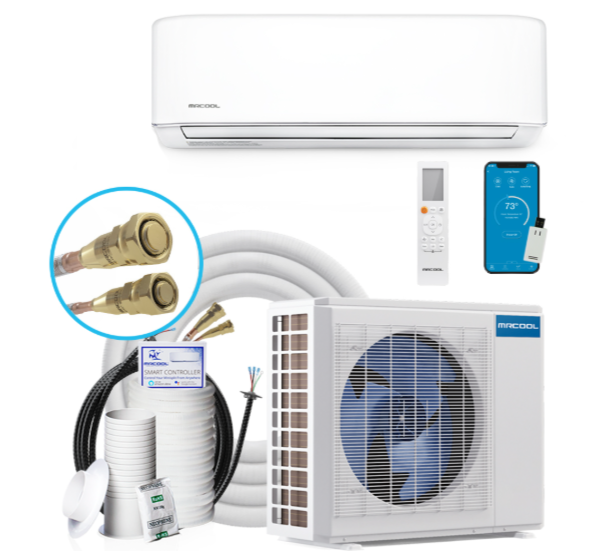
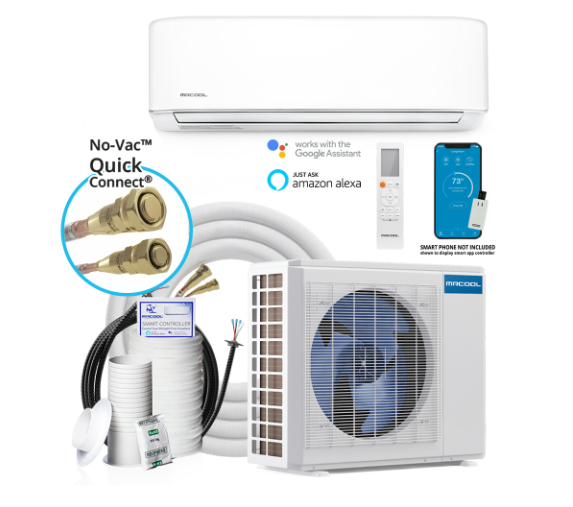
Most mini-split installs end the same way: a technician with an EPA Section 608 certification, a vacuum pump, and a manifold gauge set spends half a day connecting lines, pulling a deep vacuum, and commissioning the system. MRCOOL changed that formula. The DIY series ships with factory pre-charged refrigerant lines and Quick Connect fittings, which removes the vacuum step entirely and takes refrigerant handling out of the equation for the homeowner. No EPA 608 required. No manifold gauges. No pump. Just a torque wrench, a drill, and a few hours on a Saturday. For trade professionals, that same system means faster installs and a cleaner handoff on jobs where budget or timeline is tight. This guide covers everything needed to pick the right MRCOOL DIY unit: how the system works, the difference between generations, how to size it, what the electrical requirements actually look like, and where the DIY install ends and a licensed tech needs to take over.
What Makes the MRCOOL DIY Different
A standard ductless mini split install requires cutting and flaring copper refrigerant lines, connecting them to the system, pulling a deep vacuum with a dedicated pump to evacuate moisture and air, pressure testing, and then charging or verifying the factory refrigerant charge. Every one of those steps requires EPA Section 608 certification. The technician working without it is breaking federal law, full stop.
MRCOOL’s DIY series bypasses all of it. The refrigerant lines ship pre-charged at the factory and sealed with patented Quick Connect fittings. Connect the fittings, torque them to spec with a torque wrench, open the service valves, and the refrigerant is already in the system. No vacuum pump. No gauges. No refrigerant handling. MRCOOL is the only brand with Quick Connect valves tested and certified by Intertek, which means homeowners and contractors have documented third-party verification that the sealed installation method meets industry standards.
The 5th Generation systems use R-454B refrigerant, an A2L lower global warming potential refrigerant that replaced R-410A under the AIM Act of 2020. Older 4th Gen units used R-410A. The two refrigerants are not interchangeable, and the line sets are not swappable between generations.
4th Gen vs 5th Gen: What Actually Changed
Both generations use the same Quick Connect pre-charged line set concept. The differences are in refrigerant, efficiency, electrical, and wiring.
| Feature | 4th Gen (R-410A) | 5th Gen (R-454B) |
| Refrigerant | R-410A | R-454B (A2L, lower GWP) |
| Efficiency (single-zone 12K) | Up to 20.5 SEER | Up to 23.5 SEER2 |
| Typical 12K voltage | 208-230V | 115V or 208-230V available |
| DIYPRO Cable | Included on most models | Included, simplified wiring diagram |
| Still manufactured? | No — discontinued per AIM Act | Yes — current generation |
| Parts availability | Available for existing units | Full parts and accessory support |
| Federal tax credit eligible? | No | Yes, select 5th Gen models qualify |
| Max line set length | Up to 50 ft included kit; extensions available | Up to 75 ft total with couplers |
4th Gen units still in the field work fine and parts remain available. New purchases should always be 5th Gen. R-410A units are no longer manufactured, and a new system means R-454B.
5th Gen Single-Zone Lineup at a Glance
The 5th Gen single-zone DIY series covers five capacities. Every package includes the indoor air handler, outdoor condenser, and a 25-foot pre-charged line set with DIYPRO Armored Cable.
| BTU | Voltage | SEER2 | Coverage Estimate | SupplyHouse Link |
| 9,000 BTU | 115V | 23.6 SEER2 | ~400 sq ft | supplyhouse.com/Mr-Cool-Mini-Splits-24791000 |
| 12,000 BTU | 115V | 23.5 SEER2 | ~550 sq ft | supplyhouse.com/Mr-Cool-Mini-Splits-24791000 |
| 18,000 BTU | 208-230V | 22.5 SEER2 | ~750 sq ft | supplyhouse.com/Mr-Cool-Mini-Splits-24791000 |
| 24,000 BTU | 208-230V | 22.7 SEER2 | ~1,000 sq ft | supplyhouse.com/Mr-Cool-Mini-Splits-24791000 |
| 36,000 BTU | 208-230V | 18.0 SEER2 | ~1,500 sq ft | supplyhouse.com/Mr-Cool-Mini-Splits-24791000 |
Coverage estimates assume standard 8-foot ceilings, average insulation, and a moderate climate zone. High ceilings, poor insulation, heavy sun exposure, or extreme climates all increase the required BTU load. When in doubt, size up by one capacity step rather than down.
How to Size the Right Unit
Sizing a mini split correctly is the most important decision in the whole project. Too small and the system runs continuously without reaching setpoint. Too large and it short-cycles before removing humidity from the air, leaving the space feeling cool but clammy.
The 500-to-600 BTU-per-square-foot rule works as a starting estimate for rooms with 8-foot ceilings and average insulation in a moderate climate. Adjust from there:
- High ceilings (above 9 feet): add 10 to 20 percent to the BTU estimate
- Heavy sun exposure through large south or west windows: add 10 percent
- Garage or poorly insulated space: add 20 to 30 percent
- Very cold climates with frequent heating demand: confirm the model’s low ambient heating rating
- Server rooms or applications needing year-round cooling: look for models with low ambient cooling rated down to -5°F
The MRCOOL 5th Gen DIY lineup includes Hyper Heat models rated for heating operation down to -22°F. For most northern climate installations, confirm the condenser’s minimum operating temperature before ordering.
For precise sizing, a Manual J heat load calculation is the engineering standard. The SupplyHouse mini split sizing calculator at supplyhouse.com/sh/control/MiniSplitCalculator provides a fast starting estimate based on room dimensions.
Electrical Requirements
Getting the electrical right before the unit arrives saves a second trip. MRCOOL DIY 5th Gen units span two voltage classes depending on capacity.
| Capacity | Voltage | Typical Breaker | Notes |
| 9,000 BTU | 115V | 15A dedicated | Standard household circuit; confirm MCA on nameplate |
| 12,000 BTU | 115V | 15A dedicated | 115V availability is a 5th Gen addition; 4th Gen was 230V only |
| 18,000 BTU | 208-230V | 20A dedicated | Confirm single-phase 230V at panel before ordering |
| 24,000 BTU | 208-230V | 20-25A dedicated | Match breaker to MCA on condenser nameplate |
| 36,000 BTU | 208-230V | 30A dedicated | Larger loads require heavier wire gauge; consult NEC 440 for AC circuits |
Every MRCOOL condenser nameplate lists the Minimum Circuit Ampacity (MCA) and Maximum Overcurrent Protection (MOP). Those values override any general guidance. Wire gauge, breaker size, and disconnect selection must match the nameplate.
NEC Article 440 governs air conditioning and refrigerating equipment. The disconnect must be within sight of the condenser and rated for the load. The DIYPRO Armored Cable included with 5th Gen packages handles the communication and power wiring between indoor and outdoor units and eliminates the need for a separate electrical conduit run between them, but the dedicated breaker circuit from the panel still requires a licensed electrician in most jurisdictions.
The Quick Connect Line Set: How It Works
The pre-charged line set is the core of what makes the MRCOOL DIY installable without refrigerant certification. Here is the sequence from unboxing to a sealed system:
- Mount the indoor air handler on the wall bracket, maintaining a minimum of 6 inches clearance from the ceiling and 6 inches on each side.
- Drill the wall penetration at a slight downward pitch toward the exterior for the line set and condensate drain. Typical hole size is 3.5 inches.
- Route the pre-charged line set through the wall penetration without kinking or sharp bends. Maintain a minimum bend radius per the installation manual.
- Thread the Quick Connect fittings hand-tight at both the indoor and outdoor connections.
- Torque each fitting to the specification listed in the installation manual using a torque wrench. Hand-tight is not sufficient. MRCOOL specifies exact torque values per line size in the manual.
- Open the service valves on the outdoor condenser to release the factory charge into the system. Liquid line first, then suction line, per the manual.
- Verify connections with a soapy water spray. No bubbles at any fitting means a sealed connection. Bubbles require re-torquing or replacement fittings before proceeding.
- Restore electrical power at the breaker and commission via the remote or MRCOOL Smart HVAC app.
Line set sizing matters. 6K, 9K, and 12K air handlers use 1/4-inch by 3/8-inch line sets. 9K through 18K also support 1/4-inch by 1/2-inch sets. 18K air handlers must use 1/4-inch by 1/2-inch. 24K and 36K require 3/8-inch by 5/8-inch. Using the wrong diameter voids the warranty and affects system performance.
Standard packages include a 25-foot pre-charged line set. Maximum total system line length with extensions and approved couplers is 75 feet. Line set extensions maintain the pre-charged no-vacuum approach, so adding length does not require opening the refrigerant circuit.
Multi-Zone: Whole-Home with One Condenser
The 5th Gen MRCOOL DIY Multi-Zone series supports up to six indoor zones from a single outdoor condenser. Each indoor head connects with its own pre-charged line set, maintaining the no-vacuum DIY install method for every zone. The multi-zone system is the practical answer when a single household needs conditioned air in multiple rooms without the cost of separate condensers and disconnect boxes for each zone.
Browse the MRCOOL DIY multi-zone lineup at SupplyHouse: MRCOOL DIY Multi-Zone Systems.
One important rule: never connect a multi-zone condenser to a single indoor head. Multi-zone condensers are sized for the combined load of all connected zones and will operate inefficiently or not at all with a single indoor unit.
Where DIY Ends and a Licensed Tech Is Required
The MRCOOL DIY system genuinely eliminates refrigerant handling requirements for the homeowner. But not every part of the installation is code-clear for a non-licensed person.
| Task | DIY Permissible? | Notes |
| Mounting indoor unit | Yes | Basic carpentry; confirm wall stud or blocking for weight |
| Drilling wall penetration | Yes | Confirm no hidden wiring, plumbing, or structural members first |
| Connecting Quick Connect line sets | Yes | Follow torque specs exactly; no refrigerant handling involved |
| Opening service valves | Yes | Per installation manual; releases factory charge |
| Running DIYPRO cable (indoor to outdoor) | Yes | Included cable handles low-voltage communication and power between units |
| Installing dedicated breaker at panel | Licensed electrician typically required | NEC and most local codes require licensed electrician for panel work |
| Running new circuit wiring to disconnect | Licensed electrician typically required | Wire sizing, conduit, and terminations must meet NEC 440 and local AHJ |
| Disconnecting and disposing of old refrigerant system | EPA 608 certified tech required | Recovering refrigerant from existing systems requires certification regardless |
| Structural roof or ceiling penetration for certain cassette installs | Licensed contractor typically required | Depends on local building permit requirements |
Local building permit requirements vary. Many jurisdictions require a permit for any HVAC installation including DIY systems. Check with the local AHJ (Authority Having Jurisdiction) before starting work. Some utility rebate programs also require licensed contractor installation to qualify.
Accessories and What to Order With the System
The packaged system handles the core install. A few accessories round out a clean, code-compliant job:
- Line set cover / line hide: Protects the exterior run of refrigerant lines and communication cable from UV degradation and physical damage. MRCOOL’s LineGuard kits are sized for the DIY line set diameter.
- Condenser pad or wall bracket: The outdoor unit must sit on a stable, level surface. Concrete pads, equipment pads, and wall-mount brackets all work. Elevate the condenser at least 12 to 18 inches in snow climates to keep it above expected accumulation.
- Condensate pump: Required when the indoor unit mounts on an interior wall without a gravity drain path to the exterior. Compact units like the Aspen Mini Aqua fit inside line-hide channels for a clean install.
- Disconnect box: Required within sight of the outdoor condenser per NEC 440.14. Sized to the unit’s MOP rating.
- MRCOOL Care Kit: Coil cleaner and filter replacement kit for annual maintenance. Filters should be cleaned every 30 to 60 days under normal operation.
Browse the full MRCOOL DIY lineup at SupplyHouse: MRCOOL DIY Single-Zone Systems | MRCOOL DIY Multi-Zone Systems | All Mini Split Air Conditioners
Frequently Asked Questions
Does installing an MRCOOL DIY require EPA Section 608 certification?
No. The Quick Connect pre-charged line set approach removes refrigerant handling from the installation process. The system ships factory-charged and sealed. Connecting the fittings and opening the service valves does not involve handling or adding refrigerant, so EPA 608 certification is not required for the DIY install itself. If an existing refrigerant system is being removed or replaced, EPA 608 certification is still required to recover that refrigerant.
What is the difference between 4th Gen and 5th Gen MRCOOL DIY?
The primary differences are refrigerant type and efficiency. Fourth Gen uses R-410A and is no longer manufactured under the AIM Act of 2020. Fifth Gen uses R-454B and delivers SEER2 ratings of up to 23.6 on the 9K model. Parts for 4th Gen units remain available for existing system service. All new purchases should be 5th Gen.
Can a homeowner pull the electrical permit for an MRCOOL DIY install?
It depends on the jurisdiction. Some AHJs allow homeowner-pulled permits for work on owner-occupied single-family residences. Many require a licensed electrical contractor for any panel work, new circuit installation, or work requiring a permit. Check with the local building department before starting. Getting the permit wrong creates problems at resale and can void homeowner’s insurance coverage in the event of a claim.
What is the maximum line set length for a 5th Gen MRCOOL DIY?
Standard packages include a 25-foot pre-charged line set. Maximum total run with approved extensions and couplers is 75 feet. Extensions maintain the no-vacuum installation method. Using incompatible couplers or exceeding maximum length affects refrigerant distribution and voids the warranty.
Do MRCOOL DIY 5th Gen systems qualify for federal tax credits?
Select 5th Gen models meet ENERGY STAR and Cold Climate Heat Pump criteria and may qualify for a federal tax credit under Section 25C of the tax code. Eligibility varies by specific model and DOE regional efficiency requirements. MRCOOL publishes a rebate center with current eligibility information, and SupplyHouse product pages flag qualifying models. Always verify with a tax professional before claiming credits.
Can the 115V 12K unit run on a standard household circuit?
A dedicated 15-amp 115V circuit is required. Standard household outlets share circuits with other loads, which disqualifies them. The breaker must be dedicated to the mini split. An existing 15-amp circuit feeding only the mini split is acceptable; a shared circuit is not, regardless of the outlet voltage.
What happens if the Quick Connect fitting leaks?
A leak shows up as growing bubbles during the soapy water test after torquing. Do not attempt to over-tighten. If a fitting leaks after correct torque, the fitting or the line end needs inspection. MRCOOL’s technical support line is the correct next step before proceeding. Opening a leaking sealed system without EPA 608 certification is not permitted under the Clean Air Act.
Is the MRCOOL DIY available in a cooling-only version?
No. All current MRCOOL DIY series systems are heat pump units, providing both heating and cooling. There is no cooling-only DIY option in the current 5th Gen lineup.
How does sizing differ for a garage versus a living space?
Garages require more BTU per square foot than conditioned living spaces. Poor insulation, large uninsulated doors, and greater temperature differentials all increase the load. Plan for the BTU-per-square-foot estimate to run 25 to 30 percent higher than for a similarly sized living room. If the garage will function as a workshop or gym with sustained occupancy, size up again. A 24K unit covering roughly 1,000 square feet in a house may only cover 700 to 800 square feet in a poorly insulated garage.
Do I need a condensate pump with every MRCOOL DIY install?
No. If the indoor unit mounts on an exterior wall or near an interior wall with a direct path downward to an exterior drain point, gravity drainage works without a pump. A condensate pump is necessary when the unit mounts on an interior wall without a gravity drain route, when the drain run has to travel upward at any point, or when the drain line has to travel a long horizontal distance before finding a drop. The indoor unit produces condensate in cooling mode and in defrost mode during heating season.
DIY Done Right
The MRCOOL DIY series solves the problem that kept homeowners and budget-minded contractors out of ductless mini splits for decades: refrigerant handling. The Quick Connect pre-charged line set removes EPA 608 from the equation for the installation itself, which opens single-zone and multi-zone comfort to anyone willing to mount a bracket, drill a hole, and torque a fitting correctly.
Picking the right unit means getting three things right: BTU capacity matched to the actual space, voltage matched to the available circuit, and generation matched to current standards. All new purchases are 5th Gen R-454B. The 9K and 12K units run on 115V, which is a meaningful simplification for older homes without easy access to a 230V circuit. The 18K through 36K units require 230V dedicated circuits and a licensed electrician for panel work in most jurisdictions.
Browse the current MRCOOL DIY lineup, including single-zone and multi-zone systems, at SupplyHouse: MRCOOL DIY Single-Zone and MRCOOL DIY Multi-Zone. The full ductless category, including all brands and configurations, lives at Mini Split Air Conditioners.