
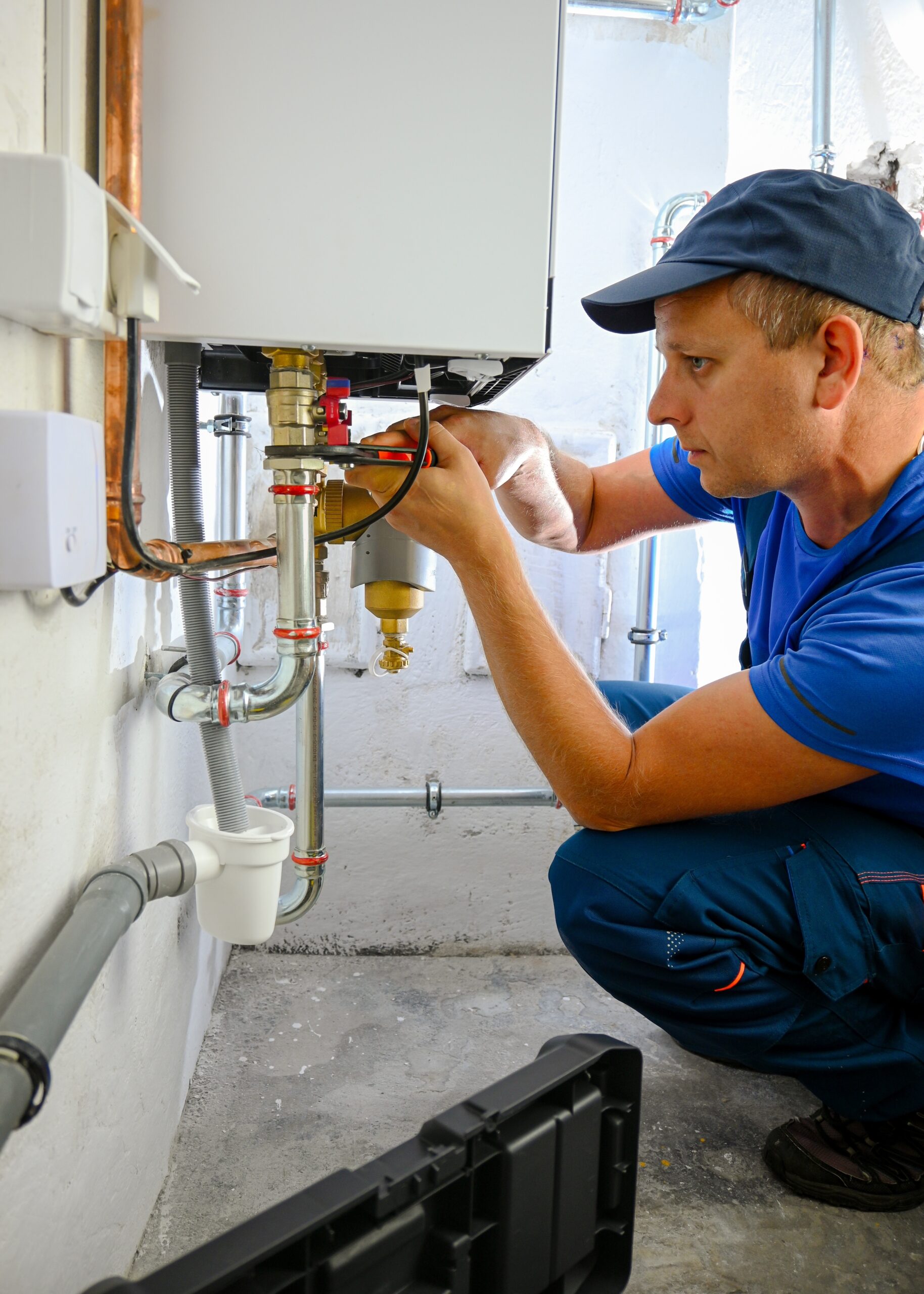
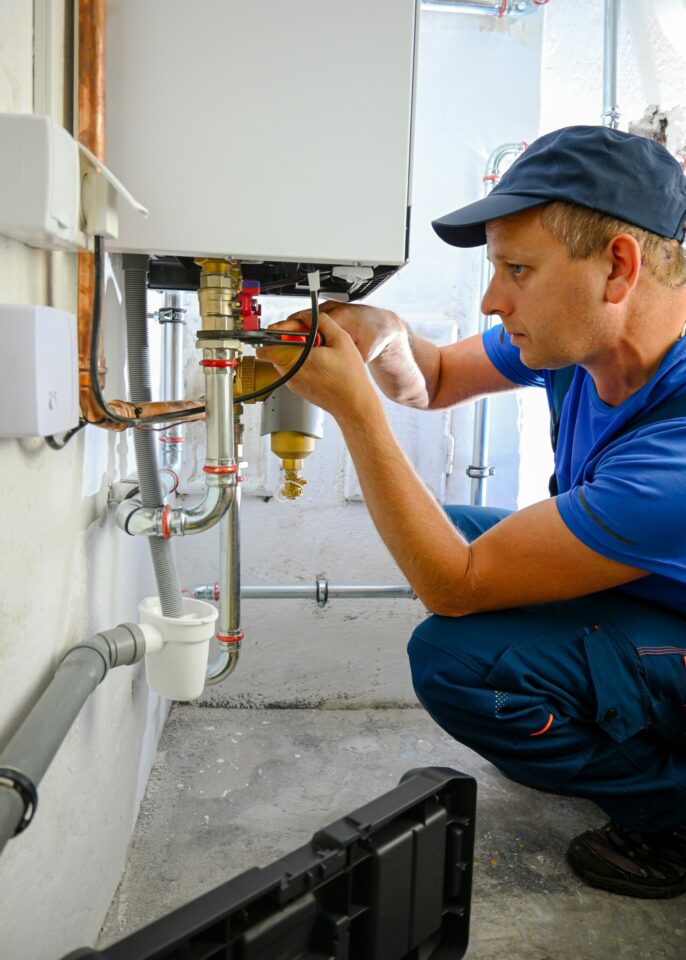
An older cast iron boiler with a 70% AFUE rating is sitting in the mechanical room. It fires, it heats the house, it sheds roughly 30 cents of every fuel dollar straight up the flue as hot exhaust. Nobody thinks about it. Then a callback comes in on a cold January night and the conversation about replacement begins. At that point, the question isn’t whether to upgrade, it’s whether to understand what the upgrade actually does, because a condensing boiler isn’t just a newer version of the same machine. The physics are different, the installation requirements are different, and the real efficiency gains only show up when the system is designed to let them happen.
The guide below explains how condensing boilers work at a mechanical level, what separates them from conventional units, how to get them into true condensing mode, and what the installation details look like on a real job.
The Fundamental Difference: Two Heat Exchangers, Not One
A conventional boiler uses a single heat exchanger. Combustion happens, hot flue gas transfers heat into the water loop, and whatever’s left in the exhaust heads up the flue at temperatures between 300 and 400 degrees F. That energy leaves the building. It’s gone. Nothing can be done with it after that point.
A condensing boiler adds a secondary heat exchanger downstream of the primary one. Flue gas, after giving up most of its sensible heat in the first pass, enters this second exchanger at a much lower temperature. If the return water coming back from the distribution system is cold enough, specifically below the dew point of the flue gas, the water vapor in the exhaust condenses into liquid. That phase change releases latent heat, and that latent heat transfers into the heating loop instead of leaving with the exhaust.
The DOE’s Advanced Manufacturing Office confirms the dew point of natural gas combustion products sits at approximately 135 degrees F. When return water temperature falls below that threshold, condensation begins. According to technical data from R.F. MacDonald Co., each pound of condensate formed transfers approximately 970 BTUs of latent energy back into the system at no additional gas cost. When every pound of methane burns, it produces roughly 2.25 pounds of water vapor. That’s a substantial pool of recoverable energy sitting in the exhaust of every conventional boiler that’s wasting it.
The condensate itself drains out of the boiler through a designated condensate port, which is why every condensing boiler installation requires a condensate management plan. More on that below.
Condensing vs. Conventional Boiler: Key Comparison
| Feature | Conventional Boiler | Condensing Boiler |
| Heat exchangers | One (primary only) | Two (primary + secondary) |
| Flue gas exit temp | 300-400 degrees F | 80-120 degrees F (condensing mode) |
| Latent heat recovery | None | Up to 970 BTU/lb of condensate |
| AFUE range | 80-85% | 90-98%+ |
| Vent material | Type B gas vent or liner | PVC, CPVC, or polypropylene (Category IV) |
| Condensate handling | Not required | Required (neutralizer + drain) |
| Best matched emitter | Fin-tube baseboard at 180 degrees F | Radiant floors, oversized emitters at 100-130 degrees F |
AFUE Ratings: What the Number Means in Real Operation
Annual Fuel Utilization Efficiency, or AFUE, measures how much of the fuel energy consumed by a boiler ends up as useful heat over a full heating season. A 95% AFUE rating means 5% of input energy is lost. The methodology comes from ASHRAE Standard 103.
The number on the spec sheet is a useful starting point, but it doesn’t capture the full picture in the field. A condensing boiler rated at 95% AFUE earns that number under specific test conditions, typically with a 140-degree F supply temperature. Operate that same boiler with a constant 180-degree F supply all season, and the real efficiency drops closer to 85%, because the return water never gets cold enough to trigger condensation. Efficiency data from HPAC Magazine and kW Engineering both confirm this operating range: 85% on the low end with high constant water temperatures, up to 97-98% when return water stays at or below 80 degrees F.
The DOE Zero Energy Ready Home program sets minimum AFUE thresholds by climate zone, per the Building America Solution Center:
- Climate Zones 1-2: 80% AFUE minimum
- Climate Zones 3-4 (non-marine): 90% AFUE minimum
- Climate Zones 5-8 and marine Climate Zone 4: 94% AFUE minimum
In most northern states, a condensing unit isn’t just the better choice. In many new construction and replacement scenarios, it’s the minimum that meets code.
How to Actually Get a Condensing Boiler Into Condensing Mode
Replacing a cast iron boiler with a condensing unit and calling it done is the setup for a callback. The boiler’s efficiency potential is capped by the distribution system around it. If the system feeds 180-degree F water through undersized baseboard and returns at 160 degrees F, condensation never happens. The unit runs as an expensive non-condensing boiler.
According to data from both the Building America Solution Center and kW Engineering, return water temperature must fall below approximately 130 degrees F for condensation to begin, and below 80 degrees F to approach peak efficiency. Getting there requires attention to emitter sizing, supply temperature, and controls.
Low-Temperature Emitters
Radiant floor systems are the best-matched load for a condensing boiler. Supply temperatures typically run between 100 and 130 degrees F, which keeps return temps in the 80-110-degree F range throughout most of the heating season, well below the condensing threshold. The system operates in condensing mode essentially all the time.
Fin-tube baseboard is more complicated. Standard baseboard sized for 180-degree F water won’t give up enough heat at 120 degrees F to maintain comfort. Oversizing the baseboard, by roughly 50% or more relative to standard calculations, allows the system to deliver the required BTUs at lower supply temperatures and still return water cold enough to condense. Panel radiators behave more linearly across a wide temperature range and can be sized to work with condensing-compatible supply temperatures with less oversizing required.
Outdoor Reset Control
Outdoor reset is the control strategy that makes condensing boilers perform across the entire heating season, not just on the coldest days. The control modulates supply water temperature based on outdoor temperature. On a mild 45-degree F day, a system that would otherwise run at 180 degrees F can drop to 120 or 130 degrees F because the building doesn’t need the full load. That cooler supply produces a cooler return, which keeps the boiler condensing.
HPAC Magazine’s technical coverage of outdoor reset puts typical energy savings from weather-responsive controls at 5-30%, with the added benefit of reduced short cycling and longer equipment life. When designing the reset curve for a condensing boiler, the Building America Solution Center recommends setting control points so return water stays below 130 degrees F. That requires sizing emitters to deliver the required heat output at the lower supply temperatures the reset curve will produce.
Venting Requirements: Category IV is Not Optional
Conventional boilers vent as Category I appliances, with hot, buoyant exhaust that naturally drafts through Type B gas vent or a masonry liner. Condensing boilers are Category IV: positive-pressure exhaust, with flue gas cool enough to condense in the vent pipe. Type B vent and masonry liners can’t handle either the moisture or the positive pressure. The wrong vent material on a condensing boiler isn’t a code technicality. It’s a safety issue.
Acceptable vent materials for condensing hydronic boilers include PVC, CPVC, and polypropylene. Each comes with constraints:
- PVC (Schedule 40): rated approximately 140-158 degrees F depending on manufacturer. Acceptable for many residential condensing boiler applications where exhaust temps stay low, but not universally listed for Category IV appliances in the U.S. Always verify with the specific boiler IOM before specifying.
- CPVC: rated to approximately 180 degrees F. Accepted by a wider range of manufacturers. Some require CPVC for the first 30 inches of vent pipe adjacent to the boiler, transitioning to PVC downstream where temps are lower.
- Polypropylene: rated to approximately 180 degrees F. Listed by most major condensing boiler manufacturers. Gasketed connections reduce solvent cement variables. R.L. Deppmann recommends polypropylene or AL29-4C stainless as the preferred materials for condensing applications, particularly in high-delta-T systems.
Slope matters on all plastic vent material. Rinnai’s installation documentation specifies a minimum 1/4-inch-per-foot slope on PVC/CPVC horizontal runs, pitching back toward the boiler so condensate in the vent drains back to the condensate collection point rather than pooling in the pipe. Polypropylene runs call for 5/8-inch-per-foot slope. Sagging horizontal sections pool condensate and corrode over time.
Always follow the specific manufacturer’s IOM. Vent material approvals are model-specific. What’s listed for a Lochinvar Knight may not be listed for a Weil-McLain Ultra.
Vent Material Quick Reference
| Material | Max Temp Rating | U.S. Category IV Listed | Notes |
| PVC Sch. 40 | 140-158 degrees F | Not universally listed | Confirm with boiler IOM |
| CPVC | ~180 degrees F | Not universally listed | Required at boiler outlet by some mfrs. |
| Polypropylene | ~180 degrees F | Widely accepted | Gasketed; preferred by Deppmann |
| AL29-4C Stainless | Highest | Yes | Best for high-delta-T systems |
Condensate Management: The Part That Trips Up Retrofits
A condensing boiler running on natural gas at 95%+ efficiency produces meaningful quantities of condensate. As a rule of thumb, a 100,000 BTU unit operating at high efficiency generates roughly a pint of condensate per hour. Over a full heating season, that’s hundreds of gallons of acidic water that needs a place to go.
The condensate is acidic. Plumbing & Mechanical Magazine’s technical coverage cites pH values ranging from 1.8 to 4.2 for raw condensate from condensing appliances. For context, vinegar sits around pH 3. Most municipalities and plumbing codes prohibit discharge of liquids below pH 5.5 or 6 into the sewer system without treatment. Some jurisdictions require neutralization; others don’t explicitly, but the corrosive potential for copper drain lines and cast iron sewer piping makes it a smart call regardless.
The standard fix is a condensate neutralizer packed with calcite media (crushed limestone). The acidic water contacts the calcite, which raises the pH to an acceptable range before the condensate reaches the drain. Neutralizer media needs annual replacement. Neglected media turns to sludge, backs up the condensate line, and can flood the heat exchanger.
If gravity can’t carry condensate to the nearest drain, a condensate pump handles the lift. The pump should be paired with an overflow safety switch wired to interrupt the thermostat call so the boiler shuts down rather than flooding the mechanical room if the pump fails or the line backs up.
Available condensate management options on SupplyHouse:
Axiom NT15 NeutraPro Condensate Neutralization Tank
Full Condensate Neutralization Tanks
Modulating Burners and Turndown Ratio
Most residential condensing boilers sold today are modulating-condensing units, often called mod-cons. Instead of firing at full capacity or not at all, a modulating burner can throttle its output across a range, typically expressed as a turndown ratio. A boiler with a 5:1 turndown ratio can reduce its output to 20% of its maximum capacity. A unit with a 10:1 turndown can drop all the way to 10%.
Higher turndown ratios matter for two reasons. First, a boiler that can match a small heating load without short cycling runs longer per start, which improves average efficiency and reduces wear on ignition components. Second, at lower firing rates, the flue gas temperature drops further, which means return water temperature can achieve condensation more easily. Efficiency data cited in HPAC Magazine confirms that lower modulation rates and lower return water temperatures compound each other, pushing thermal efficiency further up the curve.
Pairing a modulating condensing boiler with outdoor reset controls lets the control system lower both the firing rate and supply water temperature on mild days, which is exactly the operating condition where condensing efficiency peaks.
Is a Condensing Boiler Worth the Upgrade?
That depends on the system the boiler goes into. A condensing boiler dropped into a system that returns 160-degree F water all winter never reaches its rated efficiency. But a system designed around low-temperature emitters, properly sized distribution, and outdoor reset controls can capture most of what the spec sheet promises.
The strongest case for the upgrade:
- Radiant floor heating: supply temperatures of 100-130 degrees F produce return temps well below the condensing threshold essentially all season.
- Oversized baseboard or panel radiators: with appropriate emitter sizing, baseboard systems can achieve condensing-range return temps for most of the heating season.
- Older systems with high fuel consumption: the efficiency delta between a 70% AFUE cast iron boiler and a 94%+ condensing unit is substantial enough to produce meaningful payback on the efficiency gain alone.
- New construction: designing the distribution system from scratch around low-temperature operation costs nothing extra and maximizes efficiency from day one.
The weaker case:
- High-temperature baseboard sized for 180 degrees F supply that can’t be replaced: the boiler fires in non-condensing mode most of the season.
- Steam systems: condensing boilers don’t work with steam distribution.
- Very short vent runs or existing venting that can’t be replaced: vent replacement adds cost that may shift the payback calculation.
Installation Checklist for a Condensing Boiler Retrofit
These are the steps that separate a clean install from a callback:
- Calculate the heat loss first. Don’t guess at BTU requirements. Size the boiler to the actual load, not the old boiler’s nameplate. Use the SupplyHouse Boiler BTU Calculator to get a starting point before pulling the trigger on a unit.
- Verify emitter sizing. If the distribution system runs fin-tube baseboard at 180 degrees F, calculate whether existing emitters can deliver the required heat output at 120-130 degrees F. Upsize if necessary.
- Select venting material and confirm it’s listed for the specific boiler model. Check the IOM. Don’t assume.
- Plan the condensate drain route before roughing in. Determine whether gravity can carry condensate to the nearest floor drain, or whether a condensate pump is needed.
- Install a condensate neutralizer. Even where codes don’t explicitly require it, protecting the drain system from acidic condensate is straightforward and inexpensive.
- Install an expansion tank sized for the system. Condensing boilers are closed systems. Verify the existing expansion tank (if any) is correctly sized for the new loop volume and operating temperature range.
- Commission outdoor reset if the unit supports it. Set the reset curve so return water stays below 130 degrees F across the expected temperature range.
- Verify combustion. Most condensing boilers have built-in diagnostics and a combustion analysis port. Confirm CO2 and O2 are within spec at high and low fire before leaving the job.
FAQs
What does a condensing boiler condense?
Water vapor in the flue gas. When the return water temperature drops below the dew point of the exhaust (approximately 135 degrees F for natural gas), water vapor condenses into liquid inside the secondary heat exchanger. That phase change releases latent heat, which transfers into the heating loop instead of leaving with the exhaust.
How much more efficient is a condensing boiler than a conventional one?
Conventional gas boilers typically run at 80-85% AFUE. Condensing units range from 90 to 98%+ AFUE depending on return water temperature. The efficiency gap narrows significantly if the system isn’t designed for low-temperature operation.
Does a condensing boiler always condense?
No. Condensation only occurs when return water falls below approximately 130-135 degrees F. A condensing boiler feeding a standard 180-degree F baseboard system runs in non-condensing mode and achieves roughly 85% efficiency, not the 95%+ on the nameplate. System design determines whether the efficiency rating is realizable.
What emitters work best with condensing boilers?
Radiant floor systems are the ideal match. They operate at supply temperatures of 100-130 degrees F, which keeps return temps comfortably below the condensing threshold year-round. Oversized fin-tube baseboard and panel radiators can also work if sized to deliver the required heat output at lower supply temperatures.
What venting material does a condensing boiler use?
Condensing boilers are Category IV appliances, which means positive-pressure, low-temperature, condensing exhaust. They require plastic or polypropylene vent material, not Type B gas vent or masonry liners. Acceptable materials include CPVC, polypropylene, and in some applications PVC, depending on the boiler manufacturer’s specific listing. Always check the IOM.
What is outdoor reset and why does it matter for a condensing boiler?
Outdoor reset modulates supply water temperature based on outdoor conditions. On a mild day, the control lowers supply temperature because the building doesn’t need maximum heat output. Lower supply temperature produces lower return temperature, which keeps the boiler condensing more hours per season. HPAC Magazine data puts outdoor reset energy savings at 5-30% annually.
Does a condensing boiler need a condensate drain?
Yes. A condensing boiler produces liquid condensate that must drain continuously. The condensate is acidic (pH 1.8-4.2) and typically requires a neutralizer before discharge. Most jurisdictions require discharge to an approved drain point, not outdoors, which can freeze.
Can a condensing boiler work with existing baseboard?
It can, but the efficiency gain depends on whether the baseboard can deliver adequate heat output at lower supply temperatures. Standard baseboard sized for 180 degrees F won’t give up enough heat at 120 degrees F. Oversizing the baseboard by roughly 50% allows the system to run at lower temperatures while still meeting the load.
What is a modulating condensing boiler?
A mod-con boiler can vary its firing rate across a range rather than operating at full capacity or off. Turndown ratios of 5:1 to 10:1 are common. At lower firing rates, flue temperatures drop, which makes condensing operation easier to sustain even when return water temperatures are marginally above the condensing threshold.
What ongoing maintenance does a condensing boiler require?
Annual tune-ups covering heat exchanger inspection, combustion analysis, and burner performance. Condensate neutralizer media needs replacement approximately once per year, more frequently on high-output units. Vent connections should be inspected for leaks and proper slope. The expansion tank should be checked for correct pre-charge pressure.
Making Every BTU Count
An older boiler running at 70% AFUE is leaving real fuel savings on the table, season after season. The math is straightforward. The equipment to fix it exists. But a condensing boiler is only as efficient as the system it operates in. Get the return water temperatures low, pick the right emitters, add outdoor reset, handle the condensate correctly, and the spec sheet efficiency is achievable in the field. Skip any of those steps, and the investment underperforms.
For the full range of condensing boilers, combination units, and wall-mounted options, browse the categories below.
Condensing Boilers | High Efficiency Gas Boilers | Combination Boilers | Wall Mounted Boilers | Expansion Tanks | Condensate Neutralization Tanks |