
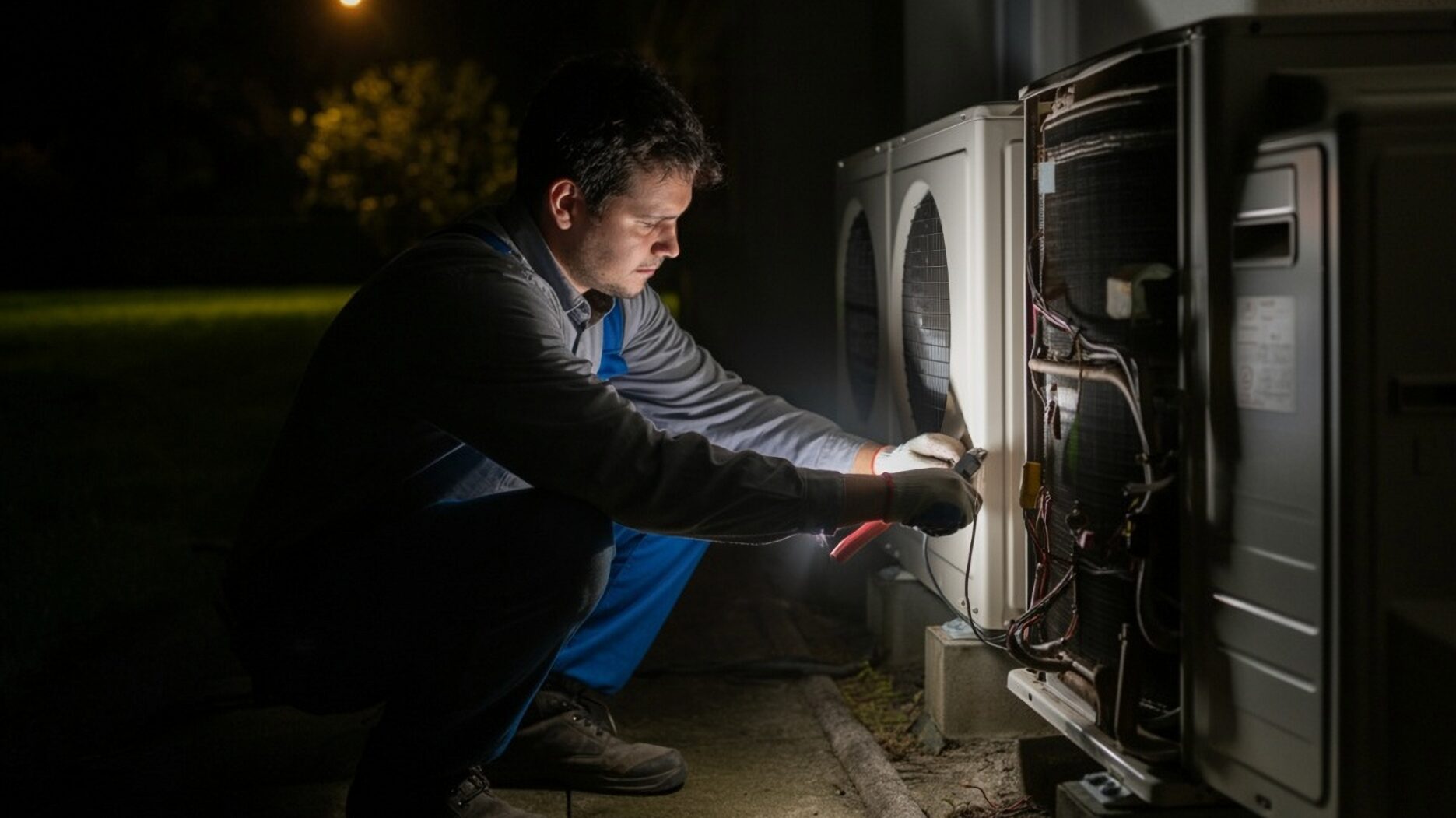
A burst pipe doesn’t wait for business hours. Neither does a furnace that quits in January or an outage in the middle of a heat wave. For the people who fix those problems, after-hours work is just part of the job and a real piece of the paycheck.
We surveyed 303 skilled trades workers to find out how much of their work, revenue, and personal time happens off the clock. Nights, weekends, and bad weather drive a steady share of what they earn, most pros charge something extra for it, and plenty of them have skipped a holiday to answer the phone.
Key Takeaways
- Skilled tradespeople earn 22% of their annual revenue from after-hours service calls, on average.
- More than three-quarters (77%) agree customers expect 24/7 availability whether the business officially offers it or not.
- Sixty percent say staffing shortages have made reliable after-hours service harder to deliver, and a third (33%) turn down at least a quarter of after-hours requests for lack of staff, parts, or energy.
- More than half (54%) say they or their team feel burned out from after-hours and emergency calls.
- Half of trades workers (51%) have missed a holiday or major family event because of an after-hours or emergency call.
Nights, Weekends, and the Money They Bring In
After-hours work isn’t a side note for most pros; it’s a measurable slice of the books, and it shows up on every part of the calendar.
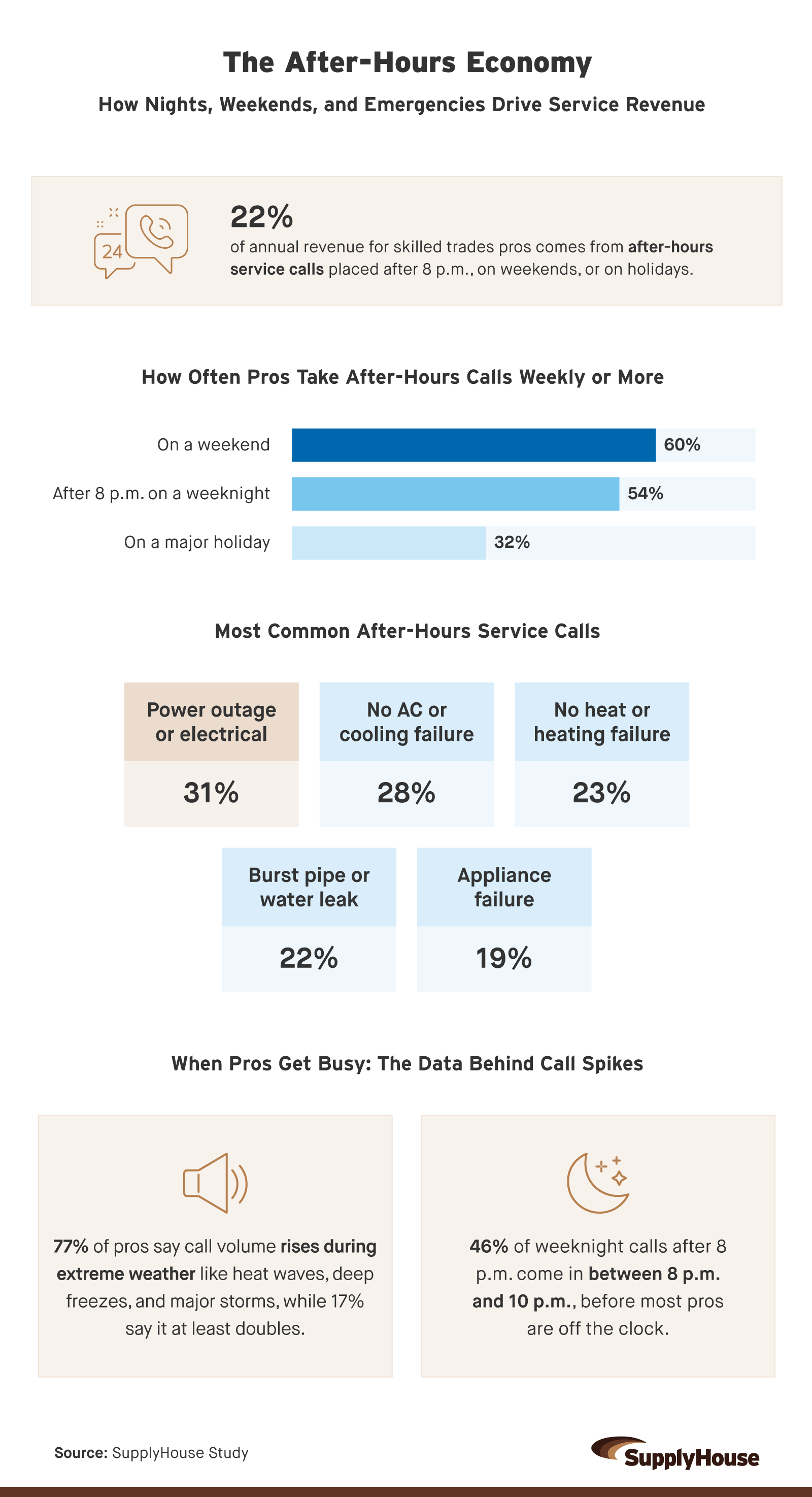
- After-hours work makes up 22% of annual revenue on average, and for nearly 1 in 3 pros (32%), it accounts for at least a quarter of everything they bring in.
- The calls land across the week and the year: 60% take weekend calls at least weekly, 54% field weeknight calls after 8 p.m. at least weekly, and 32% work major holidays that often.
- When a weeknight call does come in after 8 p.m., it usually comes early. Specifically, 46% of pros say most arrive between 8 and 10 p.m., before a lot of people have even wound down for the night, and another 14% come between 10 p.m. and midnight.
- The most common reasons people call after hours are power outages and electrical problems (31%), no AC (28%), no heat (23%), burst pipes (22%), and appliance failures (19%).
- Weather is a major driver; 77% of pros see call volume climb during heat waves, deep freezes, and major storms, and 17% see call volume at least double.
- The hit isn’t even across trades: 92% of HVAC pros and 91% of electricians see volume rise in severe weather, and 34% of electricians say it at least doubles, the highest of any trade.
The Real Cost of the On-Call Life
Charging for off-hours work is common. Charging enough to make it worth the strain is another question.
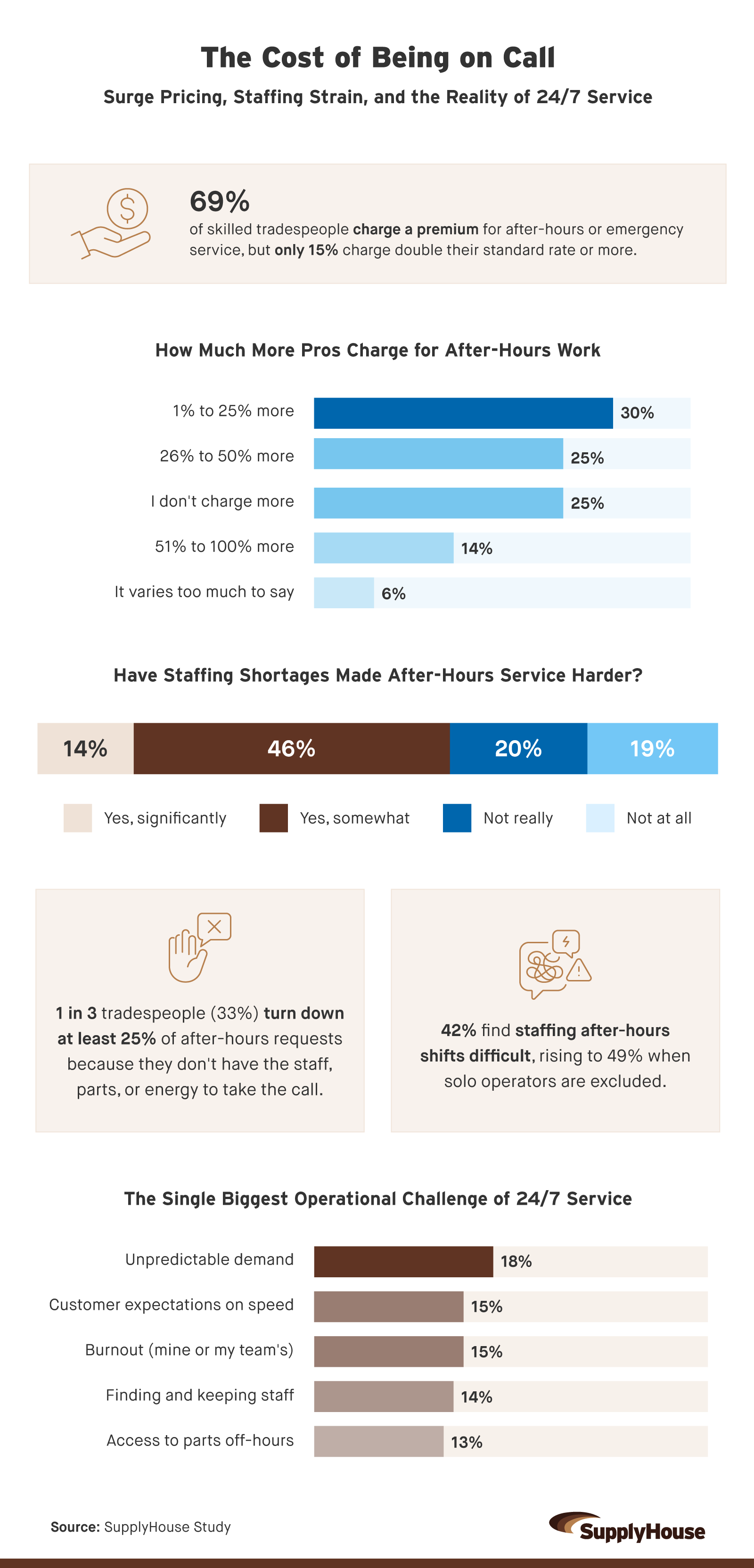
- Most pros do mark it up: 69% charge a premium for after-hours or emergency service. But only 15% charge double their standard rate or more, and a full 25% don’t charge anything extra at all.
- When they do raise the rate, the bump tends to be modest; 30% charge 1% to 25% more, and 25% charge 26% to 50% more.
- Staffing is the pressure point, as 60% say shortages have made reliable after-hours service harder, with 46% saying somewhat and 14% saying significantly. Among pros who don’t work alone, 49% say covering after-hours shifts is at least somewhat difficult.
- One-third (33%) turn down at least a quarter of their after-hours requests because they don’t have the staff, parts, or energy to take the call. On average, pros say no to 21% of what comes in.
- Asked for the single biggest operational headache of running 24/7 service, pros point to unpredictable demand (18%), customer expectations on speed (15%), and burnout (15%); staffing and overtime costs add another 25% combined.
- Some trades carry the premium more than others. Plumbers are the most likely to charge extra (86%), followed by HVAC (83%) and electricians (77%).
- Mid-size shops feel the staffing squeeze hardest: 84% of businesses with 26 to 50 employees say shortages have made after-hours service harder, versus 12% of solo operators.
The Personal Price of Always Being Available
The revenue is real, and so is what it costs at home. For a lot of pros, answering an after-hours call means missing a family dinner or holiday they’d been counting on, and those misses add up over the years.
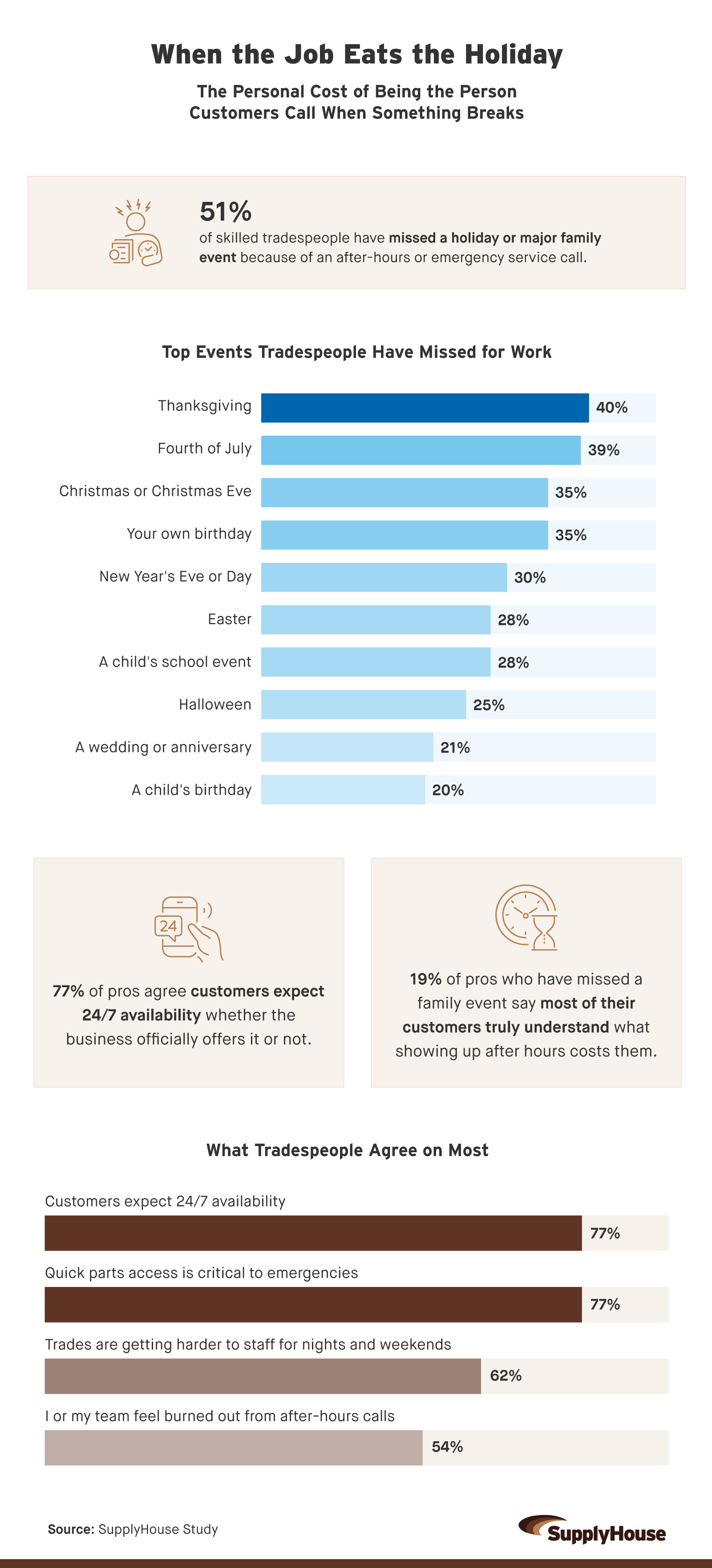
- Half of trades workers (51%) have missed a holiday or major family event because of a service call.
- Among those who’ve missed something, Thanksgiving tops the list (40%), followed by the Fourth of July (39%), Christmas (35%), and their own birthday (35%).
- It goes well beyond holidays: 28% have missed a child’s school event or performance, 21% a wedding or anniversary, and 13% a funeral or memorial.
- Only 19% of pros who’ve missed a family event say most of their customers truly understand what showing up after hours costs them.
- The expectation runs deep as 77% say customers expect 24/7 availability whether they offer it or not, and the same share (77%) say quick access to parts and supplies is critical to handling emergency calls.
- The strain shows: 54% say they or their team feel burned out from after-hours and emergency work, and 62% say the trades are getting harder to staff for nights and weekends.
- HVAC pros pay the steepest personal price, as 68% have missed a holiday or major family event, compared with 46% of general contractors and 32% of pros in other trades. Every plumber surveyed (100%) agreed customers expect them to be available around the clock.
- On average, pros say just 30% of their typical-week after-hours calls are true emergencies, meaning active damage, a safety risk, or a problem that genuinely can’t wait until morning. The other 70% are convenience calls.
One last word from SupplyHouse: to every pro who has answered the phone on a holiday, headed out on a freezing night, or given up a weekend to keep a home running, thank you. The work you do off the clock keeps families warm, safe, and dry, and it rarely gets the recognition it deserves. We see it, and we’re grateful for it.
Methodology
We surveyed 303 skilled trades workers across the United States to understand how nights, weekends, holidays, and severe weather shape their work and revenue. Respondents were screened to confirm employment in the skilled trades. Here’s the breakdown:
- Trade. General contracting and handyman (33%), HVAC (21%), other trades (18%), electrical (12%), appliance repair (8%), plumbing (7%), and roofing (1%).
- Generation. Millennial (55%), Gen X (23%), Gen Z (18%), and baby boomers (4%).
- Gender. Men (58%), women (40%), and non-binary (2%).
- Business size. Two to five employees (25%), 11 to 25 (21%), 6 to 10 (21%), solo operators (14%), more than 100 (7%), 26 to 50 (6%), and 51 to 100 (6%).
The survey data was collected between May 21st and May 25th, 2026.
About SupplyHouse
SupplyHouse is a trades-first online supplier built for people who work with their hands and don’t have time to mess around. We pair deep product knowledge with fast, nationwide delivery and straight-talk communication, so buying things like plumbing supplies and HVAC parts stays simple and reliable. Whether you’re bouncing between jobs or knocking out a project at home, we make it easy to find the right parts, check specs quickly, and get what you need when you need it.
Fair Use Statement
This article is based on original survey research and may be used for noncommercial purposes. If you share these findings, please include proper attribution with a link back to SupplyHouse.