

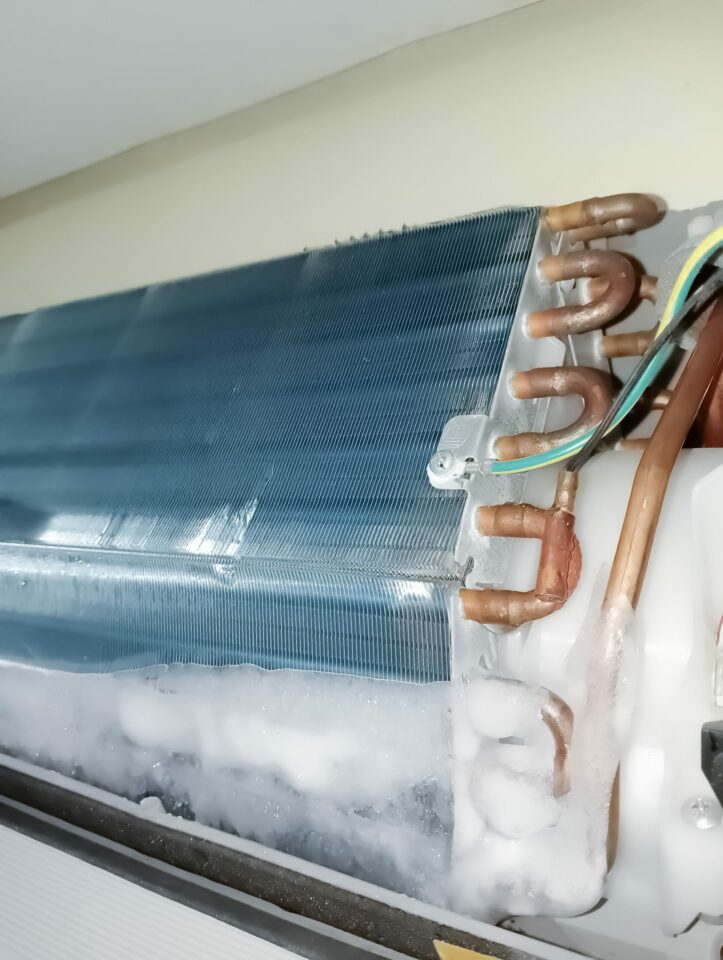
A frozen evaporator coil is one of those HVAC problems that looks self-explanatory but is not. Cold coil, ice present, seems like the system is working too well. When the evaporator coil ices over, it stops absorbing heat from the air. The AC stops cooling. Running the compressor against a completely blocked coil then risks permanent damage.
What the Evaporator Coil Actually Does
The evaporator coil sits inside the air handler. Refrigerant inside the coil evaporates at low pressure, absorbing heat from the warm room air blown across the coil surface by the blower. The coil surface typically operates around 35 to 45 degrees F during normal cooling mode. When the coil drops below 32 degrees F, moisture in the airflow freezes on contact. Once ice starts forming, it insulates the coil further, blocks airflow, and the problem compounds rapidly.
The Three Root Causes of a Frozen Coil
Restricted Airflow
Restricted airflow is responsible for the majority of residential frozen coil events. Without adequate airflow, less heat reaches the coil per unit of time. Refrigerant continues evaporating, coil temperature drops, and eventually hits the freezing point.
Common airflow restriction sources:
- Severely clogged air filter (the most common cause by far)
- Closed or blocked supply vents
- Blocked return air grilles
- Collapsed or kinked flex duct
- Dirty evaporator coil itself
Replacement air filters at SupplyHouse are available in all common sizes and MERV ratings: browse air filters here.
Low Refrigerant (Leak)
When refrigerant charge is low due to a leak, system pressure drops. Lower pressure means lower evaporation temperature, sometimes well below 32 degrees F. A refrigerant leak is confirmed when the coil refreezes within 24 hours after thawing and fixing the filter. Refrigerant leaks require a licensed HVAC technician.
Running the AC in Cold Outdoor Temperatures
Most residential central AC systems are not designed to operate in cooling mode when outdoor temperatures are below about 60 degrees F. At low ambient temps, refrigerant does not return to the condenser warm enough to complete the heat exchange cycle properly. The fix: do not run central air conditioning for cooling when outdoor temperatures are below 60 degrees F.
Symptoms and Diagnosis
| Symptom | Likely Indication |
|---|---|
| Weak airflow from all registers | Coil partially or fully frozen |
| Warm air from supply registers | Coil frozen, blocking heat exchange |
| Ice visible on copper refrigerant lines | Coil frozen (advanced stage) |
| Water pooling under air handler | Melting ice from frozen coil |
| System runs constantly, no cooling | Frozen coil or low refrigerant |
How to Thaw a Frozen Coil Correctly
- Shut off the AC completely at the thermostat.
- Switch the fan to “on” or “fan only” mode. Moving warm room air over the coil is the most efficient thaw method. Most coils thaw within two to four hours.
- Lay towels around the base of the air handler. There will be water as ice melts.
- Fix the underlying cause before restarting. Replace the air filter. Check that all supply and return vents are fully open.
- Restart and monitor. If the coil refreezes within 24 hours, call a licensed technician.
What not to do:
- Do not use a hair dryer or heat gun to speed thawing
- Do not keep running the AC to “melt the ice” — compressor damage risk is real
- Do not ignore it and wait
Prevention Checklist
- Replace air filters every 30 to 60 days during cooling season
- Keep all supply and return vents fully open
- Schedule a pre-season tune-up including refrigerant level check and coil inspection
- Do not run the AC in cooling mode when outdoor temps are below 60 degrees F
- Check the condensate drain line at the start of each season
Frequently Asked Questions
Can a frozen AC coil damage the compressor?
Yes. Running the compressor while the evaporator coil is frozen forces it to work against a blocked refrigerant circuit. In severe cases, liquid refrigerant returns to the compressor causing immediate and often irreparable damage.
How long does it take an AC coil to thaw?
With the fan running on fan-only mode, most frozen coils thaw within two to four hours. Heavy ice accumulation can take longer. Do not rush it with a heat gun.
Why does the coil keep freezing even after the filter is replaced?
Repeated freezing after a clean filter and open vents points to low refrigerant from a leak. A licensed HVAC technician needs to locate the leak, repair it, and recharge the system.
Is a frozen coil covered by AC warranty?
Typically not as a standalone claim. It is usually a symptom of a maintenance issue or a covered component failure. Check the specific warranty terms. Running the system with a known frozen coil and causing compressor damage may void coverage.
How much does it cost to fix a frozen AC coil professionally?
If the cause is a dirty filter: nothing beyond the filter cost. If the cause is a refrigerant leak, expect $150 to $400 to locate and repair the leak, plus $50 to $100 per pound of refrigerant for recharging. Compressor damage from running a frozen system costs $1,200 to $2,500 in parts.
Does a frozen coil mean the AC needs to be replaced?
Not necessarily. If the cause is a clogged filter or a repairable refrigerant leak, the issue is fully fixable. Replacement becomes relevant if the leak is in the coil itself and the repair cost exceeds 30 to 50% of a replacement system price, or if the system is already 10-plus years old.
If the coil keeps freezing after fixing the filter, what is next?
Refrigerant. A coil that freezes repeatedly after the filter is clean and vents are open almost always indicates low refrigerant due to a leak. A licensed HVAC technician needs to diagnose and repair it.
A frozen evaporator coil is almost always caused by one of three things: a clogged filter, low refrigerant from a leak, or running the system in cold outdoor temperatures. The thaw process is simple (fan-only mode for two to four hours), but the real work is finding and fixing the underlying cause before restarting. Most frozen coil events are preventable with a fresh filter, open vents, and an annual pre-season refrigerant check. Keep a stock of the right filter size on hand at all times, available at SupplyHouse in every common size and MERV rating.