
Every service plumber knows the restaurant that calls back. The cable went through in ten minutes, the sink drained, the owner said thanks. Three weeks later, same sink, same Friday-night panic. Nothing went wrong on the first visit, exactly. The cable just did what cables do: it punched a hole and left the rest of the grease on the walls.
Trade coverage keeps landing on the same fix. Contractor Magazine’s October look at the jetting boom reports that more shops now reach for high-pressure water first on grease, sludge, sand, and ice, and keep the cable machine for roots and hard obstructions. Worth noting up front: the piece was written by a jetter manufacturer’s marketing lead, so we’ve cross-checked the technical points against older independent coverage below. The trend holds up. So does the business case.
Why Grease Keeps Coming Back
The October article calls it a “self-healing stoppage,” and the name fits. A cable bores through the middle of a grease blockage, but the coating stays stuck to the pipe wall. Warm water and food waste keep feeding it, and the line closes back up.
A jetter works the wall, not just the center. Pressure lifts the buildup off the pipe, and flow carries it downstream and out. Wall-to-wall clean means the stoppage has nothing left to rebuild from.
The same coverage points to where jetters are earning their keep right now:
- Restaurants and food service kitchens
- Hotels and multifamily housing
- Hospitals and care facilities
- Schools, factories, shopping centers, and arenas
- Long runs and any property with recurring buildup
Then there’s ice. Larger gas jetters can cut through frozen four-inch lines. Freeze season is a few weeks out for a lot of the country. Good time to have the conversation.
Jetter or Cable? Let the Stoppage Decide
Nobody’s retiring the cable machine. Each tool wins different fights, and the best-stocked trucks carry both.
| Stoppage or Condition | Better First Tool | Why |
| Grease in kitchen and commercial lines | Jetter | Cleans the full wall so the clog can’t rebuild |
| Sand or sludge in a bellied line | Jetter | Water lifts settled debris out of the low spot |
| Ice in a frozen line | Gas jetter | Larger units cut ice a cable can’t clear |
| Soap buildup | Jetter | Flushes the film that hides cracks on camera |
| Root intrusion | Cable machine | Cutters shear roots; water alone won’t |
| Solid objects and hard obstructions | Cable machine | Needs mechanical force to break or retrieve |
The split isn’t new. A plumber who’d jetted for years told Contractor back in 2006 that he used the jetter for grease, sand, ice, soap, and mud, and saved the cable for roots. His other observation was more telling: once the jetter went on the truck, the cable machine came off it a lot less.
Root calls still belong to sectional and drum machines. The drum and sectional machine lineup runs from compact drum units up to workhorses like the RIDGID K-5208 sectional machine for 2″ to 8″ lines.
PSI Gets the Attention. GPM Does the Hauling.
Ask most people what makes a jetter strong and they’ll quote PSI. PM Magazine’s advanced drain cleaning tips put it the other way around: flow matters more than pressure. Pressure loosens the buildup. Flow is what actually gets it out of the pipe. The same piece suggests starting around 1,500 PSI at 2 GPM for interior lines from 1-1/2″ to 3″, and stepping up to gas units for 4″, 6″, and 8″ sewers and mains.
The October Contractor coverage lines up with those ranges:
| Machine Class | Typical Output | Best Fit |
| Electric | Up to about 1,500 PSI at roughly 2 GPM | Indoor work, 1-1/2″ to 4″ lines, shorter runs |
| Gas, portable | Around 3,000 PSI at up to 8 GPM | Larger lines, runs up to about 600 ft. |
| Trailer | Around 2,500 PSI at 12 GPM | Mains, long runs, sites short on water supply |
Here’s how a few current machines land in those classes:
- The General Pipe Cleaners JM-1450 is rated at 1,500 PSI and 1.7 GPM, with a GFCI built into the motor. Handy when the outlet in a restaurant basement is anybody’s guess.
- The RIDGID KJ-1750-C covers 1-1/4″ to 4″ lines and plugs into a standard 20A, 115V circuit.
- The General Pipe Cleaners JM-3080 steps up to 3,000 PSI and 8 GPM, with a 12-gallon buffer tank.
Don’t skip the hose. Higher flow needs a bigger hose, and an undersized one can knot up inside the pipe, which turns a cleaning call into a retrieval call. The full water jet drain cleaner category stocks replacement jet hoses and trap hoses sized to each machine.
Check the Water Before the Pump
A jetter can’t push water it never gets. On well systems especially, time a bucket fill before starting. The 2006 Contractor piece used a simple field test: a 2-gallon bucket should fill in 30 seconds or less to feed a 4 GPM machine. Three more ways to kill a pump: running it dry, feeding it water above 160°F, and letting it freeze. On cold nights, bring the unit inside or add pump antifreeze.
The Nozzle Is Where the Work Happens
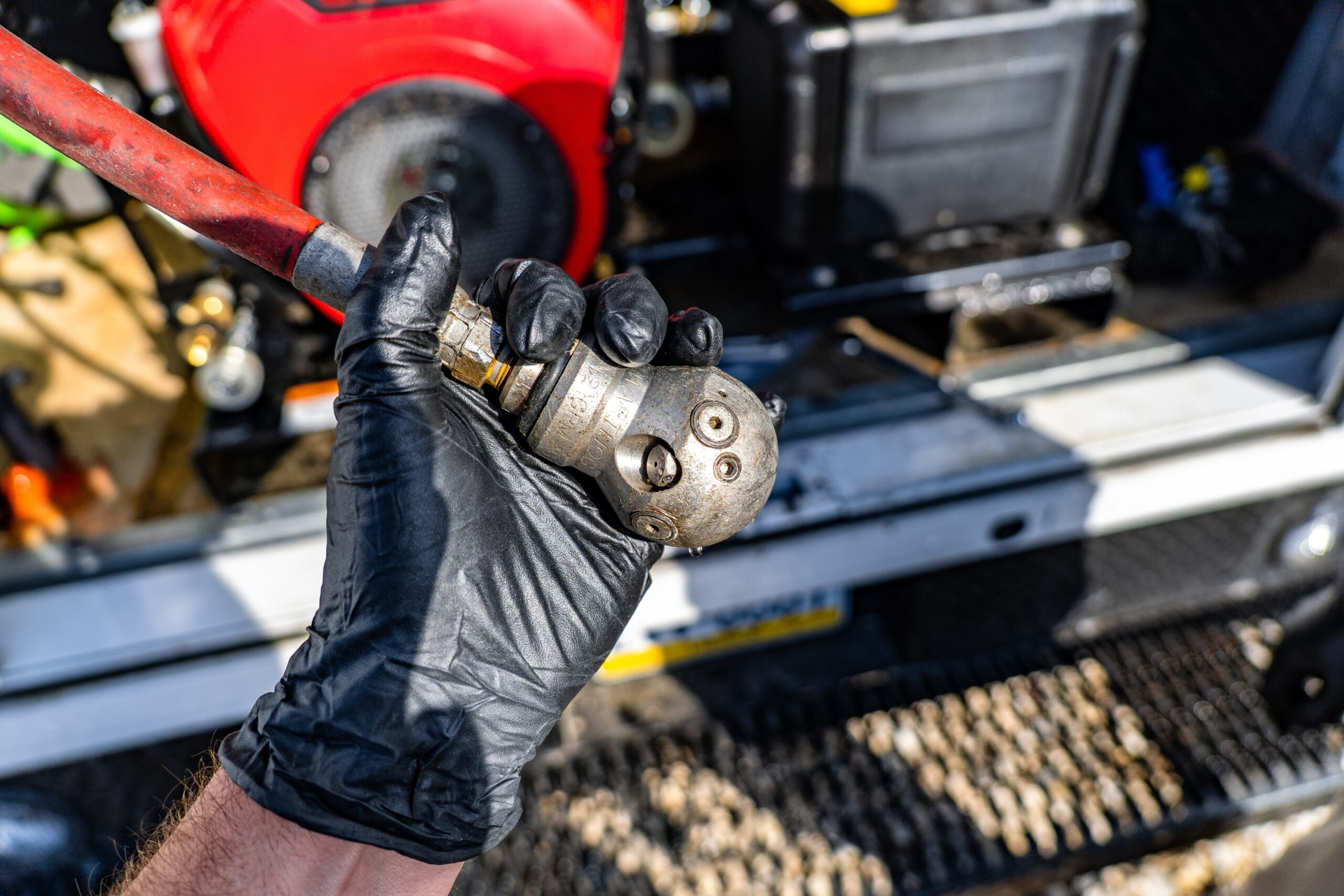
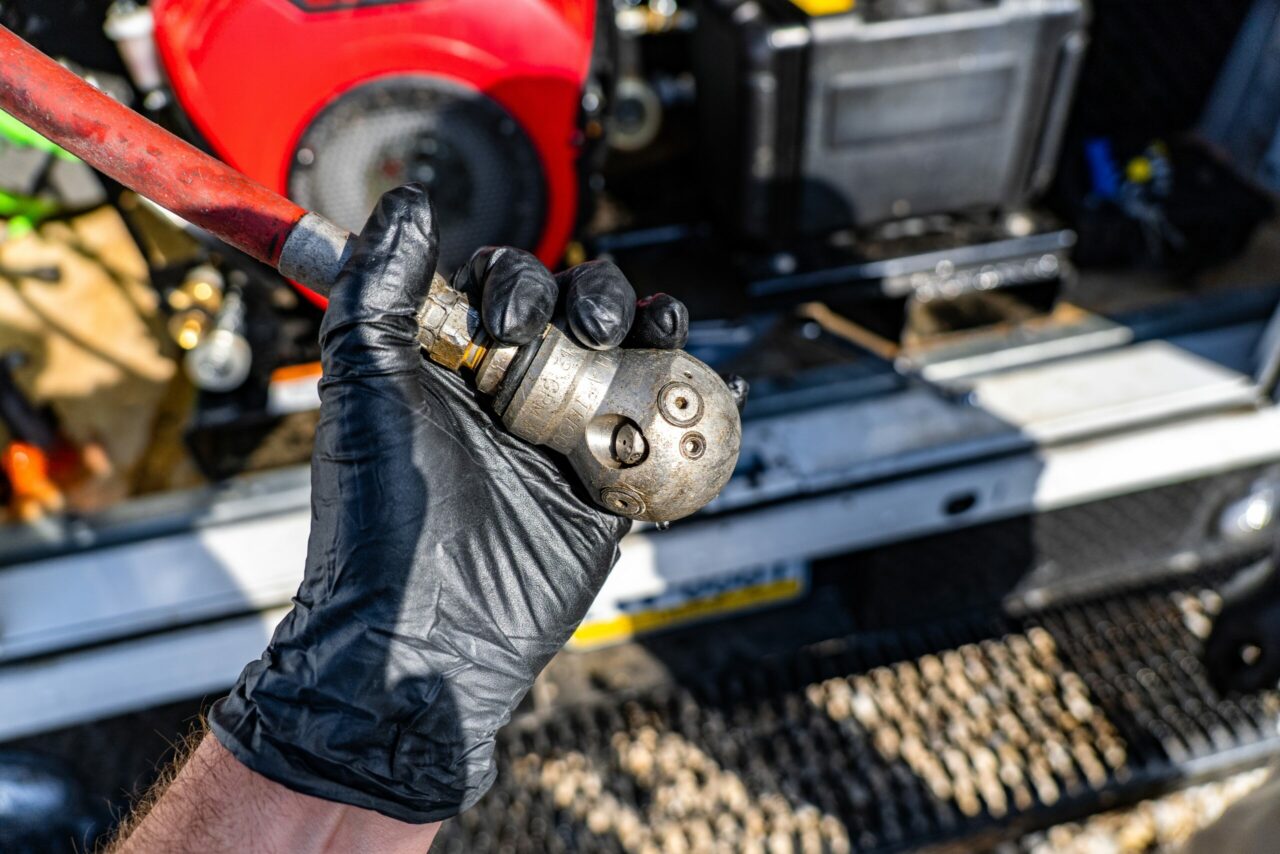
The machine makes the energy. The nozzle decides where it goes. The October coverage sorts nozzles into three working groups:
- Forward-facing (penetrating) nozzles open a blocked line and bore into heavy buildup.
- Traction (propulsion) nozzles use rear jets to pull the hose deeper and wash sand and sludge back toward the opening.
- Rotary (spinning) nozzles scour grease off the full circumference of the pipe.
Most grease calls use two: a penetrating head to open the line, then a spinning head to clean it. Nozzle kits make the swap quick. The General Pipe Cleaners JN-10 set pairs 15° and 40° heads with a spring leader, and RIDGID owners can add an H-45 spinning nozzle for scouring small lines.
One insider tip that’s held up for two decades: a 2003 PM Magazine mini-jetter build noted that ceramic orifices keep their size longer than stainless or brass, and that nozzle port count should match the hose ID, hose length, and pump output. A worn or mismatched nozzle doesn’t fail loudly. It just quietly wastes horsepower on every job.
Running a Grease Line, Start to Finish
- Figure out whether the clog sits inside or outside the building before picking an access point.
- Use a cleanout when one’s available. Skip the floor trap if it means fighting a double trap.
- Time a bucket fill to confirm the water supply.
- Open the line with a penetrating nozzle and cold water. Hot water melts grease, and melted grease just re-solidifies farther down the line.
- Let the hose pull itself forward. Don’t push it. Pulse to hop traps and bends.
- Switch to a rotary nozzle and make slow passes to clean the full wall.
- Run the camera after jetting, not before. Grease smears lenses, and soap film hides cracks until the line is clean.
- Save the footage and recommend a cleaning interval based on what it shows.
For step seven, the inspection camera category covers everything from handheld scopes to push cameras with sondes for locating trouble spots.
From Callback to Contract
Here’s where the jetter starts paying for itself. The October Contractor piece notes that many shops now build maintenance programs around jetting, cleaning restaurant and commercial lines before opening instead of waiting for the emergency call. Planned work runs on the shop’s schedule. Emergency work runs on the clog’s.
A simple way to get started:
- Pull last year’s call history and flag every address with two or more grease or sludge calls.
- Offer those customers a set jetting interval, backed by before-and-after camera footage.
- Book visits before opening or after close, when kitchens are quiet and lines are cool.
- Keep every video on file. It proves the work and makes the renewal an easy conversation.
Frequently Asked Questions
Is a water jetter better than a drain snake?
Not across the board. Jetters win on grease, sand, sludge, soap, and ice. Cable machines win on roots and hard obstructions. Most service trucks are better off carrying both.
What PSI does a jetter need for a kitchen line?
Interior lines from 1-1/2″ to 3″ are commonly cleaned starting around 1,500 PSI at about 2 GPM. Flow matters as much as pressure, since flow carries the debris out.
When does a gas jetter make more sense than an electric one?
Gas units fit 4″ and larger lines, long runs, and ice work. Electric units fit indoor jobs and smaller lines where exhaust and noise matter. Some crews park a gas unit outside and run a smaller hose reel indoors.
Why jet grease with cold water?
Hot water melts grease without removing it, and the grease re-solidifies farther down the line. Cold water and a scouring nozzle break it up and carry it out.
Which nozzle goes in first?
A forward-facing or penetrating nozzle opens the blockage. A rotary or spinning nozzle follows to clean the wall. Traction nozzles help pull hose through long runs and wash sand back.
Should the camera go in before or after jetting?
After. Grease and sludge smear the lens, and soap film hides cracks. A clean line gives usable footage and a recommendation the customer can see for themselves.
Can a jetter clear a frozen drain line?
Larger gas jetters can cut ice out of frozen lines, including four-inch lines, which a cable machine can’t do. Protect the jetter’s own pump from freezing between jobs.
How should a jetter hose be matched to the machine?
Higher flow needs a larger hose. An undersized hose restricts flow and can knot inside the pipe. Use the hose size the manufacturer specifies for the pump.
Can jetting damage older pipe?
Pressure and nozzle choice should match the pipe size and condition. When condition is unknown, camera the line first and follow the manufacturer’s guidance for older or fragile piping.
How often should a commercial grease line be jetted?
Set the interval from the property’s call history and camera findings. Lines with repeat backups are the best candidates for a scheduled program.
Going With the Flow
Grease doesn’t care how hard a cable spins. It cares whether the wall gets clean. Jetters clean the wall, cut ice, and flush sand in ways a cable can’t, and the cable still owns roots and hard blockages. Match flow to the line, pick the nozzle for the job, run the camera after cleaning, and turn repeat addresses into scheduled visits. The restaurant that used to call back on Friday night can be the one on the calendar every month.