
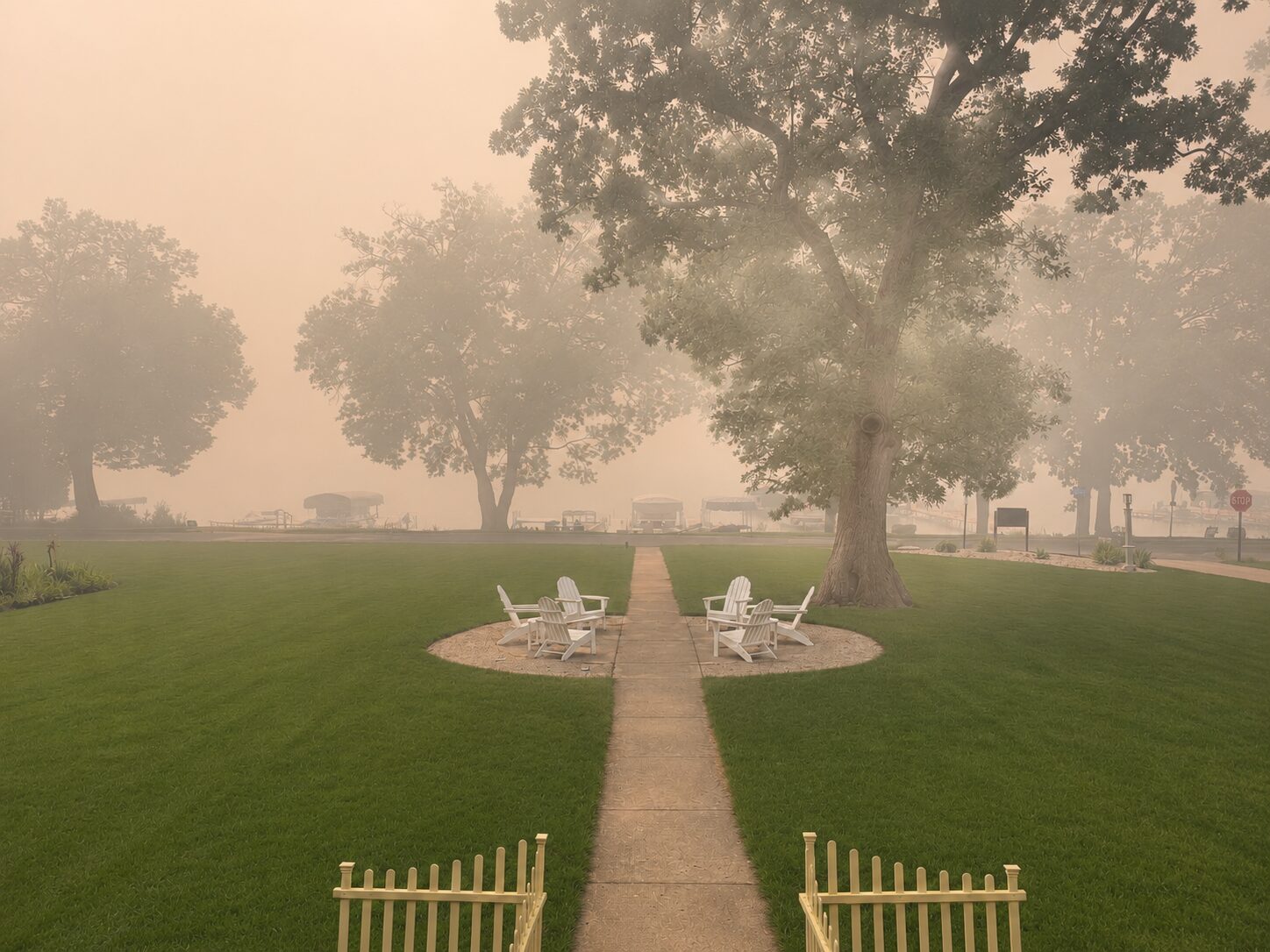
An orange sky used to be rare enough to make the local news. Now it shows up on a Tuesday, and the phone buzzes with an air quality alert before lunch. Wildfire smoke doesn’t respect property lines or a duct sealing job finished five years ago. Once the outdoor air quality index climbs past 150, there are some simple steps that go a long way in keeping your air clean.
How Wildfire Smoke Gets Indoors, Even With Everything Closed
Wildfire smoke is mostly fine particulate matter, PM2.5, small enough to slip through gaps that would stop dust or pollen. A closed window doesn’t stop it. Neither does a closed door, not fully. According to EPA’s guidance on wildfires and indoor air quality, smoke gets indoors three ways: natural ventilation through open windows and doors, mechanical ventilation through exhaust fans and HVAC fresh-air intakes, and infiltration through small gaps, joints, and cracks in the building envelope.
Exhaust fans make the problem worse in a way most homeowners don’t expect. A bathroom fan, a kitchen range hood, or a clothes dryer running during a smoke event pulls air out of the house, and that air has to come from somewhere. It gets pulled back in through every gap in the envelope, smoke included. A home that’s slightly depressurized during a smoke advisory is a home actively drawing outdoor smoke inside.
Before the Smoke Rolls In: A Pre-Season Checklist
Fire season prep pays off long before the first alert hits. A few tasks, done in advance, turn a scramble into a five-minute response:
- Confirm the furnace or air handler can run a MERV 13 filter without choking the blower. Check the equipment’s rated static pressure before upgrading; not every system handles the tighter media.
- Keep at least one spare high-MERV replacement filter on the shelf, sized and ready, instead of waiting on a delivery during a regional shortage.
- Identify one “clean room,” typically a bedroom or living room, where a portable air cleaner can run continuously and doors can stay shut.
- Bookmark AirNow.gov or a similar AQI tracker and set alert thresholds instead of relying on a hazy sky as the first warning sign.
- Walk the exterior and note any obvious gaps around windows, doors, and where pipes or wires penetrate the wall. These don’t need to get fixed today, but they need to be on the list.
The First Hour of an Active Smoke Advisory
Once the AQI alert hits unhealthy levels, the sequence matters. Working through it in order limits how much smoke gets trapped inside before the home is sealed up.
- Close every window and exterior door, including storm doors and any windows cracked for ventilation.
- Switch the thermostat fan setting to “on” instead of “auto,” so the blower runs continuously and keeps pulling air through the filter rather than cycling on and off with the compressor.
- Turn off bathroom fans, kitchen exhaust hoods, and any other fan that vents outside. Skip the shower fan for now, even with steam in the room.
- Set up a portable air cleaner in the clean room identified during pre-season prep, and close that door.
- Hold off on frying food, burning candles, using a fireplace, or vacuuming with a non-HEPA vacuum. All of these add particulate indoors at exactly the wrong time.
- Check the furnace filter. If it’s within a few weeks of its normal change date, swap it now rather than waiting.
Matching the Filter to the Job
Not every filter rated for a furnace does much against wildfire smoke. MERV, the Minimum Efficiency Reporting Value, measures how small a particle a filter can capture, and smoke particles run small enough that low-MERV filters barely slow them down.
| MERV Rating | What It Captures | Effective Against Wildfire Smoke? | Airflow Impact |
| MERV 8 | Dust, pollen, mold spores | Minimal; smoke particles pass through | Low restriction |
| MERV 11 | Finer dust, some smoke and smog | Partial help, better than nothing | Moderate restriction |
| MERV 13 | Bacteria, fine smoke, smog, virus carriers | Best residential option during smoke events | Higher; confirm blower is rated for it |
| HEPA (portable or whole-house) | 99.97% of particles at 0.3 microns | Most effective option available | No duct restriction on portable units |
A system built around a MERV 8 filter can’t jump straight to MERV 13 without a static pressure check. Pushing air through a denser filter than the blower can handle restricts airflow, strains the motor, and can shorten equipment life.
No Central Air, or a Blower That Can’t Take MERV 13?
Plenty of homes run window units, mini-splits, or no cooling at all, and plenty of central systems can’t handle a jump to MERV 13 without ductwork changes. Portable filtration fills the gap.
The EPA’s general sizing guidance for portable air cleaners is straightforward: match the unit’s clean air delivery rate to at least two-thirds of the room’s square footage, then run it on a higher setting during an active smoke event rather than the lowest, quietest one. A portable HEPA system with a two-stage filter, carbon plus true HEPA, handles a single room without any duct connection, which makes it the fastest fix for an apartment, a rental, or a bedroom that needs to double as a clean room during a bad air week.
For a whole-home fix that doesn’t require replacing the furnace filter with something the blower can’t support, a dedicated unit like the Fantech HERO HEPA whole-house filtration system mounts on the return side and adds a three-stage filter, including true HEPA media, without touching the existing furnace filter slot. It’s a bigger investment than a filter swap, but for a household in a region seeing repeat smoke seasons, it’s worth pricing out before the next one hits.
A homemade option exists too: a box fan strapped to a stack of MERV 13 furnace filters, often called a Corsi-Rosenthal box, moves a surprising amount of filtered air for very little cost. It’s not a permanent solution, and it won’t outperform a purpose-built HEPA unit, but it beats running no filtration at all during a multi-day advisory.
After the Smoke Clears: Reset and Cleanup
The advisory lifting doesn’t mean the job is done. Smoke particles settle on surfaces and load up filters even after the outdoor air clears.
- Replace the furnace filter immediately, even if it isn’t due for a change. A filter that ran through several days of heavy smoke has likely used up a meaningful chunk of its capacity.
- Wipe down hard surfaces, especially in rooms that stayed sealed for days, since settled particulate matter can get stirred back into the air by normal foot traffic.
- Run the HVAC fan on a higher speed for an hour with a window cracked to flush residual indoor particulate before returning to normal operation.
- Log the filter change date and note the MERV rating used, so the next smoke season starts with a known baseline instead of a guess.
- Reset any portable air cleaner filters on the manufacturer’s replacement schedule rather than waiting for a smell or a dust buildup to signal it.
Air Quality Index Action Guide
| AQI Range | Category | Indoor Action |
| 0-50 | Good | No special action needed |
| 51-100 | Moderate | Sensitive individuals should watch for symptoms |
| 101-150 | Unhealthy for Sensitive Groups | Close windows, consider running portable air cleaner in main living space |
| 151-200 | Unhealthy | Seal the home, run HVAC fan continuously, avoid indoor pollution sources |
| 201-300 | Very Unhealthy | Stay in a designated clean room, run HEPA filtration, avoid all outdoor exertion |
| 301+ | Hazardous | Minimize movement between rooms, keep clean room sealed, monitor for symptoms requiring medical attention |
FAQs
What AQI level means smoke has become a problem indoors?
Indoor air typically starts reflecting outdoor smoke once the AQI passes 100, though a leaky home shows the effect sooner than a tightly sealed one. By 150, most homes need active filtration running, not just closed windows.
Can a MERV 8 filter block wildfire smoke?
Not effectively. MERV 8 media is built for dust, pollen, and mold spores, particles far larger than the fine PM2.5 that makes up most wildfire smoke. A MERV 13 filter or a HEPA unit captures the smoke-sized particles a MERV 8 filter lets through.
Should the HVAC fan run constantly during a smoke advisory?
Yes, as long as the filter is rated to handle continuous airflow. Setting the thermostat fan to “on” instead of “auto” keeps air moving through the filter around the clock instead of only when the heating or cooling cycle kicks on.
Does an N95 mask work indoors during a smoke event?
It helps for brief indoor exposure, but it’s not a substitute for filtering the air itself, and it’s not practical to wear at home for days at a stretch. Filtration handles the ongoing exposure; a mask handles short trips outside.
Can a bathroom or kitchen exhaust fan make indoor air quality worse during smoke?
Yes. Any fan that vents outdoor air out of the house creates negative pressure, and that pressure pulls outdoor air, smoke included, back in through every gap in the building envelope. Skip exhaust fans during an active advisory when possible.
How long should a portable air cleaner run during a smoke advisory?
Continuously, on a mid to high fan speed, for the duration of the advisory. Running it only occasionally lets particulate build back up between sessions.
Is a whole-house HEPA system worth installing after one bad smoke season?
For a region seeing repeat smoke events year after year, it’s a reasonable upgrade to price out. For a one-time event in an area that rarely sees smoke, a portable HEPA unit and a MERV 13 filter swap usually cover the need without the larger investment.
What’s a Corsi-Rosenthal box, and does it actually work?
It’s a box fan strapped to four or five MERV 13 furnace filters, arranged into a cube shape. Testing has shown it moves a meaningful volume of filtered air for very little cost, making it a reasonable stopgap during a shortage or before a proper unit is installed, though it won’t match a purpose-built HEPA system.
How soon after smoke clears should the filter be replaced?
Right away, regardless of the printed change interval. A filter that ran through a multi-day smoke event has captured far more particulate than it would in normal conditions, and starting the next season with a fresh filter avoids compounding the load.
Can pets be affected by wildfire smoke indoors?
Yes. Pets, especially those with small lungs or existing respiratory issues, react to poor indoor air quality the same way people do. Keeping them in the same sealed, filtered room during an advisory protects them as much as it protects the household.