
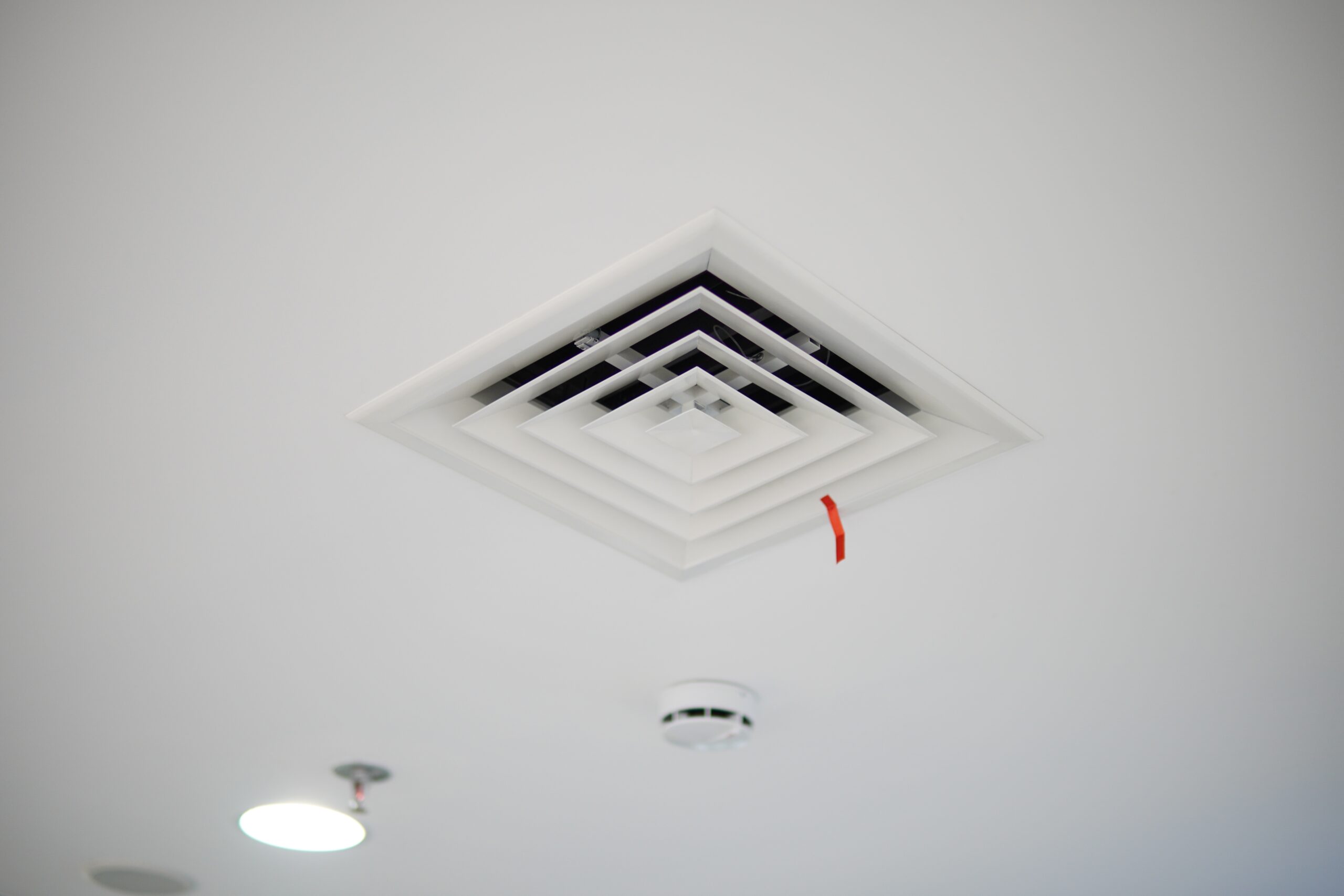
 Ask for a “vent cover” at a supply house and the counter person will ask a clarifying question: grille, register, or diffuser? Most people use those terms interchangeably. They are not interchangeable. Putting a grille on a supply opening or a register on a return creates airflow problems that turn into comfort complaints.
The Core Distinction: Supply vs. Return
Before selecting any product, identify whether the opening is a supply (conditioned air coming into the room from the duct) or a return (room air being pulled back to the air handler).
- Supply openings: registers or diffusers
- Return openings: grilles
Getting that backwards is one of the more common installation errors in residential HVAC.
Grilles: For Return Air Only
A grille is a louvered or perforated cover with no damper and no moving parts. Because there is nothing to restrict flow, grilles are designed for return air openings where unrestricted air intake back to the air handler is the goal.
Key sizing point: return grilles need to be larger than most people expect. The free area of the grille needs to match the system’s return air design flow. Size the return grille for a face velocity of no more than 400 to 500 feet per minute. An undersized return grille creates high system static pressure, restricts airflow to the blower, and generates noise.
Browse floor registers and return air grilles at SupplyHouse.
Registers: For Supply Air with Adjustable Control
A register is a supply-side device with a built-in damper. The damper opens and closes to control airflow volume, and the adjustable blades direct the airflow where it needs to go.
Single deflection vs. double deflection:
- Single deflection: blades adjustable in one plane (horizontal or vertical)
- Double deflection: blades adjustable in two planes, allowing horizontal spread and vertical direction
“Throw” refers to how far the supply air travels before dispersing. A register at one end of a long room needs high throw. A register serving a short hallway needs low throw.
| Location | Recommended Type | Reason |
| Under windows, exterior walls | Floor or baseboard register | Counters cold downdraft from glass |
| High sidewall | Horizontal deflection register | Moves air across ceiling for mixing |
| Short hallway | Low-throw sidewall register | Avoids direct draft |
| Long room | High-throw sidewall or floor register | Reaches far wall |
| Bedroom | Floor or low-sidewall | Quiet, draft-free delivery |
Browse the full sidewall and ceiling register selection at SupplyHouse.
Diffusers: Ceiling Supply for Maximum Air Distribution
A diffuser is a ceiling-mounted supply device that distributes conditioned air in multiple directions simultaneously, typically a 4-way pattern radiating outward from center. Diffusers induce room air mixing and create even temperature distribution without draft.
A standard sidewall register mounted flush in a ceiling sends air in a concentrated directional stream. A diffuser spreads the same airflow evenly in all directions, covering a much larger floor area with consistent temperature.
Browse diffusers at SupplyHouse from brands including Hart and Cooley.
How to Size Any Register or Grille
The face opening of a register or grille is typically 2 inches larger in each dimension than the duct neck size it connects to. A 10×6 duct neck takes a 12×8 face. Always verify with the manufacturer’s spec sheet.
| Duct Neck Size | Typical Face Size |
| 4×10 | 6×12 |
| 6×10 | 8×12 |
| 4×12 | 6×14 |
| 6×12 | 8×14 |
| 8×12 | 10×14 |
Material Selection Guide
| Material | Best For | Avoid For |
| Steel (painted) | Most residential supply and return | Coastal or high-humidity environments |
| Aluminum | Humid climates, coastal applications | Heavy floor traffic (less durable) |
| Wood or architectural grade | High-visibility residential | High-moisture areas |
| Plastic | Light-duty, price-sensitive | High supply air temperatures (heat pump aux heat) |
Plastic warps at elevated supply air temperatures. Do not spec plastic registers in systems with high-temperature backup heat.
Baseboard Registers
Baseboard registers supply air at floor level along exterior walls, countering downdrafts from windows. They are also the type most often installed incorrectly, with the airflow direction aimed toward the wall instead of into the room.
Browse baseboard registers and grilles at SupplyHouse.
For broader duct and venting supply options, see the HVAC venting category at SupplyHouse.
Frequently Asked Questions
What is the difference between a register and a grille?
A register has an adjustable damper for airflow control and goes on supply openings. A grille has no damper and is used on return air openings where unrestricted air intake is needed.
Can a grille be used as a supply vent?
Not ideally. Without a damper, there is no ability to control airflow direction or volume. Grilles are designed for return air applications.
Why is the return grille making a whistling noise?
A whistling return grille almost always means the grille’s free area is too small for the airflow passing through it. Replace with a larger grille or add a second return opening to distribute the flow.
What does “throw” mean on a register spec sheet?
Throw is the distance supply air travels from the register face before it disperses. High throw registers work for long rooms. Low throw registers suit short spaces. Most manufacturers specify throw at various CFM rates.
What size register is needed for a 6×10 duct?
An 8×12 register face. The standard is that the face opening is 2 inches larger in each dimension than the duct neck. Confirm with the specific product specs.
When should a diffuser be used instead of a register?
For ceiling supply applications where broad, even air distribution is needed. Diffusers spread air radially in multiple directions, which creates better room mixing than a ceiling-mounted directional register.
Does register finish matter for performance?
Finish does not affect airflow performance. It matters for aesthetics and durability. Aluminum resists rust in humid environments. Painted steel works well in standard residential applications.
Is a floor register or a high sidewall register better?
Both work. Floor registers near exterior walls counter cold air downdrafts from windows. High sidewall registers push air across the ceiling, where it mixes with room air and falls back down. Which performs better depends on room geometry and where the heat loads are.
Let Comfort Flow
Grilles, registers, and diffusers each have a specific role and a specific location. Grilles go on returns, no damper, unrestricted flow. Registers go on supplies, adjustable damper, directional control. Diffusers go on ceiling supplies where broad even distribution is needed. Getting the selection right eliminates the whistling, drafts, and hot-room complaints that nobody can quite figure out after the fact. SupplyHouse carries the full range of floor registers, sidewall registers, ceiling registers, diffusers, and baseboard grilles from Hart and Cooley and other trusted brands.