
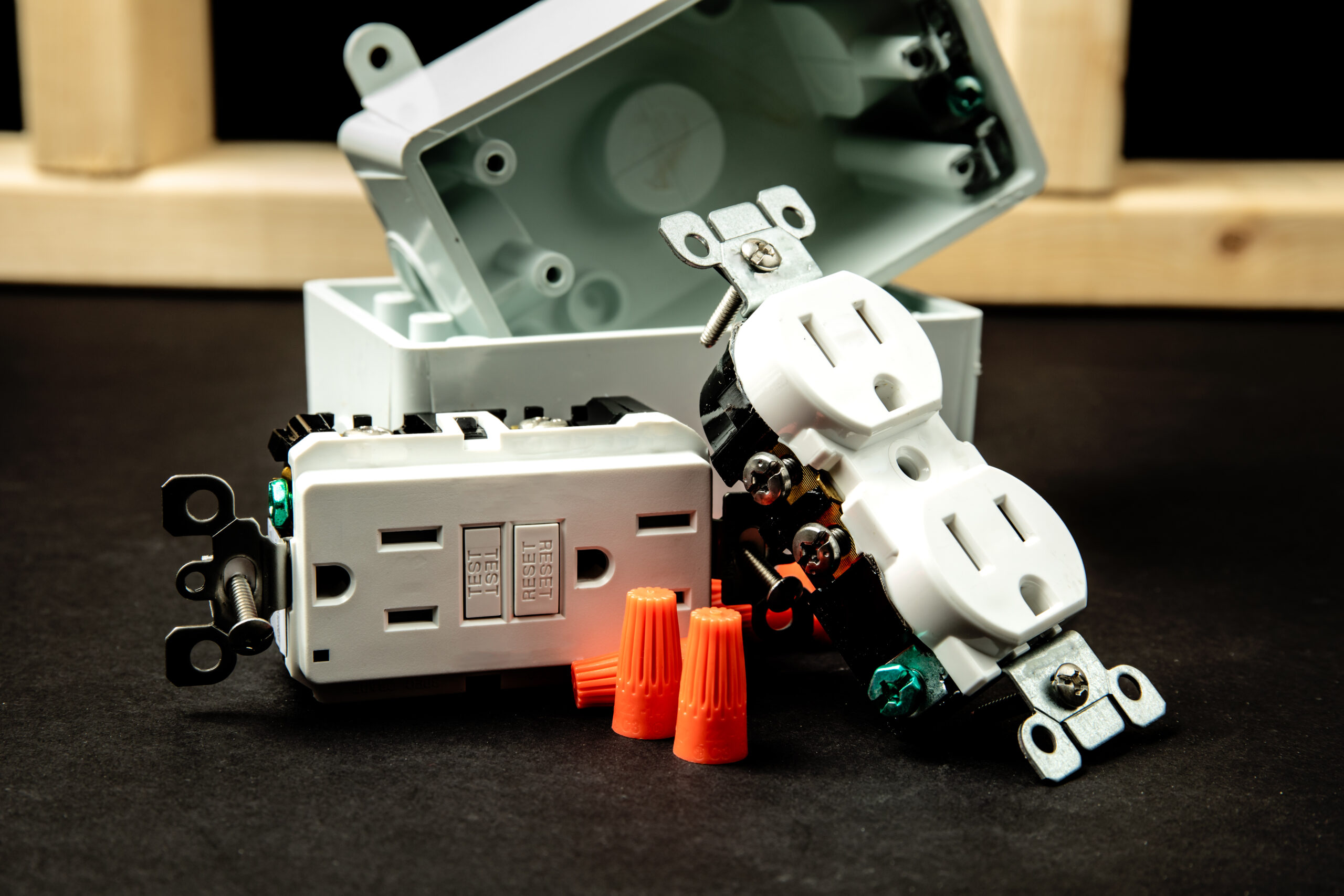

AFCI and GFCI are two of the most commonly confused terms in residential electrical work. They sound similar. They both involve safety. The abbreviations blur together on a supply run. But they protect against completely different hazards, the NEC requires them in completely different locations, and installing one where the other belongs means a system that looks compliant but isn’t actually protecting against the right threat.
Here’s how to get them straight, circuit by circuit.
Step 1: Understand What Each One Actually Does
Start here, because everything else follows from this.
GFCI (Ground Fault Circuit Interrupter) detects ground faults, meaning current that escapes the normal circuit path and flows through an unintended conductor, often a person. GFCIs detect current imbalances as small as 4 to 6 milliamps and trip in roughly 1/40th of a second. The hazard being prevented is electrocution.
AFCI (Arc Fault Circuit Interrupter) detects arc faults, meaning high-energy electrical arcing from damaged, deteriorated, or improperly installed wiring. Arc faults don’t trip standard circuit breakers because they don’t create an overcurrent. Instead, they generate heat and sparks inside walls and at connections. According to the Electrical Safety Foundation International, arc faults are responsible for more than 35,000 home fires each year in the United States.
Two separate threats. Two separate devices. Neither one substitutes for the other.
| GFCI | AFCI | |
| Threat detected | Ground fault (current to ground or person) | Arc fault (arcing in wiring) |
| Current threshold | 4 to 6 milliamps imbalance | Arcing signature detection |
| Primary risk prevented | Electrocution | Electrical fire |
| Primary location | Wet areas | Living and sleeping areas |
| Available as | Outlet or circuit breaker | Outlet or circuit breaker |
| Cost range | $15 to $40 per outlet | $30 to $60 per breaker |
Step 2: Know Where GFCI Protection Is Required
The NEC requires GFCI protection anywhere water and electricity are likely to meet. Per the 2020 NEC, that includes:
- All bathroom receptacles
- Kitchen receptacles within 6 feet of a sink
- Garage receptacles, including ceiling outlets over garage door openers
- All outdoor receptacles
- Unfinished basements and crawl spaces at or below grade level
- Receptacles within 6 feet of wet bar sinks
- Boathouses and swimming pool, hot tub, and spa equipment circuits
- Laundry areas (added in the 2020 NEC)
One important note: local jurisdictions adopt NEC editions on their own schedules. Some areas are still on 2017 or earlier. Verify the locally adopted code before assuming 2020 requirements apply to a specific job.
Browse GFCI receptacles at SupplyHouse in 15A and 20A versions from Leviton and Pass & Seymour.
Step 3: Know Where AFCI Protection Is Required
AFCI requirements have expanded significantly since their introduction in the 1999 NEC. Under the 2020 NEC, AFCI protection is required on all 120V, single-phase, 15A and 20A branch circuits supplying outlets or devices in dwelling unit:
- Bedrooms (required since 1999 NEC)
- Living rooms, dining rooms, and family rooms (added 2014 NEC)
- Kitchens, laundry rooms, hallways, and closets
- Sunrooms, recreation rooms, dens, and libraries
In short, the 2020 NEC requires AFCI protection in virtually every habitable room of a dwelling unit. Bathrooms, garages, and unfinished spaces are the main exceptions. The expansion from bedrooms-only to near whole-home coverage happened progressively from 1999 through 2017, with the list unchanged in the 2020 edition.
Step 4: Identify Locations That Need Both
Some locations require both protections at once. Kitchen circuits need AFCI protection as a living space and GFCI protection near sinks. Laundry rooms are the same situation. Trying to handle that with two separate devices can get complicated fast. Here are the three ways to meet dual requirements:
| Solution | How It Works | Best For |
| Combo AFCI/GFCI breaker | Single panel breaker provides both protections | New construction or panel replacement |
| AFCI breaker + GFCI outlet | AFCI at the panel, GFCI outlet at the receptacle | Retrofit: adding GFCI to an AFCI-protected circuit |
| AFCI/GFCI outlet | Outlet device provides both protections | Single-location retrofit where panel work isn’t practical |
Browse GFCI receptacles and circuit breakers at SupplyHouse, including dual-function AFCI/GFCI breakers from Siemens and Leviton.
Step 5: Understand Why Standard Breakers Don’t Catch Arc Faults
A standard circuit breaker monitors current magnitude only. It trips when current exceeds its rated ampacity. Arc faults don’t necessarily cause high current. A wire nicked by a nail, a loose connection at a receptacle, or deteriorated insulation can arc at current levels well below the breaker’s trip threshold, generating heat and creating ignition points without ever tripping the breaker.
AFCI breakers analyze the waveform of the current, not just its magnitude. Arcing produces a distinctive signature pattern that AFCI electronics detect and use to trip the breaker before a fire starts. Standard breakers are blind to that signature entirely.
Step 6: Diagnose AFCI Nuisance Tripping Before Resetting
Not every AFCI trip means the house is on fire. Some are nuisance trips from equipment that produces arcing signatures resembling a genuine fault. Common causes include:
- Certain motor loads like older vacuum cleaners and power tools
- Dimmers paired with incompatible LED fixtures
- Long wire runs with improper installation
- Loose connections elsewhere on the circuit
That last one matters. Loose connections can be genuine arc fault conditions worth finding before simply resetting the breaker. When an AFCI breaker trips repeatedly without obvious
Full Comparison: AFCI vs. GFCI
| Feature | GFCI | AFCI |
| Detects | Current imbalance (ground fault) | Arcing signature in wiring |
| Hazard prevented | Electrocution | Electrical fire |
| NEC required locations | Wet areas | Living and sleeping spaces |
| Form factor | Outlet or breaker | Outlet or breaker |
| Test method | TEST/RESET button on outlet or breaker | TEST button on breaker |
| Installed by | Homeowner or electrician (outlet) | Licensed electrician for panel breaker work |
| Helps with old wiring? | Partially, protects from shocks at outlets | Yes, detects arcing from deteriorated wiring |
Frequently Asked Questions
What’s the difference between AFCI and GFCI? GFCI protects against ground faults, meaning current flowing through a person and causing electrocution. AFCI protects against arc faults, meaning high-energy arcing from damaged wiring that causes fires. Completely different hazards, completely different required locations.
Can one device provide both AFCI and GFCI protection? Yes. Combination AFCI/GFCI circuit breakers and dual-function outlets both provide both protections in a single device. Breakers are the preferred solution for kitchen and laundry circuits in new construction.
Where is GFCI protection required by the NEC? All bathrooms, kitchens within 6 feet of a sink, garages, outdoor receptacles, unfinished basements, crawl spaces, wet bar areas, boathouses, and laundry areas under the 2020 NEC.
Where is AFCI protection required? The 2020 NEC requires AFCI protection on all 120V, 15A and 20A branch circuits in dwelling unit living spaces, including bedrooms, living rooms, dining rooms, kitchens, hallways, and most other habitable spaces.
Do bedrooms need GFCI protection? Standard bedrooms aren’t in the NEC’s GFCI-required locations because they’re not wet areas. They do require AFCI protection. If a bedroom has an attached bathroom, those receptacles require GFCI.
Why does an AFCI breaker keep tripping? Repeated AFCI trips point to either a genuine arc fault condition (loose connection, damaged wire, failing device) or a nuisance trip from motor loads or incompatible dimmers. Inspect the circuit thoroughly before treating it as nuisance tripping.
Does replacing a standard breaker with an AFCI breaker require an electrician? Work inside an electrical panel should be done by a licensed electrician. The panel contains always-live conductors even with the main breaker off, and improper work creates real shock and fire risk.
Can an AFCI breaker work on a circuit that already has GFCI outlets? Yes. An AFCI breaker on a circuit with existing GFCI outlets provides arc fault protection for the entire circuit while the GFCI outlets continue providing ground fault protection. The two protections work independently.
Do AFCI breakers protect against old knob-and-tube wiring? Partially. AFCI breakers can detect arc faults on circuits they protect regardless of wiring type. Connecting AFCI-protected modern circuits to old knob-and-tube wiring requires evaluation by a licensed electrician, because old wiring systems have problems beyond arc fault protection alone.
What does it mean when an AFCI breaker trips immediately upon reset? An immediate re-trip usually means an active fault condition is present. Don’t repeatedly reset. Disconnect all devices on the circuit and try again. If the breaker holds with nothing connected, reconnect devices one at a time to isolate the fault.
The Final Plug
AFCI and GFCI aren’t interchangeable options. They’re two separate protections targeting two completely different electrical hazards. GFCI goes where water is a concern, protecting against shock. AFCI goes in living spaces, protecting against fires from damaged wiring. Modern NEC editions require both in kitchens and laundry rooms, and combination AFCI/GFCI breakers make meeting that dual requirement clean and simple.
SupplyHouse carries GFCI receptacles from Leviton and Pass & Seymour in 15A and 20A versions, plus dual-function AFCI/GFCI breakers and the full range of electrical panel components. Order today and get it on the truck fast.