

Traditional incandescent light bulbs have gone by the wayside, having been replaced by a slew of newer energy-efficient options. Clearly, something has changed. So what’s going on? In 2007, the federal government passed the Energy Independence and Security Act (EISA), mandating higher energy standards. One target of these new regulations was lighting efficiency. While the typical consumer probably never noticed, the standard incandescent bulb is a real energy-waster; in fact, it wastes about 90 percent of the energy it uses. Efficient bulbs can produce the same amount of light with much less energy.
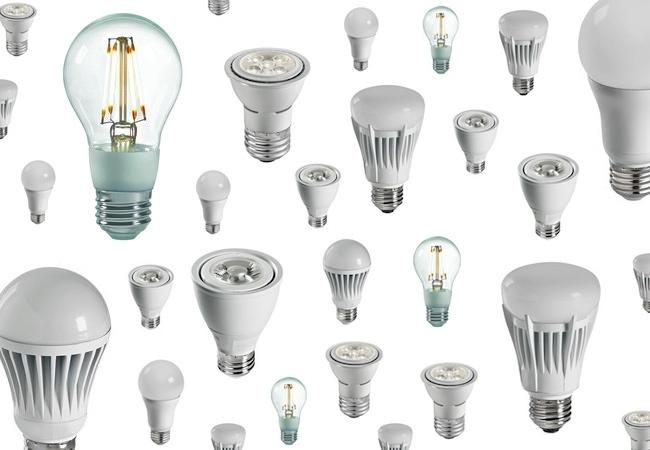
Among the field of new energy-efficient light bulbs, LEDs are emerging as a favorite. Their stats are impressive: LEDs operate five times more efficiently than yesterday’s incandescent. Daniel O’Brian, a a tech team member here at SupplyHouse.com, adds, “Another large advantage is projected lifespan. While incandescent bulbs last about 1,200 hours, you can expect an LED bulb to last up to 50,000 hours. That would be equal to having to replace 42 incandescent bulbs over the lifetime of a single LED.”
Though LED light bulbs cost more to purchase (about $10 per, as of this writing), they save the average household about $50 annually, according to the U.S. Department of Energy.
Watts vs. Lumens
Only a couple of years ago, we’d compare wattages in order to distinguish between the brightness of different light bulbs. Nowadays, what matters is the bulbs’ output in lumens. O’Brian explains, “Lumens actually measure the brightness of a light. While a 40-watt incandescent can give off around 450 lumens, a 7-watt LED can provide the same brightness.”
These guidelines from the American Lighting Association helps define equivalents to the incandescents they’re accustomed to buying:
- To replace a 40-watt incandescent bulb, choose a bulb that will produce 450 lumens.
- To replace a 60-watt incandescent bulb, choose a bulb that will produce 800 lumens.
- To replace a 75-watt incandescent bulb, choose a bulb that will produce 1,100 lumens.
- To replace a 100-watt incandescent bulb, choose a bulb that will produce 1,600 lumens
Color Temperature
Anybody who’s worked in a fluorescent-lit office knows too well that brightness isn’t the only key factor. Equally important is color temperature—that is, how warm or cool the light appears. Color temperature is measured in Kelvin (K); the higher the number, the cooler the light. For example, “soft white” bulbs are rated up to 2700K, on the low side of the scale, producing a warm, relaxing glow. “Daylight” bulbs, rated from 5000K to 6500K, produce a crisp light suitable for laundry rooms, garages, and security purposes.
Why Concert to LED Bulbs?
It’s certainly true that LED bulbs cost more than incandescents. The financial benefit of the efficient light bulbs comes over the long term, because LEDs cost about 75 percent less to operate and seldom need replacement. Think of it this way: Whereas running a 60-watt incandescent bulb costs about $4.80 per year, running an equivalent LED costs only a dollar.
We offer a large selection of LED light bulbs from industry-leading brands. For more information or to view an assortment of LED bulbs, click here!