
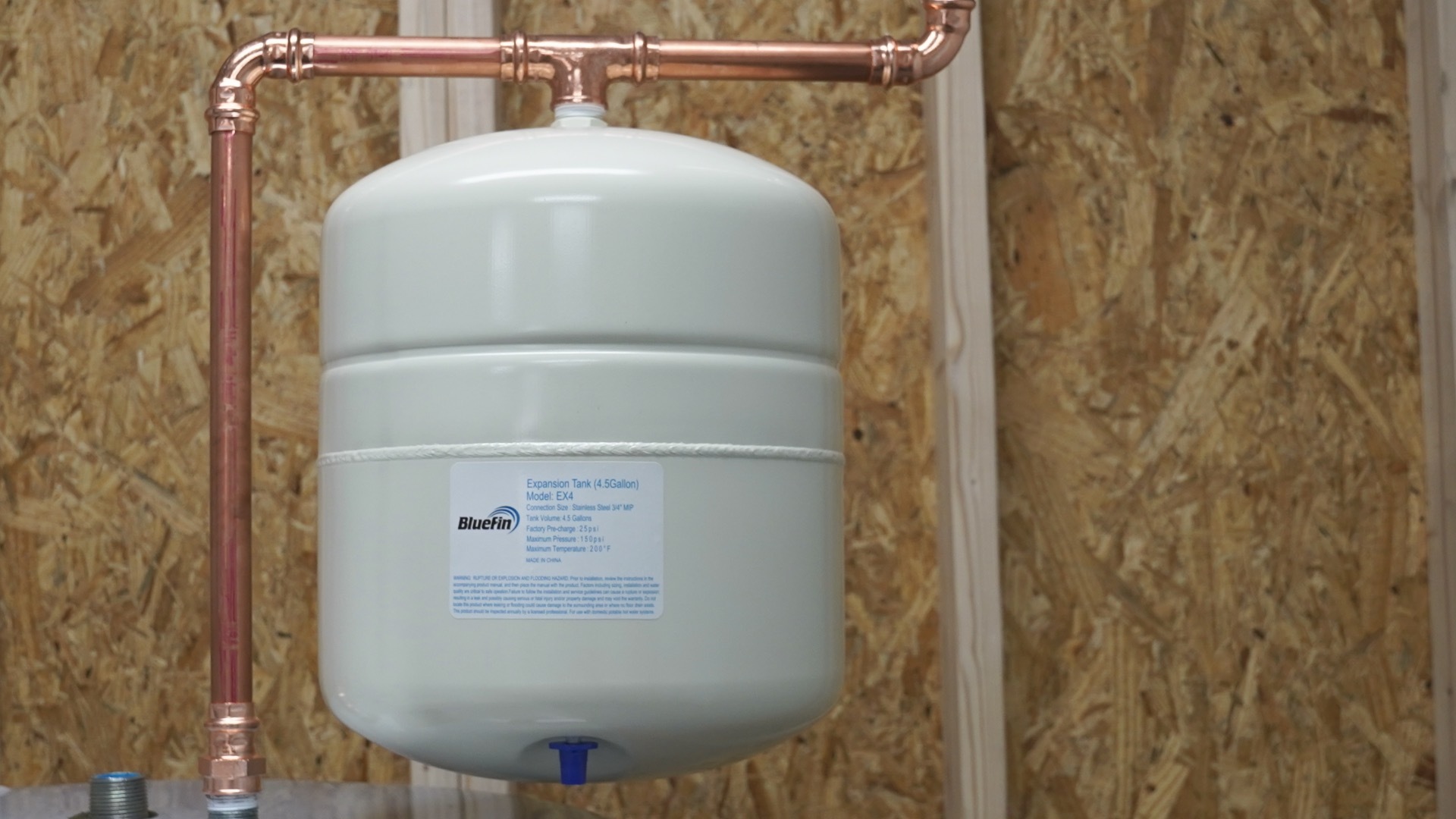
Most installers know expansion tanks work in more than one orientation. What’s less often discussed is where manufacturer guidance draws the line, how much a failed tank actually weighs, and why skipping the wall bracket on a horizontal or inverted install is the kind of shortcut that turns into a callback.
The video below covers all three mounting positions along with the bracket options available at SupplyHouse.
Watch: SupplyHouse: Expansion Tank Mounting Positions (YouTube)
How Orientation Affects an Expansion Tank
A diaphragm expansion tank works by separating a pressurized air charge from the system water with a flexible membrane. As system water heats and expands, it compresses the air cushion. When pressure drops, the air charge pushes water back into the system. The function doesn’t depend on the tank being in any particular orientation.
The orientation question that actually matters is about weight management, not normal operation. When a diaphragm fails, the tank floods and the weight goes up fast. A dry EX-30 weighs a few pounds. A waterlogged EX-30 is closer to 35 lbs. A waterlogged EX-60 can exceed 50 lbs. An unsupported tank hanging sideways or overhead off a half-inch tee nipple is a pipe failure waiting to happen when that diaphragm gives out.
Support the tank before the diaphragm fails. It’s a cheap fix compared to what happens after.
The Three Mounting Positions
| Position | Functions? | Wall Support Required? | Manufacturer Notes |
| Upright, connection up | Yes | Not required; recommended for larger tanks. | Preferred position per Amtrol installation instructions. |
| Horizontal, connection to side | Yes | Required. | Amtrol EX-30 product documentation notes horizontal mounting can reduce product life. |
| Inverted, connection down | Yes | Required. | Amtrol Extrol PRO installation instructions specify vertical downward position only. |
Upright, Connection Up
Mounting the tank vertically with the pipe connection at the top is the standard residential install and the orientation Amtrol’s installation documentation shows as the default. The tank hangs directly off a tee in the system return piping. For smaller tanks on a rigid, well-supported line, a wall bracket isn’t required, though adding one on any EX-30 or larger is worth doing.
Browse Amtrol Extrol hydronic tanks: Extrol Expansion Tanks for Hydronic Heating
Horizontal, Connection to the Side
Horizontal mounting functions normally. Pressure control isn’t affected. Per the product documentation on the Amtrol EX-30 at SupplyHouse, horizontal mounting can cause a reduction in product life, though for most residential applications that’s a secondary concern compared to the spatial constraints of a mechanical room.
What isn’t secondary: the wall bracket. A tank mounted sideways off the pipe connection with no independent support is a problem when the diaphragm eventually fails. Bracket the tank to the wall.
Inverted, Connection Down
Inverted mounting comes up when the supply pipe drops from overhead and ceiling clearance is limited. The Amtrol Extrol PRO installation instructions, pulled directly from Amtrol’s current published IO sheet, specify: “Mount tank vertically in downward position only.” For the standard EX series, the SupplyHouse product listing notes horizontal mounting can reduce product life. Inverted carries similar considerations.
If an inverted install is the only option, a wall bracket is mandatory. An inverted waterlogged tank overhead is a real hazard.
Why Wall Support Isn’t Optional for Non-Upright Installs
The Amtrol Extrol PRO installation instructions include this line explicitly: “Ensure the piping can support the entire weight of the tank when full of water.” For a vertical upright install on a rigid return line, that’s reasonable. For horizontal or inverted, the pipe connection alone wasn’t engineered to carry 40-plus pounds of dead weight at an angle or overhead.
The HydroClaw and Flamco Flexconsole both exist to solve this problem. Neither is expensive. Both are in stock at SupplyHouse. Use one.
Bracket Options: HydroClaw and Flamco Flexconsole
Two bracket systems cover most residential and light commercial expansion tank installs. The right choice depends on tank size and how the system pipe is routed.
| Bracket | Best For | Tank Diameter / Size | Mount Surface | SKU |
| HydroClaw 8″ | Smaller hydronic and DHW tanks | 8″ tanks (EX-15, ST-5) | Stud or concrete | HC8-B |
| HydroClaw 11″ | EX-30 and EX-60 hydronic tanks | 11″ tanks (EX-30, EX-60) | Stud or concrete | HC11-A |
| Flamco Flexconsole Steel/Red | Hydronic systems, pipe-through wall mount | Up to 6.6 gal., 1/2″ NPT | Slotted wall plate | 97975 |
| Flamco Flexconsole Stainless/White | Domestic hot water / potable systems | 3/4″ x 1/2″ NPT connection | Slotted wall plate | 97976-FLAMCO |
HydroClaw by Storm King Enterprises
The HydroClaw is a two-piece clamping bracket. One half mounts to the wall with lag bolts through studs or into concrete. The other half clamps around the tank body. Rubber lining on the interior prevents metal-to-metal contact and locks the tank in place. The tank is held independently of the connection pipe.
Two sizes are available:
- HC8-B (8″): 8″ HydroClaw Expansion Tank Support Bracket — fits EX-15, ST-5, and similar 8″ diameter tanks.
- HC11-A (11″): 11″ HydroClaw Expansion Tank Support Bracket — fits EX-30, EX-60, and their radiant and non-potable variants.
The HydroClaw must be mounted to a structural surface. A stud, concrete block, or masonry backing is required. Drywall alone won’t hold. If the only available surface is drywall, a backing board anchored to studs behind the wall solves it.
Browse all expansion tank brackets: Expansion Tank Brackets
Flamco Flexconsole
The Flexconsole takes a different approach. Instead of clamping around the tank body, it’s a wall-mounted bracket that the system pipe routes through, with the tank threading directly into the bracket. Water flows through the Flexconsole itself, so no additional nipple or tee is required between the bracket and the tank. Fewer connection points, cleaner install.
The Flexconsole mounts to the wall using a slotted plate for easy leveling. The tank hangs vertically off the bracket. It works well when the pipe drops down from the wall and ceiling clearance is available.
Two versions are stocked at SupplyHouse:
- Steel Red (SKU 97975): Flexconsole 1/2″ x 1/2″ NPT Steel Red — for hydronic heating systems, non-potable only. Supports tanks up to 6.6 gallons.
- Stainless Steel White (SKU 97976-FLAMCO): Flexconsole 3/4″ x 1/2″ NPT Stainless Steel White — for domestic hot water applications where potable water contact applies.
The steel red Flexconsole is rated for hydronic systems only and not suitable for potable water. Use the stainless steel version on any domestic hot water application.
Installing the HydroClaw: Step-by-Step
The HydroClaw ships in two halves and goes together quickly. Here’s the process:
- Locate the mounting surface. Find a stud or concrete backing at the correct height for the tank’s connection point. Mark the bracket position.
- Mount the wall half of the HydroClaw. Drive lag screws through the mounting holes into the stud, or anchor bolts into concrete. Test it before adding the tank.
- Thread the tank connection nipple into the system tee. Hand-tight, then one to two turns with a wrench.
- Slide the tank into the wall-mounted half of the HydroClaw. The rubber lining grips the tank body. The weld bead around the tank helps seat it in the bracket.
- Clamp the second half of the HydroClaw around the tank and fasten with the included hardware. Tighten evenly.
- Check the pre-charge pressure at the air valve. Per Amtrol’s installation instructions, adjust the pre-charge to match the boiler fill valve setting before adding water. For most residential systems, that’s 12 PSIG on the standard EX series, and 15 PSIG on the Extrol PRO. Verify against the tank’s documentation.
- Pressurize the system, check for leaks at the connection, and verify pressure behavior at operating temperature. If the relief valve drips, the tank may be improperly charged or undersized.
FAQ: Expansion Tank Mounting Positions
Does an upright expansion tank need a wall bracket?
Not always, but it’s worth adding on larger tanks. An EX-30 or EX-60 mounted vertically off a tee is fine in most installs, but a wall bracket adds long-term stability and protects the piping connection if the diaphragm eventually fails.
What does Amtrol’s installation documentation actually say about mounting position?
The Amtrol Extrol PRO IO sheet, available on amtrol.com, states: “Mount tank vertically in downward position only. Ensure the piping can support the entire weight of the tank when full of water.” The EX-30 product listing at SupplyHouse notes that horizontal mounting can cause a reduction in product life. For any non-upright install, check the specific installation instructions for the tank model being used.
What happens if an unsupported horizontal tank fails?
When the diaphragm fails, the tank floods and weight increases dramatically. A waterlogged EX-60 can exceed 50 lbs. An unsupported horizontal tank puts that entire load on the pipe connection. Fitting failure and water damage are the likely outcomes. A bracket prevents that.
What’s the difference between the HC8-B and HC11-A HydroClaw brackets?
Tank diameter. The HC8-B fits 8″ diameter tanks including the EX-15 and Amtrol ST-5. The HC11-A fits 11″ diameter tanks including the EX-30 and EX-60. Match the bracket to the tank diameter before ordering: HC8-B | HC11-A.
Can the HydroClaw be mounted to drywall?
No. The HydroClaw requires a structural surface, a stud, concrete, or masonry. If the only available surface is drywall, a backing board secured to studs behind the wall provides the needed support.
How does the Flamco Flexconsole differ from the HydroClaw?
The HydroClaw clamps around the tank body and is independent of the pipe connection. The Flamco Flexconsole is a wall-mounted bracket that the system pipe routes through, with the tank threading directly into the bracket. The Flexconsole combines the mounting bracket and the pipe connection into one component, reducing the number of fittings needed.
Does tank orientation affect pre-charge pressure?
No. Pre-charge is set based on the system fill pressure, not the tank orientation. Per Amtrol’s installation instructions, adjust the pre-charge to match the boiler fill valve setting before adding water. Orientation doesn’t change that.
Where should the expansion tank connect in the system?
Per Amtrol’s installation instructions, the tank should be installed on the supply side of the boiler, on the suction side of the heating circulator. Connecting on the pressure side causes the circulator to work against the air charge. Most near-boiler piping diagrams show the tank tee on the return line, close to the boiler, before the circulator.
Is there a difference between a hydronic expansion tank and a domestic hot water expansion tank?
Yes. Amtrol’s installation instructions are explicit: the Extrol series is for use in residential closed hydronic systems only and should not be installed on domestic water systems. Amtrol’s Therm-X-Trol and Therm-X-Span lines are designed for domestic hot water applications. Using a non-potable hydronic tank on a domestic hot water system isn’t code-compliant.
How do technicians know when an expansion tank has failed?
The quickest field check is the Schrader valve on the air stem. If water comes out when the valve is depressed, the diaphragm has failed. On Amtrol Extrol PRO tanks, the InSight Service Indicator Cap changes from clear or white to a discolored state when tank replacement is needed, per the product IO sheet. System-level symptoms include repeated pressure relief valve discharge and pressure spikes that don’t stabilize at operating temperature.
Can the Flamco Flexconsole be used on a domestic hot water system?
The steel red version (SKU 97975) is rated for hydronic systems only and is not suitable for potable water. The stainless steel white version (SKU 97976-FLAMCO) is the correct choice for domestic hot water applications.
Positioned for Success
Expansion tanks work in all three orientations. That’s the short answer. The longer answer is that Amtrol’s installation documentation recommends vertical downward mounting, notes that horizontal positioning can reduce product life, and explicitly requires that piping support the full weight of the tank when flooded.
Bracket the tank any time it goes horizontal or inverted. A HydroClaw or Flamco Flexconsole handles it cleanly, mounts to a stud or concrete wall, and costs far less than the pipe repair that follows an unbracketed failed tank. Both are in stock and ship fast from SupplyHouse.
Shop expansion tanks and mounting hardware at SupplyHouse: All Expansion Tanks | Expansion Tank Brackets | Extrol Hydronic Tanks | Water Heater Expansion Tanks